🌳4️⃣0️⃣🏜️ The Number 40 in Scripture: Testing, Transition, Judgment, and Formation [3 parts]
🌿 Introduction: From Gardens to Deserts
The number 40 in Scripture repeatedly appears at moments of testing, judgment, purification, transition, preparation, and covenantal formation. It often signals a God-appointed period in which something old dies, something hidden is exposed, and something new is prepared.
Importantly, biblical numbers are often symbolic without being merely symbolic. The events really happened, yet the repetition of patterns invites theological reflection. Forty becomes a kind of “wilderness number”—a season of divinely permitted hardship aimed at revelation and transformation.
Scripture repeatedly moves through a striking pattern: garden, choice, wilderness, refinement, restoration. The story of humanity begins not in scarcity but in abundance—in a garden where trust could be freely chosen.
Yet what unfolds after Eden suggests that gardens and deserts serve different purposes in God’s dealings with humanity. Gardens are often places where desires are revealed through choice; deserts become places where those choices are tested, exposed, and refined.
From Adam in Eden, to Israel in the wilderness, to Elijah at Horeb, to Jesus fasting forty days in the desert, Scripture portrays wilderness not merely as punishment but as formation. What is chosen in abundance is often clarified in deprivation.
The desert strips away distractions, false securities, and competing loves, revealing what truly governs the heart. As Moses explains concerning Israel’s forty years, God led them into the wilderness “to humble and test you in order to know what was in your heart” (Deuteronomy 8:2).
This study explores the possibility that gardens are places of decision, while deserts are places of refinement—that the wilderness reveals whether the trust expressed in the garden was rooted in genuine faith or merely favorable circumstances.
In tracing this theme, we may discover that some of Scripture’s harshest landscapes are also among its most transformative, for it is often in the desert that God reshapes perception, purifies desire, and prepares His people for deeper communion.
I. 1. Forty as a Period of Testing and Revelation
One of the clearest patterns is that 40 often marks a season where the heart is revealed.
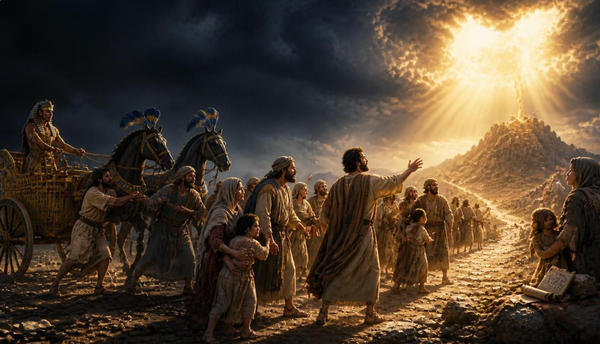
Israel’s 40 Years in the Wilderness
Deuteronomy gives the interpretive key:
Deuteronomy 8:2 - “Remember how the LORD your God led you all the way in the wilderness these forty years, to humble and test you in order to know what was in your heart…”
The wilderness was not merely punishment. It was diagnostic.
✨ Israel left Egypt physically in days, but Egypt had to leave Israel spiritually over decades. ✨
Several things happened during these 40 years:
- False securities were exposed (food, idols, Egypt)
- Trust was learned through manna
- Dependence on God was cultivated
- A generation defined by unbelief died
- A new covenant generation was formed
This becomes the template for later biblical “forties.”
Key Insight:
The wilderness was less about geography than formation.
Israel’s issue was fundamentally trust and perception—would they believe God or define reality by fear?
✨ Repeatedly, their perception governed their destiny. ✨
Moses: 40 Years × 3
The life of Moses unfolds in three forty-year movements:
- 40 years in Egypt — formation in power
- 40 years in Midian — stripping and humbling
- 40 years leading Israel — service and testing
Acts 7 presents Moses almost as a living parable.
He spends:
- 40 years learning to be somebody
- 40 years learning to be nobody
- 40 years learning what God can do with somebody who surrendered
The pattern again: death → preparation → calling.
2. Forty and Covenant Judgment
Forty also appears in contexts of judgment that aim toward restoration.
The Flood: 40 Days of De-Creation
Genesis 7:12 - Rain fell for 40 days and 40 nights.
The flood is a return to chaos waters—a reversal of creation. But judgment is not the final word. After forty days comes a cleansed world, a renewed covenant, and a new beginning through Noah.
Forty here marks a period where evil reaches exposure and cleansing occurs.
Ezekiel 4:5–7 - Forty Years of Judah’s Sin
This passage is especially important. Ezekiel symbolically bears Israel’s judgment:
- 390 days for Israel (northern kingdom)
- 40 days for Judah
Ezekiel 4:5–7 - “...I assign you a day for each year...”
Thus, Judah receives 40 years. Why forty? The connection to the wilderness is likely intentional. Judah is portrayed as needing another wilderness judgment because they repeated the covenant failures of their ancestors.
✨ Just as Israel wandered 40 years for rebellion, Judah experiences a symbolic 40-year covenant consequence. ✨
Theological Pattern:
Forty often follows covenant unfaithfulness. Yet the goal is not annihilation.
✨ God disciplines to restore. ✨
This resonates strongly with prophetic themes:
- exile as wilderness
- wilderness as purification
- purification as preparation for restoration
The prophets often portray exile as a new Exodus waiting to happen.
3. Forty and Preparation for Encounter with God
Forty also precedes major encounters with God or new stages of ministry.
Moses on Sinai - 40 Days
Exodus 34:28 - Moses was there with the LORD forty days and forty nights without eating bread or drinking water. And he wrote on the tablets the words of the covenant—the Ten Commandments.
This period precedes revelation, covenant law, and divine presence.
Yet while Moses fasts on the mountain, Israel descends into idolatry below (golden calf).
A striking biblical irony: waiting exposes worship.
Elijah’s 40-Day Journey
After victory over Baal, Elijah collapses into exhaustion and despair. Fed miraculously, he journeys:
1 Kings 19:7-8 - The angel of the Lord came back a second time and touched him and said, “Get up and eat, for the journey is too much for you.” So he got up and ate and drank. Strengthened by that food, he traveled forty days and forty nights until he reached Horeb, the mountain of God.
Why Horeb? Because Horeb = Sinai. Elijah is symbolically retracing Israel’s story. Israel failed in covenant. Elijah thinks he alone remains faithful. Yet at Horeb God reveals Himself—not in wind, earthquake, or fire, but in a whisper.
Forty here becomes: exhaustion → wilderness → encounter → recommissioning.
God reforms Elijah’s perception. He thinks, “I alone am left.” God says, “There are 7,000.”
✨ The wilderness corrects distorted vision. ✨
Jesus’ 40 Days in the Wilderness
This is arguably the climax of the biblical “40” motif.
Matthew 4:1-2 - Jesus was led by the Spirit into the wilderness to be tested by the devil. After fasting forty days and forty nights, He was hungry.
This takes place before beginning public ministry. This is not random. Jesus is replaying Israel’s story.
Notice the parallels:
| Israel | Jesus |
|---|---|
| Passes through water (Red Sea) | Baptism in Jordan |
| 40 years wilderness | 40 days wilderness |
| Tested | Tested |
| Failed repeatedly | Remains faithful |
| Complained about bread | “Man shall not live by bread alone” |
| Worshiped idols | Worships God alone |
Jesus quotes mostly from Deuteronomy, specifically wilderness texts.
He is presented as the faithful Israelite, succeeding where Israel failed. This matters enormously theologically: Jesus is not merely resisting temptation, He is recapitulating Israel’s history and redeeming it.
Where Adam failed in a garden, where Israel failed in a wilderness, Jesus overcomes.
Forty Here Means:
Preparation through testing before mission. No public ministry before wilderness. No crown before testing.
4. Forty as the Death of an Old Reality
A repeated biblical rhythm emerges:
Forty often marks the death of an old order before a new beginning.
Examples:
| Forty Event | Old Thing Dying | New Thing Emerging |
|---|---|---|
| Flood | Corrupt humanity | Renewed creation |
| Moses in Midian | Egyptian identity | Deliverer |
| Wilderness wandering | Slave mentality | Covenant people |
| Sinai fasting | Chaos of Egypt | Covenant nation |
| Elijah journey | Despair | Renewed prophetic mission |
| Ezekiel judgment | Covenant rebellion | Hope of restoration |
| Jesus fasting | Hidden/private life | Messianic ministry |
This resembles a biblical principle:
- pruning before fruit
- wilderness before inheritance
- testing before authority
5. Is Forty Literal or Symbolic?
Likely both.
In the ancient Near East, 40 could function as an idiom for a significant, complete period—a full season of testing or judgment. Yet Scripture also presents many of these periods as historical.
The point is not:
“Was it exactly forty?”
The larger biblical question is:
“What was God accomplishing during the forty?”
The answer is remarkably consistent: God reveals hearts during periods of deprivation.
In abundance (gardens), motives stay hidden, but in the wilderness, the heart becomes visible. This explains why Deuteronomy links the 40 years directly to testing what was in Israel’s heart.
🪞A Unifying Biblical Theme
Viewed together, the biblical use of forty suggests this pattern:
✨ Forty = a God-appointed season of testing that exposes the heart in order to prepare for covenant faithfulness and new life. ✨
The wilderness is therefore not merely punishment—it is often God’s workshop for transformation, where illusions tend to die.
✨ Forty is often the distance between bondage and maturity. ✨
II. 1. Begin with the Wilderness as God’s Classroom
The interpretive key is:
Deuteronomy 8:2–5
Israel’s forty years were for:
- Humbling
- Testing
- Revealing the heart
- Teaching dependence
- Forming sonship
Notice verse 5:
“As a man disciplines his son…”
✨ The wilderness is framed as fatherly formation. ✨
That immediately opens connections to:
Exodus 4:21-23 - The Lord said to Moses... "say to Pharaoh, ‘This is what the Lord says: Israel is My firstborn son, and I told you, “Let My son go, so he may worship Me.” But you refused to let him go; so I will kill your firstborn son.’”
Matthew 3:17/4:1 - A voice from heaven said, “This is My Son, whom I love; with Him I am well pleased. Then Jesus was led by the Spirit into the wilderness to be tested by the devil.
Hebrews 12:5-7, 10– 11 - You completely forgotten this word of encouragement that addresses you as a father addresses his son? It says, “My son, do not make light of the Lord’s discipline, and do not lose heart when He rebukes you, because the Lord disciplines the one He loves, and he chastens everyone he accepts as his son.”
Endure hardship as discipline; God is treating you as His children.
God disciplines us for our good, in order that we may share in His holiness. No discipline seems pleasant at the time, but painful. Later on, however, it produces a harvest of righteousness and peace for those who have been trained by it.
2. Trace the Pattern Through the Bible
Instead of isolated examples, study the sequence.
Adam → Israel → Jesus
A striking pattern emerges:
| Figure | Place | Test | Result |
|---|---|---|---|
| Adam | Garden | Food/desire | Failure |
| Israel | Wilderness | Hunger/trust | Failure |
| Jesus | Wilderness | Hunger/trust | Victory |
Jesus appears to intentionally reverse both Adam and Israel.
Notice: Adam had abundance and failed, Israel had provision and failed, Jesus had deprivation and obeyed.
This raises a major theological question: Is the wilderness the place where God restores failed humanity?
The answer increasingly looks like yes.
3. Exploring the Relationship Between Forty and “Testing” Language
The Hebrew: (nasah) — “to test, prove”
Used in:
- Abraham and Isaac
- Israel in the wilderness
- Deuteronomy 8
And compare with Greek: (peirazō) — “to test/tempt”
Used for:
- Jesus in the wilderness
- trials in James 1
This creates an important distinction. God tests to reveal or refine, the devil tempts to destroy. Same event, different intention. This fits James beautifully: Trials reveal what is already present. Just as wilderness exposed Israel’s heart.
Important Link:
James 1:2–4 and 1:12 sound very much like wilderness theology.
Especially: perseverance → maturity → crown of life
which mirrors: wilderness → endurance → promised land
4. Examining the Relationship Between Forty and Food 🍞
This becomes surprisingly important. Notice how often food appears in forty narratives:
Israel
Hungry in wilderness. Question: Will they trust manna?
Elijah
Fed miraculously before forty days of desert travel.
Jesus
Forty-day fast. Tested to see if He would make bread.
Moses
Forty days fasting on Sinai.
Food repeatedly becomes the arena of trust. This points back to Eden.
The first temptation was fundamentally: Will humans receive from God or seize for themselves? Forty may repeatedly expose that same Edenic fracture.
Possible Thesis:
The wilderness reveals whether people trust God’s provision or attempt autonomous control.
5. Investigating “Forty” and New Creation
What emerges after forty.
What comes on the other side?
| Forty Period | What Comes After |
|---|---|
| Flood | New creation |
| Moses on Sinai | Covenant |
| Wilderness | Promised land |
| Elijah | Renewed mission |
| Jesus fasting | Kingdom ministry |
| Resurrection appearances (40 days in Acts 1) | Ascension + Spirit |
That last one is especially fascinating.
Acts 1:3 - After His suffering, He presented Himself to them and gave many convincing proofs that He was alive. He appeared to them over a period of forty days and spoke about the kingdom of God.
This often gets overlooked. Why 40 again? Possibly because: The disciples themselves are in a transition wilderness.
Old expectations must die. A new Spirit-empowered mission begins.
Again: revelation → preparation → sending
6. Exploring Ezekiel More Deeply
Why exactly 40 for Judah?
Possible avenues:
- Echo of wilderness rebellion
- Covenant curse fulfillment
- Symbolic purification
- New Exodus anticipation
Compare:
- Numbers 14
- Deuteronomy 8
- Ezekiel 20
Ezekiel 20 is especially rich because God explicitly retells Israel’s wilderness failures.
It may provide the theological explanation for Ezekiel 4.
7. Studying the Wilderness as a Place of Divine Intimacy ❤️🔥
Paradoxically, the wilderness is where people often encounter God most deeply.
Examples:
- Moses at Sinai
- Elijah at Horeb
- Hagar in desert
- Israel receiving manna
- John the Baptist in wilderness
- Jesus praying in desolate places
Hosea 2:14 - “I will allure her, bring her into the wilderness, and speak tenderly to her.”
The wilderness becomes not abandonment, but courtship; God removes competing voices. That fits beautifully with unseen worship and heart formation.
III. 🌿➡️🏜️ Gardens and Deserts: Choice, Exposure, and the Refinement of the Heart
There appears to be a profound narrative rhythm running through Scripture:
Gardens are places of choice, exposing desire, while deserts are places of revelation and refinement, exposing the heart behind the desire.
In Scripture, humanity repeatedly moves through a pattern:
Garden → Choice → Exile → Wilderness → Formation → Return
This pattern begins in Eden and echoes all the way to the New Creation.
🌿 1. Eden: The Garden of Choice
The first major setting in Scripture is a garden. Genesis presents Eden as a place of:
- abundance
- communion
- beauty
- provision
- freedom
- moral choice
God gives nearly unlimited permission, “You may freely eat…”
Choice exists because love without meaningful choice is coercion. But the garden contains something essential, a boundary. The tree represents trust. The question beneath the command is: will humanity receive wisdom from God or seize it autonomously?
The temptation is not merely fruit, its independent perception. Genesis 3 repeatedly emphasizes sight: “The woman saw…” This begins the biblical pattern of seeing and taking.
✨ The garden becomes the place where desire is revealed; what was hidden in the heart emerges through choice. ✨
Key Principle: Gardens expose what we love.
🏜️ 2. The Desert: Where Choices Are Tested
After Eden comes exile. And exile leads to hardship. Adam must now wrestle with sweat, thorns, hunger, and ultimately, mortality. The garden becomes wilderness. This is a recurring biblical movement.
Choice in abundance→ refinement in scarcity.
Because scarcity reveals what abundance concealed.
🌿 Adam → 🏜️ Israel
Israel mirrors Adam almost exactly.
Eden Pattern
Adam:
- placed in sacred land
- given food
- receives command
- fails test
- exiled eastward
Israel:
- delivered toward promised land
- receives manna
- receives Torah
- fails repeatedly
- wanders wilderness
Israel almost becomes corporate Adam. Even details overlap.
Eden imagery in Israel
The promised land is described almost like Eden: flowing with milk and honey
Yet before inheritance comes the wilderness. Because hearts exposed by Egypt and fear needed refinement.
🪞 3. The Desert Reveals What the Garden Choice Actually Meant
The wilderness does not create the problem, it exposes it. God says explicitly:
Deuteronomy 8:2 - “You shall remember the whole way that the Lord your God has led you these forty years in the wilderness, that He might humble you, testing you to know what was in your heart, whether you would keep His commandments or not.”
The issue was already there, the desert simply removed distractions.
The wilderness reveals their hearts still trusted slavery more than God. This explains why Scripture repeatedly associates wilderness with:
- hunger
- thirst
- waiting
- silence
- dependence
These conditions force hidden loyalties into the open.
✨ Garden choices become desert revelations. ✨
🍞 4. The Test Is Often About Provision
A remarkable pattern emerges. The issue repeatedly becomes: Will you trust God’s provision?
- Eden: Food test.
- Israel: Manna test.
- Elijah: Miraculous food in wilderness.
- Jesus: Bread testing.
This seems deliberate. Because food represents dependence. The serpent’s temptation was essentially, 'Take for yourself.' God’s invitation is 'Receive from Me.'
This is why grumbling becomes such a major wilderness sin. Grumbling reveals distrust. The desert exposes whether the heart believes God is good.
🌿 5. Gardens Reveal Desire; Deserts Refine Desire
The garden asks: What do you want?
The desert asks: Why do you want it?
Or perhaps: What rules you when everything else is stripped away?
This is why biblical wilderness often feels severe. God removes substitutes. Not necessarily to punish, but to expose dependencies.
Think of what disappears in wilderness: comfort, abundance, certainty, distraction, false securities.
Suddenly the heart becomes visible.
🏜️ 6. Jesus Reverses Eden in a Desert
This is one of Scripture’s most stunning reversals. Adam fails in abundance, Jesus succeeds in the deprivation of the desert during a fast.
Adam had food, companionship, beauty, and ease, while Jesus had hunger, isolation, and hardship. Yet Jesus succeeds where Adam failed because He refuses autonomous grasping. He trusts the Father.
The desert becomes the undoing of Eden’s failure. The first Adam took. The second Adam, as a faithful Son, receives.
❤️🔥 7. Hosea: Wilderness as Romantic Restoration
One of Scripture’s most surprising reversals: God intentionally leads His people back into wilderness...to restore intimacy.
Hosea 2:14 - “I will allure her, bring her into the wilderness…”
Not to destroy, to speak tenderly. The wilderness becomes relational refinement. Competing loves are exposed. False lovers removed. The heart clarified. The desert becomes a place where affection is purified.
This echoes James 1 beautifully in that testing produces maturity.
🌳➡️🏜️➡️🌳 8. Scripture Ends with a Garden Again
The Bible begins and ends in a garden. In Revelation we have the river of life, tree of life, fruitfulness, and healing. But something changed. Humanity has passed through wilderness. The final garden is inhabited by refined people.
The first garden tested innocence, the last garden contains proven faithfulness.
✨ Gardens reveal hearts, deserts refine hearts, and Kingdom inheritance reveals transformed hearts. ✨
🪞Peter as a Miniature Example
Consider Simon Peter.
Garden:
At the Last Supper and Gethsemane, Peter makes a choice “I will never deny You.” Heart exposed: self-confidence.
Desert:
Trial, fear, failure, weeping. Heart refined.
Garden restored:
On the shore after resurrection: “Do you love Me?” Then “Feed My sheep.”
The refined heart becomes useful.
🌳🏜️ Conclusion: The Wilderness Between Gardens
When viewed together, Scripture suggests that gardens and deserts are not opposites but partners in God’s redemptive work. Gardens reveal the heart through freedom; deserts refine the heart through dependence. What begins as a choice in abundance often becomes a test in scarcity.
Eden exposed humanity’s desire to grasp apart from God. Israel’s wilderness exposed whether their hearts truly trusted the God who delivered them. Elijah’s desert confronted distorted perception. Jesus entered the wilderness and succeeded where Adam and Israel failed, choosing trust over grasping and obedience over self-preservation.
Yet the wilderness is never presented as the final destination. Deserts are transitional spaces. They are severe, but purposeful. God does not bring His people into wilderness merely to leave them there; He brings them there to reveal, refine, and restore.
As Hosea suggests, even the desert can become a place where God “speaks tenderly” to His people. The wilderness strips away illusions so that love, trust, and faithfulness may become genuine rather than circumstantial.
Perhaps this is why Scripture both begins and ends in a garden. Humanity moves from the innocence of Eden to the maturity of the New Creation through the refining fire of wilderness experience.
The first garden contained untested trust; the final garden is inhabited by those who have learned faithfulness through trial. Between the two stands the desert—a place where hearts are uncovered, idols exposed, and dependence relearned.