🕊️🩸🛐🫧👣❤️🔥“As I Have Loved You” - The Command Born in a Basin
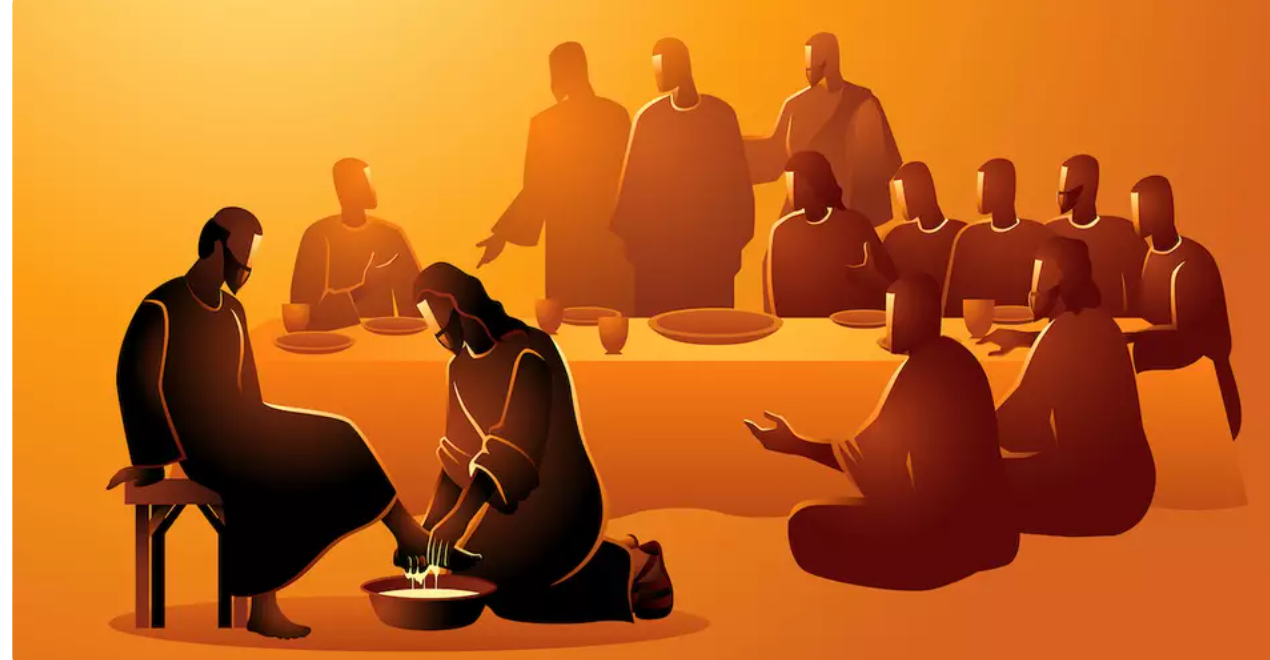
(Exploring John 13:34–35 in light of John 13:3–15)
I. 🧺🫧 A New Command...From Kneeling Height
When Jesus says, “A new command I give you: Love one another. As I have loved you…” (John 13:34–35), He does not give that command from a throne, a pulpit, or even a mountain. He gives it from His knees.
With a towel around His waist.
And with the smell of a servant’s work already on Him.
The command to love is not abstract.
It is not sentimental.
It is not optional.
It is rooted in the basin, born in the act of washing the very feet that would scatter and deny Him.
To understand the command, we must understand the example.
1. Jesus Loved With Full Awareness
“Jesus knew that the Father had put all things under His power…” (John 13:3)
Before He got down on the floor, Jesus knew:
- Who He was (Lord and Master) 👑
- Where He came from (the Father) ☁️
- Where He was going (back to glory) ✨
And with that absolute security of identity, He did the most insecure, humiliating job in the room.
🫧👣 Jesus didn’t serve to earn identity; He served from identity. 🫧👣
And He invites us to love the same way—not from insecurity, but from confidence in the Father’s love.
2. The Foot-Washing Was a Living Parable of the Cross
Jesus strips Himself of His outer garment (symbol of status) 🧥
—just as He would soon be stripped of dignity on the cross.
He stoops low 🫧
—just as He stooped into human flesh itself.
He washes dirt from their feet 👣
—just as the cross would wash sin from their souls.
The basin is a preview of Golgotha.
Every drop of water foreshadows every drop of blood.
When He says, “As I have loved you,” He means: Love one another with cruciform love—self-giving, self-emptying, self-forgetting. 💧➡️🩸
3. The Call to Follow His Example (John 13:12–15)
Jesus ends the foot-washing with:
“I have set you an example that you should do as I have done for you.” (v. 15)
Not what I have done, but as I have done. Not just the action, but the posture. Not just the deed, but the heart. Not just the letter but the spirit.
This is not:
- “Be nice.”
- “Be polite.”
- “Try to get along.”
This is:
Lower yourself.
Serve when it is beneath you.
Love when it is costly.
Wash feet that will run away.
🧺👣💔➡️❤️🔥
This...is...how...Jesus...loved.
4. The New Command Explained (John 13:34–35)
“As I have loved you, so you must love one another.”
Only now—after the basin—is this command meaningful.
What Makes It “New”?
- The Standard is New
Not “Love your neighbor as yourself.”
But “Love as I have loved you.”
🔥 This is divine-level love, not human-level love. - The Community is New
He isn’t speaking to crowds.
He’s speaking to His disciples—those who will form the new covenant family.
The Witness is New
“By this everyone will know that you are My disciples…” (v. 35)
The mark of discipleship is not:
- miracles,
- doctrine precision,
- bold preaching,
- deep study,
- impressive ministry.
The mark is:
Do you love like the One who washed feet? 👥❤️
👣❤️
The world isn’t convinced by our arguments, but it is pierced by sacrificial love.
5. The Command and the Example Are One Story
John 13 flows like this:
Identity → Humility → Service → Command → Witness
👑 → 🫧 → 👣 → ❤️ → 🌍
We cannot jump to the command without passing through the basin.
The “new commandment” is not a requirement; it’s a reflection.
When we obey it, we reflect Him. When we wash feet, we prove we belong to Him. This is why Jesus says: “By this everyone will know…”
Not by proclamation. Not by power. But by the basin-shaped love of the cross lived out in community.
Conclusion: The Towel Is the True Crown
Love that kneels
Love that serves
Love that bears shame
Love that goes low
Love that washes dirt
Love that forgives betrayers
Love that reflects the Crucified King
This is the love that identifies us.
This is the love that changes the world.
This is the love that began with a towel and ended with lonely linen cloth.
So Jesus says:
“Love one another—just like this.”
II. How Jesus Made Disciples: The Slow, Personal, Table-Shaped Way
Not primarily by apologetics, miracles, or crowds—but by proximity, presence, and practice.
Jesus Didn’t Run a School—He Built a Life
We often picture discipleship as:
- classes
- sermons
- apologetics arguments
- big miracle moments
- public ministry
But when you zoom in on the Gospels, something stunning appears:
👣🔥 Most of Jesus’ disciple-making happened in small, ordinary, relational spaces—around tables, on roads, in homes, on long walks, in conversations interrupted by real life. 👣🔥
His goal wasn’t to produce students but followers who imitate His way of life.
1. Jesus Made Disciples by Being With Them
“He appointed twelve…that they might be with Him.” — Mark 3:14
This is the heart of it. Before teaching, before sending, before miracles—
He wanted them with Him.
Discipleship for Jesus was:
- proximity
- shared life
- constant exposure
- seeing Him respond to interruptions, pain, sinners, crowds, crisis, and joy
The kingdom was not learned in a classroom but caught through constant companionship.
2. Jesus Taught in Real Life, Not Just In Lessons
Jesus taught plenty, but look how He taught:
- by responding to questions
- by reinterpreting ordinary moments (sparrows, lilies, seeds, lamps)
- by storytelling adapted to the listener
- by rebuking when needed
- by affirming faith whenever He saw it
- by turning mistakes into formation
His teaching was immersive and situational, not abstract.
He didn’t just teach about forgiveness;
He brought His disciples along to watch Him forgive.
He didn’t just teach about compassion;
He touched the untouchable in front of them.
3. Jesus Used Miracles as Signs, Not Recruitment Tools
Miracles did draw crowds—but crowds weren’t disciples.
Jesus actually resisted miracle-based discipleship:
- “A wicked generation seeks a sign…”
- He often withdrew after miracles
- He told people not to spread the news
- Many who saw miracles walked away when His teaching got difficult (Jn 6)
Miracles revealed His identity, but relationship formed disciples.
4. Jesus Explained Himself Privately to His Disciples
Crowds heard parables. Disciples heard the explanations.
This is crucial.
Jesus gives “public mystery” and “private clarity.”
Why? Because understanding is relationally gated in the kingdom. The more you walk with Him, the more you understand Him.
5. Jesus Used Table Fellowship as a Primary Discipleship Tool
Jesus ate constantly.
Why?
Because meals do something sermons can’t:
- break social barriers
- build trust
- slow us down
- let love be felt, not just taught
Some of Jesus’ deepest moments of discipleship happened:
- at dinners in homes
- at feasts with sinners
- at quiet meals with His disciples
- at the Last Supper
- after the resurrection (breaking bread at Emmaus, cooking fish by the sea)
Jesus discipled by table fellowship because love is most visible when we share bread.
6. Jesus Challenged His Disciples’ Assumptions Constantly
He let them fail…and then used the failure as fuel for formation.
- Peter sinks → “Why did you doubt?”
- James & John want fire → “You do not know what spirit you’re of.”
- They argue about greatness → “Become like a child.”
- Philip asks for proof → “Have I been with you so long?”
Jesus didn’t coddle. He didn’t flatter. He shaped. Discipleship included correction, confrontation, and recalibration.
7. Jesus Modeled Everything Before Commanding Anything
He washed feet before saying,
“Do as I have done.”
He forgave enemies before saying,
“Love your enemies.”
He prayed in hidden places before saying,
“When you pray…”
His life was the curriculum.
8. Jesus Discipled Through Prayer—Before, During, and After
He prayed:
- before choosing the twelve
- before miracles
- for His disciples’ protection
- for their unity
- for their future fruitfulness
- with them
- in front of them
- away from them
- over them
He taught prayer not just with words but by showing what a life of communion with the Father looked like.
9. Jesus Sent Them Out to Practice What They Learned
After:
- walking with Him
- watching Him
- listening to Him
- failing with Him
He sent them out two by two.
They weren’t done.
They weren’t polished.
They weren’t “ready.”
But Jesus trusted the process.
Then they returned and debriefed with Him—
the perfect cycle of practice → reflection → growth.
10. Jesus Loved Them All the Way to the End
Ultimately, discipleship culminated not in a method but in a sacrifice.
- The towel in John 13
- The cross in John 19
- The Spirit in John 20
- The commission in Matthew 28
He didn’t produce scholars, He produced imitators. And the final formative act was laying down His life for His friends.
Conclusion: Jesus’ Disciple-Making Was Slow, Personal, Embodied, and Relational
Here’s the pattern in a single line:
Be with them → Teach them → Model for them → Invite them → Correct them → Send them → Love them → Empower them
Not a program or a curriculum but a way of life.
And this is the way He still forms disciples today—in kitchens more than classrooms, through conversations more than conferences, in interruptions more than schedules, and through love far more than arguments.
The kingdom grows at the speed of relationship, not the speed of events.
That’s how the Master disciple-maker made disciples.
III. Jesus Lived Deuteronomy 6 Out Loud
How the Messiah fulfilled the Shema in real time—teaching when He sat, walked, rose, and rested. Deuteronomy 6 doesn’t merely command Israel to believe in God—it commands them to weave Him into every rhythm of daily life.
“These words…shall be on your heart.
You shall teach them diligently to your children,
and shall talk of them
when you sit in your house,
and when you walk by the way,
and when you lie down,
and when you rise.” (Deut. 6:6–7)
This is the blueprint for discipleship—not classroom instruction, but whole-life conversation.
👣🔥When Jesus steps into the story, He doesn’t just quote the Shema (though He does), He embodies it. He walks it out. 👣🔥
He lives the Shema as a Rabbi and fulfills it as the Son.
1. “When You Sit in Your House” — Jesus Taught at Tables
Much of Jesus’ discipleship happened while sitting:
At table fellowship
- With sinners (Luke 15)
- With Pharisees (Luke 7; 14)
- With disciples (Mark 2; Matt. 26)
At home
- Peter’s mother-in-law’s house
- Martha and Mary’s home
- Levi’s house
- Zacchaeus' house
The table was His classroom. Bread was His object lesson. People were His curriculum. Jesus fulfilled Deuteronomy 6 by turning ordinary meals into sacred moments.
Discipleship happened with crumbs on the table, laughter in the room, and sinners at His side.
2. “When You Walk Along the Road” — Jesus Taught on the Move
Jesus rarely stayed still.
Many of His greatest teachings were delivered while walking:
- The Sermon on the Mount was prompted while walking with crowds
- The teachings on anxiety came while pointing to lilies and birds
- The parables often arose from something seen on the road (fields, lamps, wheat, trees)
- The Emmaus revelation in Luke 24—perhaps His greatest Bible study—happened on a walk
He taught:
- as they traveled from village to village
- while passing through grain fields
- while entering or leaving cities
- when interrupted on the road
- when approached on the way
Like Deuteronomy 6 commands, Jesus used the road as a classroom—
formation happened with dust on their feet and questions in their minds.
3. “When You Lie Down” — Jesus Taught at Night
Nighttime moments shaped the disciples deeply.
Jesus taught at night:
- Nicodemus comes “at night,” and Jesus delivers the new birth teaching
- In Gethsemane, Jesus urges the disciples to watch and pray
- On the Sea of Galilee at night, Jesus calms the storm
- In a house at night, He predicts Peter’s denial
Night is a theme for spiritual blindness vs. enlightenment in John’s Gospel.
Jesus used the night as a teaching moment:
- “Are there not twelve hours of daylight?”
- “Walk while you have the light.”
His disciples learned faith, prayer, vigilance, and dependence when the sun went down.
4. “When You Rise” — Jesus Began Days With Prayer, Presence, and Purpose
Jesus rose early—often before the disciples—to pray.
This was His “morning liturgy,” His embodied Shema:
- “Very early…He got up and prayed.” (Mark 1:35)
- After prayer, He set direction for the day
- After prayer, He chose disciples
- After prayer, He performed miracles
- After prayer, He taught crowds
He lived in constant morning communion with the Father.
Every sunrise was surrendered.
Every day began with obedience to the greatest commandment:
❤️🔥“Love the LORD your God with all your heart…”❤️🔥
5. Jesus Didn’t Just Recite the Shema—He Is the Fulfillment of It
When asked the greatest commandment, Jesus quotes Deut. 6 immediately:
“Hear, O Israel…Love the LORD your God with all your heart…” (Mark 12:29–30)
But then He does something astonishing: He places love of neighbor right beside it—as if the two are inseparable.
Why?
Because Jesus’ life illustrated the truth: To love the Father is to love those made in His image.
The Shema becomes a relational way of life in His ministry.
And discipleship means:
- sitting with Him,
- walking with Him,
- rising with Him,
- praying with Him,
- watching Him at night,
- obeying Him always.
Just like Deuteronomy 6 describes.
6. The Shema Was the Rhythm of Jesus’ Disciple-Making
Here is the Shema mapped to Jesus’ ministry:
Sit → Table Fellowship
He ate with them (Luke 22; Mark 2).
🍞
Walk → Roadside Teaching
He taught on roads, hills, and fields (Luke 24).
👣
Lie Down → Night Lessons
He trained them in watchfulness and faith in the dark (Mark 4; Matt. 26).
🌙
Rise → Morning Presence
He rose early to pray—and called them into His rhythms (Mark 1:35).
🌅
This is how He made disciples.
This is how the kingdom spreads.
This is how the Shema becomes flesh and dwells among us.
🕊️🔥
Conclusion: Jesus Is the Shema Walking
Deuteronomy 6 commanded Israel to talk about God at all times.
Jesus lived this.
He demonstrated:
- morning devotion
- daytime formation
- roadside parables
- evening reflection
- midnight wrestling
- table fellowship
- embodied love
He didn’t disciple in a classroom. He discipled in the normal flow of life. He turned every sunrise, every road, every meal, every night into an opportunity to love God and love people.
He didn’t just teach the Shema. He was the Shema incarnate.
![👑🍞🍷🎭💔🚪(B) The King’s ‘Friend’: Near the Table, Far from the Heart [5 parts]](/content/images/size/w600/2026/04/Screenshot-2026-03-31-7.03.14-PM-1.png)
![👁️ 👁️✨🧠👣 (A) Discernment Through Transformation: Why Right Action and Right Timing Require a Renewed Mind [3 parts]](/content/images/size/w600/2026/04/Screenshot-2026-03-31-7.03.14-PM.png)