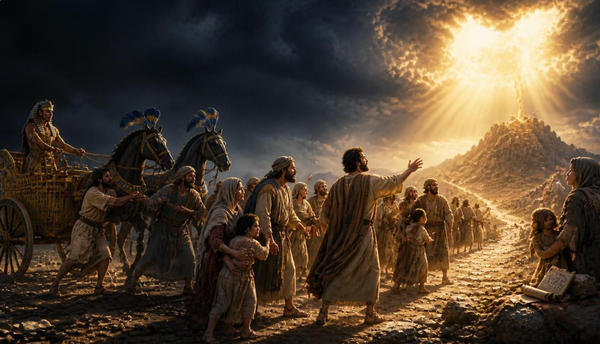
(B) 🍞🥖🧠🌾 From Famine in the Midst of Angelic Bread to “My Food Is to Do the Will of Him who sent Me” [4 parts]
![(B) 🍞🥖🧠🌾 From Famine in the Midst of Angelic Bread to “My Food Is to Do the Will of Him who sent Me” [4 parts]](https://storage.ghost.io/c/ab/d8/abd818ed-d1c7-4d9a-800d-8de8bae8d50c/content/images/size/w1200/2026/04/Screenshot-2026-04-21-8.45.58-AM-1.png)
🧠 1. Will as Discerned Reality
Romans 12:1-2 - “Be transformed by the renewing of your mind. Then you will be able to test and approve what God’s will is…”
This is where most people misunderstand the process. They try to discover God’s will externally Instead of being transformed internally.
Paul flips it:
Transformation precedes recognition.
- “Be transformed by the renewing of your mind…”
Then you will discern (δοκιμάζω — to test, examine, prove genuine)
➡️ The will of God isn’t hidden—it’s misrecognized by an unrenewed mind.
➡️ Obedience actually sharpens perception.
🥖 2. Will as Sustenance (John 4:34)
“My food is to do the will of Him who sent Me…”
Jesus re-frames “food” from physical intake to functional obedience.
- Food sustains biological life (bios).
- Obedience sustains relational life with the Father (zoe).
This implies something disruptive:
➡️ Disobedience is a kind of starvation.
➡️ Alignment with God’s will is nourishment.
Not metaphorically only—experientially. The more one acts in alignment, the more one lives.
🩸 3. Will as Surrender
Luke 22:42 - “Not My will, but Yours be done.”
Here, the will of God is not abstract—it’s costly.
- In John 4, doing the will is satisfying.
- In Gethsemane, doing the will is agonizing.
Same will. Different moment.
This exposes a critical truth:
The will of God is not always aligned with human preference, but it is always aligned with eternal life.
So obedience isn’t driven by emotional agreement—it’s driven by allegiance.
🌍 4. Will as Cosmic Order
Matthew 6:10 - “Your kingdom come, Your will be done, on earth as it is in heaven.”
Now the scope expands.
- Heaven = the realm where God’s will is perfectly enacted.
- Earth = the realm where God’s will is contested.
The prayer is not passive—it’s a request for invasion:
➡️ That earth would begin to look like heaven
➡️ Through people who embody the will of God
So the will of God is:
- Personal (My food)
- Costly (not My will)
- Cosmic (kingdom come)
🔄 Putting It Together - A Living Cycle
These aren’t disconnected ideas—they form a loop:
- You surrender your will
(“Not mine, but Yours…”) - You act in obedience
(“My food is to do His will…”) - You participate in the kingdom
(“On earth as in heaven…”) - Your mind is transformed
(“Then you will discern…”) - You see more clearly what His will is
→ which leads back to deeper surrender
👁️ Connection to Sight (Ayin Tovah vs Ayin Ra’ah)
A “good eye”:
- Sees reality as aligned with God’s will
- Interprets life through trust and generosity
An “evil eye”:
- Sees reality as disconnected from God’s will
- Interprets life through scarcity, control, self-preservation
Doing the will of God doesn’t just change behavior—it heals vision.
🌱 Eden Reversal Motif
In Eden:
- Humanity rejected God’s will (“not Your will, but mine”)
- Took what looked “good for food”
- Result: death entering life (bios continues as zoe decayed)
In Christ:
- He embraces the Father’s will
- Calls obedience His “food”
- Result: life (zoe) entering death
It’s a precise reversal.
⚖️ Synthesis
The will of God is not merely:
- A set of instructions
- A hidden blueprint
- A moral checklist
It is the environment in which true life exists.
To step outside of it is not just “wrong”—it is to step outside of life itself.
And that’s why:
- Jesus feeds on it
- Submits to it unto death
- Teaches us to pray for its global manifestation
- And through transformation, enables us to finally recognize it
II. 🔥 1. Entry Into the Wilderness: Flight vs. Leading
🌵 Desert as Diagnostic: Elijah and Jesus Under the Will of God
Placing 1 Kings 19 (Elijah) beside Matthew 4 / Luke 4 (Jesus) exposes a controlled comparison: two wilderness encounters, both involving hunger, isolation, and divine purpose—but radically different outcomes in relation to the will of God.
Elijah — Driven by Fear
- Flees after Jezebel’s threat
- Motivated by self-preservation
- His movement is reactive: away from danger
Jesus — Led by the Spirit
- “Led by the Spirit into the wilderness”
- Motivated by obedience
- His movement is intentional: into testing
Connection:
➡️ Elijah runs from threat
➡️ Jesus walks into testing
Same terrain. Different posture toward the will of God.
🍞 2. Hunger and “Food”
Elijah (1 Kings 19:4–8)
- Collapses under a broom tree: “I have had enough… take my life.”
- God provides bread and water twice
- That food sustains him for a 40-day journey.
Jesus (Matthew 4:2–4)
- Fasts 40 days, then hunger hits
- Refuses to turn stones into bread
Anchors Himself in:
“Man shall not live by bread alone…”
- Because bread only sustains bios, it does nothing for zoe.
Key inversion:
- Elijah needs physical food to continue
- Jesus refuses physical food to remain aligned
But this doesn’t contradict “My food is to do the will of the Father”—it reveals it:
Jesus is sustained by obedience itself, even when physical hunger intensifies.
🧠 3. Internal Dialogue: Distortion vs. Alignment
Elijah
His words spiral:
“I am no better than my fathers”
“I am the only one left” (factually incorrect)
His perception is warped under pressure.
Jesus
Responds to every temptation with:
“It is written…”
His perception remains anchored in truth.
Romans 12:2 connection:
- Elijah is overwhelmed—unable to “test and approve” clearly
- Jesus demonstrates a fully renewed mind under pressure
🧎 4. Will and Surrender
Elijah
- “Take my life” → effectively: end my assignment
- He resists continuing in what God has for him
Jesus
- Refuses shortcuts (bread, spectacle, power)
- Later culminates in: “Not My will, but Yours…”
Important nuance:
Elijah isn’t rebuked harshly—he’s restored. But he does momentarily step out of alignment with the will of God. Jesus never does.
When God sees that Elijah is burnt out he tells him to appoint his replacement, Elisha.
🌬️ 5. Revelation of God: Whisper vs. Word
Elijah (1 Kings 19:11–13)
- Wind, earthquake, fire… then a low whisper
- God meets him in gentle recalibration
Jesus
- No sensory spectacle
- The Word of God is already internalized and active
Contrast:
- Elijah needs God to reintroduce Himself
- Jesus is already operating in continuous union
🌍 6. Mission Continuity
Elijah
- Receives new instructions (anoint kings, appoint Elisha)
- His role begins transitioning—he’s nearing completion
Jesus
- Leaves the wilderness “in the power of the Spirit”
- His mission is just beginning publicly
🔄 Thematic Synthesis - Will, Food, and Wilderness
🥖 “My food is to do the will…”
- Jesus embodies this in the wilderness: obedience sustains Him beyond bread
🩸 “Not My will, but Yours…”
Wilderness is the training ground for Gethsemane.
🌍 “Your will be done on earth…”
- Jesus enacts heaven’s order in a place defined by chaos and temptation
🧠 “Then you will discern…”
- Jesus discerns perfectly under pressure
- Elijah temporarily loses clarity—but is restored
🌱 Eden Echo (Again, but Sharper)
- Israel failed in the wilderness (craving bread, doubting God)
- Elijah struggles in the wilderness (despair, misperception)
- Adam failed in a garden (took what was “good for food”)
Jesus:
- Refuses illegitimate food
- Trusts the Father’s word
- Aligns fully with the will of God
He succeeds in every environment humanity previously failed in.
👁️ Wilderness Reveals What You Feed On
The desert strips away distractions and exposes the core question: What actually sustains you?
- Elijah: momentarily, relief and escape
- Jesus: consistently, the will of the Father
And that difference determines:
- Alignment vs. drift
- Clarity vs. confusion
- Endurance vs. collapse
If we are aligned with God we will have clarity and be able to endure. Conversely, if we drift we will be confused and collapse.
III. 🌾 Rebellion as Famine: When Starvation Becomes a System
If:
- Obedience = nourishment (food, life, zoē)
- Disobedience = starvation (loss of sustaining life)
Then:
Rebellion is not just hunger—it is the collapse of the food system itself.
🍞 → 🚫 → 🏜️ From Meal to Famine
1. Disobedience = Missed Meal
A single act of disobedience is like skipping food:
- Weakens clarity
- Reduces strength
- But recovery is still immediate and available
Think momentary misalignment—you feel it, but you can turn back quickly.
2. Rebellion = Refusal of the Food Source
Rebellion (Hebrew meri) is not accidental—it’s willful resistance.
Now it’s no longer:
- “I didn’t eat”
It becomes:
- “I reject what feeds me”
This shifts from behavioral lapse to relational rupture.
3. Famine = Environmentalized Rebellion
Famine isn’t just lack of food—it’s the removal or breakdown of access to food at scale.
So spiritually:
- Disobedience = personal starvation
- Rebellion = collective or sustained starvation system
Now entire environments are shaped by:
- Distorted perception
- Misaligned desires
- Inability to recognize true nourishment
📖 Biblical Pattern: Famine as Judgment and Revelation
🕊️ “Not a famine of bread…” (Amos 8:11)
A famine of:
- Hearing the word of God
- Receiving the word of God
- Responding to the Word of God
The famine isn’t just absence of supply—it’s loss of appetite and recognition.
🌵 Wilderness Generation (Numbers)
- Manna provided daily (will of God made tangible)
- Rebellion leads to:
- Complaining/grumbling
- Craving Egypt (false nourishment)
- Death in the wilderness
They were surrounded by provision—but lived like they were in famine.
🏛️ Kings and National Rebellion
When Israel corporately rebels:
- Literal famines occur
- Land stops “yielding”
Why? Because:
The land itself is portrayed as responding to alignment or misalignment with God’s will.
👁️ Perception Collapse: The Hidden Layer
Famine doesn’t just empty the stomach—it rewires perception.
In rebellion:
- What is life-giving looks undesirable
- What is destructive looks appealing
This is straight Genesis 3:
- “Good for food… desirable…”
- But actually death-bearing
Rebellion produces a world where people no longer recognize what feeds them.
🥖 Jesus as the Anti-Famine
“My food is to do the will…”
Jesus doesn’t just eat rightly—He redefines food itself.
Wilderness temptation
- Refuses to create bread outside the Father’s will
- Prevents a false food system from emerging
Feeding miracles
- Physical bread points to deeper reality
- “I am the bread of life (zoe)”
Kingdom prayer
“Your will be done…”
This is effectively:
“End the famine. Restore the flow of true nourishment from heaven to earth.”
🌱 Elijah Revisited (1 Kings 19)
Elijah sits under a tree and asks to die.
That’s famine language:
- No strength
- No hope
- No perceived future
God’s response is instructive:
- Gives physical food (stabilization for bios)
- Speaks truth (corrects perception)
- Reassigns mission (restores alignment with will)
So recovery from famine is:
- Not just feeding
- But realigning with the will of God
🔄 Romans 12:2 - Breaking the Famine Cycle
“Be transformed… then you will discern…”
Rebellion produces famine because it distorts the mind.
Transformation restores:
- Appetite
- Recognition
- Alignment
Renewal of the mind is like restoring agriculture after a famine.
⚖️ Synthesis
- Disobedience starves the individual
- Rebellion starves systems, communities, generations
It creates:
- Environments where truth is scarce
- Souls that no longer hunger for what gives life
- A breakdown in recognizing God’s will as good
But:
Every act of obedience is like planting in a famine.
It reintroduces:
- Life
- Clarity
- Sustenance
And ultimately:
The will of God isn’t just food—it’s the only ecosystem where life can grow. 🌾
IV. 🍞👼 “Bread of Angels” vs. “Nothing at All” - Appetite, Perception, and the Will of God
Placing Psalm 78:25 beside Numbers 11:6 exposes a jarring contradiction that isn’t about supply—it’s about perception shaped by desire.
📖 The Two Statements
🌤️ Psalm 78:24-25
“[God] rained down manna for the people to eat, He gave them the bread of heaven. Man ate the bread of angels; He sent them food in abundance.”
- Retrospective interpretation
- Divine evaluation of the wilderness provision
- Elevates manna to heavenly origin and dignity
🌵 Numbers 11:6
“Now our appetite is gone; there is nothing at all but this manna to look at.”
- Real-time complaint
- Human evaluation under craving
- Reduces manna to monotony and insufficiency
⚖️ Same Provision - Opposite Realities
Nothing changed externally.
- Same manna
- Same daily miracle
- Same sustaining power
What changed was the internal lens.
Psalm 78 = reality as God defines it
Numbers 11 = reality as distorted by craving
👁️ The Eye Determines the Meal
- A good eye sees manna and calls it:
- “Bread of angels”
- Gift
- Sustenance
- An evil eye sees the same manna and says:
- “Nothing at all”
- Boring
- Insufficient
The issue isn’t what they were given—it’s what they were hungry for.
🍖 Craving vs. Calling
In Numbers 11, their complaint is specific:
- They long for Egypt’s food (fish, cucumbers, melons, leeks…)
This is not just dietary preference—it’s directional rebellion.
They are physically in the wilderness but internally oriented toward Egypt.
Their appetite is misaligned with their destination.
🌾 Famine in the Midst of Abundance
- Disobedience = starvation
- Rebellion = famine
Here’s the paradox:
They are eating heaven’s bread…
and experiencing it as famine.
Why? Because rebellion doesn’t remove provision—it corrupts the ability to receive it.
🍞 Jesus as the Contrast
When Jesus says:
“My food is to do the will of the Father…”
He is reversing Numbers 11 in real time.
- Israel: “We have nothing but this…”
- Jesus: “This is everything.”
And in the wilderness temptation:
“Man shall not live by bread alone…”
He refuses to:
- Redefine food
- Upgrade provision
- Escape dependence
Instead, He affirms:
The will of God is sufficient—even when physical hunger is present.
🔄 Psalm 78 as Interpretation of Failure
Psalm 78 isn’t just history—it’s theological diagnosis.
It’s saying:
“What they despised was actually divine abundance.”
The psalm re-frames their complaint as not just ingratitude but misrecognition of heaven’s provision.
🧠 Romans 12:2 Connection
“Be transformed… then you will discern…”
Israel in Numbers 11 could not “approve” what was good because their minds were shaped by Egypt. Psalm 78 reveals what a renewed perspective would have seen all along.
How are we shaped by sin in a way that makes us view the divine as "nothing but?"
🏜️ Elijah and the Manna Echo
Elijah receives bread in the wilderness and:
- Eats
- Travels 40 days
- Continues in God’s will
No complaint. No reinterpretation.
Contrast that with Israel:
- Eats daily miracle
- Complains
- Calls it “nothing”
The same God, the same wilderness, the same pattern—
but radically different responses to provision.
⚖️ Final Synthesis
- Manna is objectively sufficient
- But its value is subjectively experienced
Appetite determines whether provision feels like abundance or absence.
Rebellion doesn’t just reject God’s will—it redefines His provision as insufficient.
Which is how people can be sustained by God, surrounded by abundance, and still live as if they are starving. 🌵