✨🌌📖👑✨ The Heavens Declare the Glory of the King: Traveling Magi, Paul, and John's Great Sign [3 parts]
![✨🌌📖👑✨ The Heavens Declare the Glory of the King: Traveling Magi, Paul, and John's Great Sign [3 parts]](https://storage.ghost.io/c/ab/d8/abd818ed-d1c7-4d9a-800d-8de8bae8d50c/content/images/size/w1200/2026/09/ChatGPT-Image-Sep-13--2026--12_49_52-PM.png)
Introduction
The Bible repeatedly presents creation as more than a backdrop to God's activity. The heavens declare, proclaim, speak, and bear witness, while Scripture gives that testimony a covenantal and redemptive voice.
When Paul quotes Psalm 19:4 in the middle of his discussion of hearing the message of Christ, and Revelation describes a “great sign” appearing in heaven surrounding the birth of the child who will rule the nations, an intriguing biblical pattern emerges.
Dr. Michael Heiser's proposal invites us to place these passages alongside Matthew's account of the Magi and ask how celestial signs, Scripture, and the proclamation of the Messiah may have intersected within the worldview of the biblical authors.
I. Who Were the Magi?
Matthew 2:1–12 is much more interesting than the familiar Christmas-card picture of “three kings.” Matthew never calls them kings, never says there were three, never gives their names, and does not even explicitly call them “men” in the way our tradition imagines them.
He calls them μάγοι (magoi), a term with a fairly specific ancient cultural meaning. And their journey becomes especially fascinating when we place them against the world of Daniel, Babylon, Persia, Jewish prophecy, and ancient astronomy.
The Greek word magoi is the plural of magos. It originally referred particularly to a priestly/expert class associated with the Medes and Persians, and by the first century it could refer more broadly to learned religious specialists, interpreters of dreams and omens, astrologers, and court advisers.
Herodotus, for example, uses magoi for a Median priestly group. By the Hellenistic and Roman periods, the term had become associated throughout the eastern Mediterranean with people who interpreted celestial and other signs.
That makes the connection with Daniel immediately intriguing.
Daniel 2:2 - King Nebuchadnezzar summoned the magicians, enchanters, sorcerers and astrologers to tell him what he had dreamed.
Daniel 2:27-28 - Daniel replied, “No wise man, enchanter, magician or diviner can explain to the king the mystery he has asked about, but there is a God in heaven who reveals mysteries.
Matthew 19:26 - Jesus said, “With man this is impossible, but with God all things are possible.”
Daniel 2:24 - Daniel went to Arioch, whom the king had appointed to execute the wise men of Babylon, and said to him, “Do not execute the wise men of Babylon. Take me to the king, and I will interpret his dream for him.”
Daniel 2:48 - The king placed Daniel in a high position. He made him ruler over the entire province of Babylon and placed him in charge of all its wise men.
The Septuagint uses terminology that places Daniel within this larger world of magoi/wise men. The Magi were most likely Gentile religious scholars from the eastern world, probably somewhere within the Persian/Mesopotamian sphere.
“From the east” is all Matthew explicitly tells us. Matthew is presenting something almost paradoxical: Gentile specialists in the heavens recognize Israel's King before Jerusalem does.
How did they know about a Jewish king?
The Daniel connection becomes particularly fruitful as part of the cultural and theological world in which Daniel's legacy could have mattered.
Daniel spent his entire career inside the intellectual and governmental institutions of Babylon and Persia. He demonstrated repeatedly that the God of Israel—not the court astrologers—reveals mysteries, which Nebuchadnezzar acknowledges:
Daniel 2:47 - “Truly, your God is God of gods and Lord of kings, and a revealer of mysteries.”
Then Daniel is elevated over the very class of people who had failed to interpret the king's mystery. So imagine the eastern intellectual tradition centuries later. There exists a long-standing Jewish diaspora throughout Mesopotamia and Persia.
Jewish Scriptures are circulating. Jewish communities have lived in Babylonian and Persian territories for generations. And Jewish prophetic writings contain extraordinarily interesting material about a coming king.
One particularly striking passage is:
Numbers 24:17 - “A star shall come out of Jacob, and a scepter shall rise out of Israel.”
That is spoken by Balaam, an eastern seer—a non-Israelite whose encounter with YHWH radically redirects his prophetic activity. That creates an intriguing biblical pattern:
An eastern Gentile seer → encounters revelation from Israel's God → speaks about a coming ruler associated with a star.
Then Matthew gives us:
Eastern Gentile sages → observe a star → recognize a Jewish king → come seeking Him.
What did they actually see?
Matthew 2:2 - “We saw His star when it rose.”
The Greek expression is (en tē anatolē). Anatolē can refer to the east/eastern region, but it can also refer to rising, particularly the rising of a celestial body. That creates an important interpretive question. Did they mean:
“We saw his star in the east” or “We saw his star when it rose”?
The latter fits the astronomical context quite naturally. Ancient astrologers paid extraordinary attention to the rising and positioning of celestial bodies. Notice, though, that Matthew does not say that the Magi followed the star all the way from Persia to Bethlehem.
That's a popular reconstruction, but it isn't actually what the text says. The sequence is much more precise.
- 1. They see a celestial sign: “We saw his star when it rose.”
- 2. They interpret it: “Where is He who has been born king of the Jews?”
The star apparently communicated royal significance, not a GPS coordinate.
- 3. They travel to Jerusalem.
That's perfectly logical. If you are eastern foreigners who have discovered evidence that a Jewish king has been born, where do you go? Jerusalem. It's the Jewish capital and the obvious place to investigate a royal birth.
- 4. Jerusalem doesn't know.
And this is one of Matthew's delicious ironies. The outsiders know something has happened. But Herod doesn't. Jerusalem doesn't. The religious leadership apparently doesn't. The Magi arrive asking:
Matthew 2:2 - “Where is He who has been born king of the Jews?”
And Herod has to assemble the chief priests and scribes to find the answer. That is the first major revelation about the Magi: Their celestial knowledge gets them close. Israel's Scriptures get them to Bethlehem.
The star did not tell them “Bethlehem”
This is perhaps the most important point in understanding the passage. Herod's experts quote:
Micah 5:2 - “And you, O Bethlehem, in the land of Judah... from you shall come a ruler who will shepherd My people Israel.”
Now suddenly the search becomes geographically precise. The Magi had correctly identified: a king → Jewish → newly born. But they did not apparently know: Bethlehem. That comes from Jewish revelation.
So the journey isn't: ⭐ → Bethlehem.
It is more like: ⭐ celestial sign, 👑 recognition of royal birth, Jerusalem logical investigation, 📜 Micah 5:2, Bethlehem specific location, ⭐ confirmation/guidance.
Matthew may therefore be deliberately combining general revelation and special revelation. The heavens get their attention, Scripture supplies the interpretation.
The strangest part of the star
After leaving Jerusalem:
Matthew 2:9 - “Behold, the star that they had seen when it rose went before them until it came to rest over the place where the child was.”
This is difficult to explain as an ordinary astronomical object. A normal star is not going to function like a directional marker that moves ahead of travelers and then indicates an individual house.
Modern astronomical explanations have proposed planetary conjunctions, comets, novae, and other phenomena, but none fits every feature of Matthew's description neatly. There are therefore several possibilities:
A natural astronomical phenomenon that the Magi interpreted within their worldview;
a remarkable providential astronomical event that God used to communicate with them;
or a miraculous celestial manifestation specifically given to guide them.
The text itself doesn't force us to settle the astronomical mechanism. And Matthew's theological point may actually be more important than the mechanism.
✨ God communicates to these Gentiles through something they understand. ✨
They are Magi, they study the heavens. God doesn't first give them a Torah scroll and say, “Here is your assignment.” He meets them in the category of knowledge they possess. But He doesn't leave them there.
- Their star-reading gets them to Jerusalem.
- Scripture gets them to Bethlehem.
- And then God Himself warns them in a dream not to return to Herod.
Their entire journey is progressively brought under divine revelation.
Their “belief system” is more complicated than simple biblical faith
This is where we need to resist romanticizing the Magi. The Bible explicitly condemns Israel's practice of divination and astrology:
Deuteronomy 18:9–14 - “When you enter the land the Lord your God is giving you, do not learn to imitate the detestable ways of the nations there. Let no one be found among you who sacrifices their son or daughter in the fire, who practices divination or sorcery, interprets omens, engages in witchcraft, or casts spells, or who is a medium or spiritist or who consults the dead.
Anyone who does these things is detestable to the Lord; because of these same detestable practices the Lord your God will drive out those nations before you. You must be blameless before the Lord your God. The nations you will dispossess listen to those who practice sorcery or divination. But as for you, the Lord your God has not permitted you to do so.”
Isaiah 47:9–14 - “Both of these will overtake [Babylon] in a moment, on a single day: loss of children and widowhood. They will come upon you in full measure, in spite of your many sorceries and all your potent spells. You have trusted in your wickedness and have said, ‘No one sees me.’
Your wisdom and knowledge mislead you when you say to yourself, ‘I am, and there is none besides me.’ Disaster will come upon you, and you will not know how to conjure it away. A calamity will fall upon you that you cannot ward off with a ransom; a catastrophe you cannot foresee will suddenly come upon you.
Keep on, then, with your magic spells and with your many sorceries, which you have labored at since childhood. Perhaps you will succeed, perhaps you will cause terror. All the counsel you have received has only worn you out!
Let your astrologers come forward, those stargazers who make predictions month by month, let them save you from what is coming upon you. Surely they are like stubble; the fire will burn them up. They cannot even save themselves from the power of the flame. These are not coals for warmth; this is not a fire to sit by.”
So Matthew is not giving Christians a biblical endorsement of astrology. Instead, Matthew seems to be doing something much more subversive. God is sovereign enough to use people whose worldview is incomplete—even religiously defective—to accomplish His purposes.
They begin with an imperfect understanding. They see something in the heavens. They interpret it according to their intellectual/religious framework. They respond. And as they respond, God gives them more light.
That's a pattern on display throughout Scripture. "We know in part." The Magi don't begin with complete theological knowledge.
- They begin with attention.
- Then comes interpretation.
- Then journey.
- Then Scripture.
- Then worship.
- Then obedience.
And ultimately they receive a dream warning them to go home another way. That's a remarkable discipleship pattern.
Why travel such an enormous distance?
Because they weren't simply curious.
Matthew 2:2 - “Where is the one who has been born king of the Jews? We saw His star when it rose and have come to worship Him.”
That's extraordinary. They apparently believed the celestial sign announced something sufficiently important that it justified a major expedition. And remember what they encounter when they arrive. Not a palace. Not an adult king. Not an army. Not even necessarily a newborn lying in a manger.
Matthew 2:9-11 - “After they had heard the king, they went on their way, and the star they had seen when it rose went ahead of them until it stopped over the place where the child was. When they saw the star, they were overjoyed. On coming to the house, they saw the child with His mother Mary, and they bowed down and worshiped Him.”
That makes the contrast with Herod even sharper. Herod has the palace but wants the child dead. The Magi have traveled hundreds of miles to kneel before Him. Jerusalem has the Scriptures but doesn't go, the Gentiles have only partial light but follow it.
Matthew quietly makes them the fulfillment of Israel's own Scriptures
Their gifts are also significant in light of Psalm 72 and Isaiah 60 depicting the nations bringing tribute to Israel's king:
Matthew 2:11 - “gold and frankincense and myrrh.”
Psalm 72:11 - “May all kings fall down before him, all nations serve him!”
Isaiah 60:3, 6 - “Nations [goyim] shall come to Your light, and kings to the brightness of Your rising. They shall bring gold and frankincense,
and shall bring good news, the praises of YHWH.”
The Hebrew (goyim) can mean both “nations” and, depending on context, “Gentiles”—that is, the non-Israelite nations. The Greek New Testament preserves this conceptual overlap with (ethnē).
Thus, when Jewish authors writing in Greek use ethnē, we should not automatically impose our modern distinction between “nations” as geopolitical entities and “Gentiles” as a religious category.
Psalm 2:7-9 - I will proclaim the Lord’s decree: He said to me, “You are my son; today I have become your father. Ask Me, and I will make the nations your inheritance, the ends of the earth your possession. You will rule them with an iron scepter (LXX).
Revelation 12:5 - She gave birth to a son, a male child, who “will rule all the nations with an iron scepter.” And her child was snatched up to God and to his throne.
Matthew 28:18-20 - Jesus said, “All authority in heaven and on earth has been given to Me. Therefore go and make disciples of all nations, baptizing them in the Name of the Father and of the Son and of the Holy Spirit, and teaching them to obey everything I have commanded you.”
The categories overlap because, from Israel's covenantal perspective, the nations are precisely the Gentile peoples outside Israel. That linguistic continuity helps us hear the New Testament's Jewish authors on their own terms:
✨ the Messiah's kingdom is not merely expanding geographically; Israel's King is reclaiming the nations. ✨
Matthew's Magi arrive from the nations, following light, bringing precious gifts, and honoring Israel's king. And that becomes increasingly important as Matthew's Gospel progresses. The nations are already beginning to come to Jesus.
The really fascinating possibility: Daniel's fingerprints
I think there is a particularly fruitful theological possibility here, provided we distinguish textual connection from historical certainty.
Daniel lived among the Magi-like intellectual elite of Babylon. Daniel became their superior. Daniel's God was proclaimed as the God of gods and Lord of kings.
Daniel's God reveals mysteries that human diviners cannot discover. Daniel's prophetic visions concern kingdoms, kings, and the coming kingdom of God. And Daniel's influence extended into the eastern imperial world for generations.
Then, centuries later, Matthew introduces us to eastern magoi who recognize that the King has arrived. They come looking for Him. And who has to tell them where He is? The Scriptures of Israel. That produces a beautiful irony:
- Babylon's wise men once failed to discover God's mystery.
- Daniel's God reveals the mystery.
- Centuries later, eastern wise men come looking for Israel's King.
- When they find Him, they do what Herod refuses to do: they bow.
Whether these Magi had any direct knowledge of Daniel cannot be established. But Matthew's original readers would have known exactly what “Magi from the east” evoked—the world of Daniel, Babylon, Persia, court sages, astrology, dreams, kingdoms, and Gentile power.
And Matthew turns that whole world upside down. The supposedly wise Gentiles recognize the King. The supposedly powerful king fears Him. The supposedly biblically informed Jerusalem leadership doesn't go looking for Him.
And the God of Israel is already drawing the nations toward His Son. That makes Matthew 2 much more than a charming story about exotic visitors following a Christmas star.
It is an early announcement that Jesus is the King whose arrival reaches beyond Israel—And that even imperfect, partial, Gentile knowledge can become the beginning of a journey toward Him when people are willing to follow the light they have been given.
II. 1. Revelation 12 Points to a "Sign"
The Magi can give us an important interpretive lens for Revelation 12:1–5, particularly because Matthew demonstrates that first-century people could understand a celestial phenomenon as a sign communicating something about a royal birth.
Revelation 12:1 - “And a great sign appeared in heaven: a woman clothed with the sun, with the moon under her feet, and on her head a crown of twelve stars.”
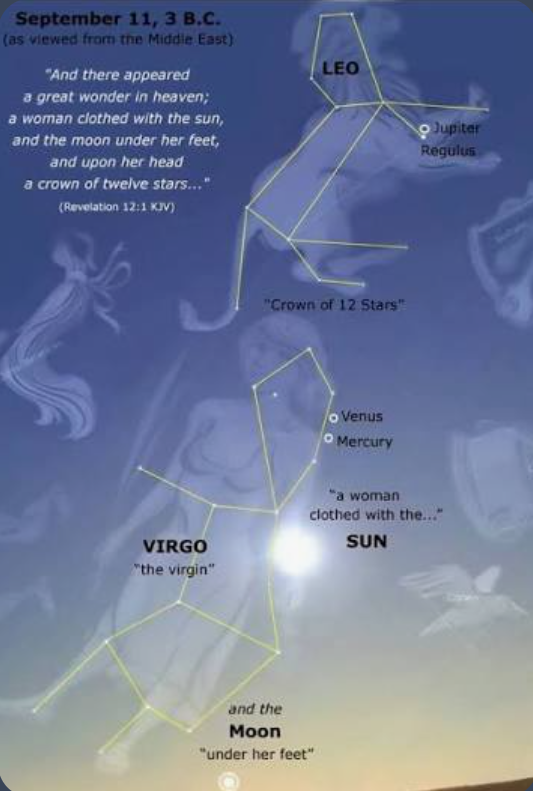
The first word that deserves our attention is “sign” (sēmeion).
John does not merely say that he saw a woman in heaven. He says he saw a great sign in heaven. That matters because sēmeion ordinarily carries the idea of something that signifies, points beyond itself, or communicates something meaningful.
And Matthew 2 gives us a remarkably useful precedent. The Magi see something in the heavens and understand it as a sign concerning a king: “We saw his star when it rose and have come to worship him.”
Matthew doesn't portray the star as meaningless scenery. The celestial phenomenon means something to people capable of interpreting it. That makes Revelation 12:1 worth slowing down over.
John is effectively saying: Pay attention. What I am showing you is a heavenly sign.
2. John's “signs” are not merely miracles-they are revelations
John consistently prefers σημεῖον (sēmeion, plural sēmeia) for Jesus' miraculous works. But the important point is what a sign does: it points beyond itself to something that must be recognized.
John's first sign is the water becoming wine:
John 2:11 - “This, the first of His signs, Jesus did at Cana in Galilee, and manifested His glory.”
The miracle is not the final point. The sign points to Jesus' glory. John then explicitly says that the purpose of the written signs is:
John 20:31 - “that you may believe that Jesus is the Christ, the Son of God.”
So John's pattern is essentially: observable phenomenon → recognition → interpretation → revelation about Jesus → faith. That is important for Revelation 12 because John says:
Revelation 12:1 - “A great sign (sēmeion) appeared in heaven...”
The same author who repeatedly uses sēmeion for observable phenomena that signify something beyond themselves deliberately uses the word here for a celestial phenomenon.
That doesn't mean everything in Revelation 12 is a literal astronomical object. The woman is obviously simultaneously symbolic. But John's terminology should make us reluctant to say, “It's only symbolic, so there is nothing to investigate in the actual heavens.”
The category of sēmeion actually allows for both.
3. John himself uses sēmeion for celestial phenomena
There is a fascinating detail in the vocabulary. In Revelation 12:1, John says: sēmeion mega - “a great sign.” And sēmeion had a broader ancient semantic range than simply “miracle.”
It could denote a sign, indication, omen, portent, and in ancient astronomical contexts could even refer to celestial signs/constellations.
Heiser specifically highlights this point, noting the ancient use of sēmeion for zodiacal constellations and astronomical signs. That is significant because John says: “A great sign appeared in heaven.”
Then he immediately describes a configuration involving:
- the sun,
- the moon,
- twelve stars,
- a woman,
- pregnancy,
- and birth.
In other words, the vocabulary and the imagery belong naturally to the world of celestial observation.
Heiser's basic proposal was that Revelation 12:1–7 reflects celestial circumstances associated with Jesus' birth, and that John is communicating those circumstances through the symbolic language of Revelation.
He proposed September 11, 3 BC as the date that best fits the celestial configuration he was investigating, while stressing that this is a scholarly reconstruction rather than a prophetic date code.
Could John's ‘great sign in heaven’ preserve a genuine celestial configuration associated with the historical birth of Jesus, which John then interprets through biblical imagery?
4. And here is where the Magi become enormously relevant
Think back to Matthew 2. The Magi read the heavens. They saw something they understood as significant. Their astronomical observation apparently communicated royal significance. And notice how Matthew structures the information:
- Celestial observation
- interpretation: a Jewish king has been born
- journey to Jerusalem
- Scriptural interpretation: Bethlehem
- encounter with the child
The heavens provided a sign, but Scripture provided the interpretive framework. That is almost exactly the kind of conceptual world Heiser is asking us to consider in Revelation 12.
5. What were the stars “saying”?
The ancient world did not necessarily think of the stars as random balls of nuclear plasma. They understood the heavens as a communicative realm.
Genesis 1:14 - God said, “Let there be lights in the vault of the sky to separate the day from the night, and let them serve as signs to mark sacred times, and days and years.”
So the biblical worldview already contains the category of God communicating through the heavens.
Psalm 19:1 - “The heavens declare the glory of God.”
And Psalm 19:4, interestingly, speaks of their “line” going out through all the earth—a text with an astronomical dimension that Heiser discusses in connection with the ecliptic/path of the heavens.
Deuteronomy 18 condemns divination precisely because it seeks forbidden access to knowledge or power. But Genesis 1, Psalm 19, and Revelation can still portray the heavens as meaningful signs within God's providence.
And Matthew 2 gives us an actual narrative example of Gentile observers doing precisely that.
6. The twelve stars may be doing double duty
Heiser's discussion becomes especially useful here. The twelve stars of Revelation 12 are obviously connected with Israel's twelve tribes. That's strongly supported by the Genesis 37 imagery: sun + moon + stars → Jacob/Israel and his family.
But Heiser points out another ancient layer: the twelve constellations of the zodiac could themselves be associated with the twelve tribes of Israel in later Jewish tradition.
He also notes that Jewish and Greco-Roman discussions of Israel's priestly vestments could associate the heavenly bodies with Israel's twelve tribes. So John may be communicating simultaneously on multiple levels:
- Celestial level: a configuration involving the zodiac/heavens.
- Biblical-symbolic level: Israel represented through sun, moon, and twelve stars.
- Priestly level: Israel's heavenly vocation/identity.
- Messianic level: Israel gives birth to the ruler who will shepherd the nations.
This is exactly the kind of layered symbolism Revelation loves. Which leads to the question: “What astronomical reality is John symbolically interpreting?”
7. John's Gospel gives us an additional clue about how “signs” work
There is something subtle about John's Gospel that is especially relevant. The people see Jesus' sēmeia, but seeing isn't the same as understanding.
John 6:26 - “You are seeking Me, not because you saw signs, but because you ate your fill of the loaves.”
John 12:37 - “Though He had done so many signs before them, they still did not believe in Him.”
The sign itself does not automatically produce faith, it demands interpretation. That's exactly what happens with the Magi. They see. They interpret. They act. And then they worship.
Meanwhile, Jerusalem possesses the Scriptures but does not make the journey. That gives us an extraordinary contrast:
The heavens speak.
The Magi listen.
Scripture clarifies.
The Magi act.
The Magi worship.
8. And Revelation 12 may be doing the same thing at a cosmic scale
John sees something. He calls it a sēmeion. Then he interprets it for us. The woman is in labor. The dragon waits. The child is born. The child is the one destined: “to rule all the nations with a rod of iron.”
That takes us directly to Psalm 2. So John's celestial observation is not the final revelation, it is the sign. The sign points toward: Israel → Messiah → nations → conflict → enthronement.
And that is precisely how John's sēmeia function elsewhere. The water becoming wine isn't merely about wine. The loaves aren't merely about bread. Lazarus isn't merely about resuscitation.
The signs reveal who Jesus is.
Likewise, the celestial configuration of Revelation 12 isn't merely about stars. It reveals something about who the child is.
9. This also explains why Revelation 12 is so precise
Look at the amount of information John gives us:
woman
clothed with the sun
moon under her feet
crown of twelve stars
pregnant
crying out in labor
dragon
seven heads
ten horns
tail sweeping stars
child born
male
destined to rule nations
rod of iron
child caught up to God and His throne
That's not casual poetry, it's high-density apocalyptic communication.
And once we recognize that John calls the celestial portion a sēmeion, we have good reason to ask whether some of those details correspond to an actual celestial arrangement that John's audience could have recognized.
10. The most exciting possibility: the Magi and John may be looking at the same kind of heavenly language
I think this is the synthesis worth exploring:
- Matthew 2 tells us that eastern sages could recognize a celestial configuration as announcing the birth of a Jewish king.
- John 12 tells us that Jesus' signs reveal His identity and glory.
- Revelation 12 calls its celestial imagery a “great sign in heaven.”
- Genesis 1 says the heavenly lights are for signs.
- Genesis 37 supplies the sun/moon/stars imagery for Israel.
- Numbers 24 connects a star with a ruler arising from Jacob.
- Psalm 2 identifies that ruler as the one who will rule the nations.
And Revelation brings all of those threads together:
Israel is represented in the heavens.
Israel gives birth to the Messiah.
The Messiah is the ruler of the nations.
The dragon attempts to destroy Him.
God preserves Him and enthrones Him.
That makes the possibility of an actual astronomical configuration far more theologically interesting than the modern “what day was Jesus born?” debate. The point isn't ultimately the date.
The point is that God may have written a sign in the heavens that corresponded to the birth of His Son—and John may be showing us, retrospectively, what that sign meant.
And that fits the Johannine concept of sēmeion beautifully.
A sign is something visible that points beyond itself to an invisible reality. The stars don't become the revelation, they point to the King. And that may be exactly why the Magi saw something in the heavens and went looking for Him.
Then Revelation becomes extraordinarily specific about the child
Revelation 12:2 - “The woman was pregnant and was crying out in birth pains and the agony of giving birth.”
Then the dragon appears. And the dragon waits:
Revelation 12:4 - “before the woman who was about to give birth, so that when she bore her child he might devour it.”
Revelation 12:5 - “She gave birth to a male child, one who is to rule all the nations with a rod of iron.”
That last phrase removes much of the ambiguity. John is drawing directly on Psalm 2 (LXX). Psalm 2 describes YHWH's anointed king: “You shall break them with a rod of iron.” And the nations are explicitly involved: “Ask of Me, and I will make the nations your heritage.”
So Revelation 12 isn't merely saying: “A child is born.” It is saying: The messianic King prophesied in Psalm 2 has been born. And the dragon wants to destroy Him. That sounds remarkably like Matthew 2.
Matthew 2 beside Revelation 12
The correspondence becomes fascinating:
| Matthew 2 | Revelation 12 |
|---|---|
| Celestial sign | Great sign in heaven |
| Star | Sun, moon, stars |
| Magi recognize significance | John is shown the significance |
| Jewish king is born | Messianic ruler is born |
| Herod wants the child destroyed | Dragon wants the child devoured |
| Child escapes Herod | Child is caught up to God |
| Gentiles recognize the King | The nations are the King's inheritance |
| Jerusalem is threatened by the birth | Dragon's kingdom is threatened by the birth |
And there is an especially striking difference.
Matthew gives us the historical surface. Herod hears about a newborn king and tries to kill Him. Revelation pulls back the curtain. Behind Herod stands the dragon, who wanted the Messiah dead.
Behind the earthly conflict is a cosmic conflict concerning the arrival of the Messianic King. Those aren't competing explanations. Revelation gives the heavenly dimension of the earthly event Matthew records.
And Revelation gives us something Matthew doesn't: the cosmic timestamp
- Matthew gives us the earthly event: Magi → star → Jerusalem → Scripture → Bethlehem → child.
- Revelation gives us the cosmic interpretation: Israel → Messiah → dragon → nations → enthronement.
Notice what happens to the child in Revelation 12:5: “her child was caught up to God and to his throne.” John compresses the Messiah's entire earthly mission into the vision: Birth → threat → ascension.
He isn't trying to give us a second infancy narrative, he's giving us a cosmic synopsis of the Messiah's victory. And that makes the celestial sign even more significant.
There is another fascinating connection: Balaam
Numbers 24:17 - “A star shall come out of Jacob, and a scepter shall rise out of Israel.”
That prophecy comes from Balaam, a Gentile eastern seer. Then Matthew gives us eastern magoi who see a star associated with the birth of Israel's king. And Revelation gives us a heavenly sign surrounding the birth of the child who will rule the nations. We therefore have an intriguing biblical constellation of ideas:
- Numbers 24 - Star → Jacob → scepter → ruler
- Matthew 2 - Star → Jewish king → Gentile Magi → worship
- Psalm 2 - God's Anointed → nations → rod of iron
- Revelation 12 - Heavenly sign → woman/Israel → male child → nations → rod of iron
That is not enough to establish a particular astronomical event. But it is enough to demonstrate that “star + Israel + king + nations” is an established biblical conceptual vocabulary.
There may be an intentional Matthew–Revelation bookend
- Matthew begins the New Testament with Gentiles looking for the Jewish Messiah, “We saw his star...”
- Revelation ends with the nations walking by the light of the Lamb (Rev. 21:24).
That is a breathtaking trajectory.
At the beginning, Gentiles are able to recognize the arrival of the King through a light in the heavens. At the end, the redeemed nations no longer need celestial signs pointing toward the King, the King Himself is their light.
Matthew 2 teaches us that celestial signs could function as meaningful royal announcements within the ancient world. Revelation 12 explicitly calls its celestial imagery a “great sign.”
And the sign is extraordinarily precise about what it signifies:
Israel's long-awaited Messiah has entered the world; the dragon recognizes the threat; the child is destined to rule the nations; and the apparent vulnerability of His birth is actually the opening movement of His enthronement and victory.
In that sense, Revelation 12 isn't merely telling us that Jesus was born, it is showing us what His birth meant in heaven.
III. A Three-Stage Biblical-Theological Chain
What does Paul mean when he says that people have “heard” because the heavens’ “voice” has gone out to the ends of the earth?
Dr. Michael Heiser argues that Paul’s use of Psalm 19 should be taken seriously as evidence for an ancient Israelite concept of celestial communication—and that Revelation 12 gives us an example of what such celestial communication concerning Jesus’ birth could look like.
1. Psalm 19: The heavens are communicating
Psalm 19:1–4 is unusually emphatic about the communicative activity of the heavens:
Psalm 19:1–2 - “The heavens declare the glory of God, and the sky above proclaims His handiwork. Day to day pours out speech, and night to night reveals knowledge.”
Then David says that their “voice” goes throughout the earth and their “words” to the ends of the inhabited world.
The important point for Heiser is that this isn't merely saying, “Look at a beautiful sunset and realize God exists.” The psalm repeatedly employs vocabulary of communication—declare, proclaim, speech, knowledge, voice, words.
The heavens are portrayed as communicating something that can be universally encountered. Heiser therefore places Psalm 19 within the ancient concept of astral theology: God created the celestial realm and could use the celestial realm as a medium of communication.
2. Romans 10:14–18: Why does Paul quote Psalm 19 here?
Paul's argument is initially about hearing the Gospel:
call upon Him → believe → hear → preacher → sent
Romans 10:14 - “How are they to hear without someone preaching?”
Romans 10:17 - “So faith comes from hearing, and hearing through the word of Christ.”
At that point we expect Paul to say, essentially, “Exactly—and that is why the apostles have been sent.” Instead he asks, “But I ask, have they not heard? Indeed they have…”
Psalm 19:3-4 - [The heavens] have no speech, they use no words; no sound is heard from them. Yet their voice goes out into all the earth, their words to the ends of the world.
This is the interpretive crux. The conventional reading understands Paul to be making an analogy: just as the heavens universally proclaim God's glory, so the apostolic proclamation of the Gospel has spread throughout the world.
Paul is borrowing Psalm 19's universal language to describe the worldwide dissemination of the Gospel. That remains a very defensible reading. Heiser, however, presses the quotation further.
He asks: If Paul is merely making a loose analogy, why does he choose this text—one in which the heavens themselves possess a voice and words that reach the entire earth?
And more importantly, Paul has just said that people need to hear about Christ. He then says, “Indeed they have,” and invokes a passage describing a universal heavenly communication.
For Heiser, that suggests Paul knows of a heavenly testimony concerning Christ's coming that preceded or accompanied the human proclamation of the Gospel.
He explicitly identifies the “voice” in Psalm 19 with the heavens and then asks whether we find an example elsewhere in the New Testament of the heavens communicating something about Jesus. His answer is Revelation 12.
3. Revelation 12:1–5 - an actual “sign in heaven”
Revelation 12 begins:
“A great sign appeared in heaven: a woman clothed with the sun, with the moon under her feet, and on her head a crown of twelve stars.”
“She was pregnant…”
And the child she bears is explicitly identified by His destiny:
“one who is to rule all the nations with a rod of iron.”
That is obviously messianic language, drawing from Psalm 2. Notice the unusual construction: “a great sign appeared in heaven.” John doesn't just say that he saw a woman in a vision. He specifically locates the sign in heaven and describes it using sun, moon, and stars.
That is precisely what Heiser thinks we should expect if the heavens can function as God's communicative medium. Revelation 12, in his reading, is therefore not merely a symbolic theological story about Jesus' birth.
It contains an astronomical configuration that corresponds to the symbolic language John is using. And this is where the three passages converge.
4. The remarkable progression
Heiser's proposal can be represented like this:
PSALM 19
The heavens declare →
the heavens speak →
the heavens possess a voice →
their words reach the whole earth
⬇️
ROMANS 10
Paul asks whether people have heard →
answers, “Indeed they have” →
quotes Psalm 19:4 →
the heavenly voice/words have gone throughout the world
⬇️
REVELATION 12
John sees a great sign in heaven →
sun + moon + stars →
a woman is pregnant →
she gives birth to the Messianic child →
the child will rule the nations
If Psalm 19 establishes that the heavens can communicate, and Paul invokes that heavenly communication when discussing whether humanity has “heard” about Christ, where is that heavenly communication concerning Christ actually depicted?
Revelation 12:1–5 - A great sign appeared in heaven: a woman clothed with the sun, with the moon under her feet and a crown of twelve stars on her head. She was pregnant and cried out in pain as she was about to give birth.
Then another sign appeared in heaven: an enormous red dragon with seven heads and ten horns and seven crowns on its heads. Its tail swept a third of the stars out of the sky and flung them to the earth.
The dragon stood in front of the woman who was about to give birth, so that it might devour her child the moment he was born. She gave birth to a son, a male child, who “will rule all the nations with an iron scepter.” And her child was snatched up to God and to his throne.
5. Revelation 12 isn't merely “stars = Israel”
Jacob's dream in Genesis 37 gives us: sun + moon + eleven stars + Joseph as the twelfth. The imagery represents the covenant family of Israel. John is invoking an established biblical symbolic vocabulary.
There is no need to abandon the symbolic interpretation of Revelation 12 in order to consider an astronomical layer. The woman can simultaneously signify Israel while corresponding to an actual constellation.
The configuration corresponds to an actual moment in the ancient sky. Leo has 12 stars in it and is easily identifiable as the Lion of Judah to someone in the ancient near east.
The celestial configuration could be doing two jobs simultaneously:
- symbolic identity: Israel → twelve tribes → Messiah
- celestial identification: sun → moon → stars → identifiable astronomical arrangement
That is the heart of the “astral prophecy” concept.
The woman is clothed with the sun.
The moon is beneath her feet.
She has twelve stars around her head.
She is pregnant.
She gives birth to the Messiah.
Heiser identifies the woman primarily with Israel, rather than reducing her simply to Mary. The twelve-star imagery naturally evokes Israel's twelve tribes, especially in light of Genesis 37. Yet he argues that the imagery can also describe a real celestial configuration.
That produces an important interpretive principle: The astronomical layer does not eliminate the theological-symbolic layer. Rather, the heavenly configuration becomes a kind of celestial canvas upon which Israel's story and the Messiah's birth are being announced.
6. And this explains why the Magi matter
The Magi see something in the heavens that they interpret as announcing the birth of a king of the Jews. Their conclusion leads them hundreds of miles westward:
“We saw His star when it rose and have come to worship Him.”
Matthew therefore gives us a narrative example of what Heiser's proposed celestial communication would look like in practice: heavenly phenomenon → interpretation → identification of a king → geographical investigation → worship
And notice the fascinating distinction: The heavens give the Magi the royal announcement, but the Scriptures give them Bethlehem.
When Herod asks where the Messiah is to be born, the answer comes from Micah 5:2. So Matthew 2 potentially gives us the same kind of two-witness structure: celestial sign + Scripture
The heavens announce something; Scripture interprets and locates it. That makes the Magi particularly interesting when placed alongside Psalm 19, Romans 10, and Revelation 12.
7. Heiser's concept is not simply “astrology”
This distinction is important. Heiser's terminology is astral theology/astral prophecy, rather than simply saying that the Bible endorses astrology.
The ancient distinction is between: reading the heavens as God's creation and possible communication versus treating celestial beings as independent gods, manipulating supernatural powers, or practicing divination.
Heiser argues that ancient Jews could believe that the true God had created the celestial realm and could communicate through it while simultaneously rejecting pagan polytheism.
He points to the biblical language of Genesis 1:14—celestial objects are appointed for “signs and seasons”—as part of the conceptual background. He also points to evidence such as ancient Jewish synagogue zodiac imagery as evidence that celestial symbolism was not automatically regarded as pagan by Jews.
8. The deeper connection: God speaks through creation, Scripture, and incarnation
There is a beautiful theological progression here even apart from whether one accepts every element of Heiser's astronomical reconstruction.
Psalm 19: God's creation speaks.
Romans 10: God's Gospel is proclaimed.
Revelation 12: God's Messiah appears within the heavenly sign-language.
And then the ultimate Christian claim is that the One being announced by all of this does not remain merely a message written in the heavens, the Word becomes flesh. That makes John 1:1–14 a particularly powerful theological backdrop:
The One whom creation declares,
the One whom Scripture announces,
the One whom the heavens may signify,
comes down into His creation and becomes visible.
And that gives Romans 10 an especially profound trajectory: How can they call? → believe → hear → proclamation → Christ → salvation. The heavens themselves had already been declaring that something was happening.
The celestial announcement ultimately gives way to the apostolic announcement: the sign points → the Scriptures identify → the apostles proclaim → people believe → people call upon the Name of the Lord.
That is a much richer picture than “Paul randomly quoted Psalm 19.”
It proposes a biblical theology in which God's created heavens can serve as a universal witness, while the Gospel supplies the explicit saving interpretation of what God has done in Christ.
Conclusion
Taken together, Psalm 19, Romans 10, Revelation 12, and Matthew 2 invite us to consider a remarkably expansive picture of divine communication. The heavens declare; the Scriptures interpret; the sign identifies; the Gospel proclaims; and the Messiah Himself is the One to whom all of it points.
Dr. Michael Heiser's reading of Revelation 12 as an astronomical and theological sign gives particular weight to Paul's otherwise striking quotation of Psalm 19 in Romans 10:18, suggesting that the language of the heavens having a “voice” may deserve more attention than it ordinarily receives.
Whether one accepts every element of that proposal or not, the passages together leave us with a profound biblical theme: God is not silent. His creation bears witness, His Word gives understanding, and His Son stands at the center of the testimony.
![👑🌎🤲❤️⚖️✨ Entrusted by the King: Ezekiel 44, Matthew 25 and the Theology of Faithful Stewardship [3 parts]](https://storage.ghost.io/c/ab/d8/abd818ed-d1c7-4d9a-800d-8de8bae8d50c/content/images/size/w600/2026/09/Screenshot-2026-09-12-9.43.40-AM.png)
![⚡🎭⏳✨ Jannes and Jambres: The Egyptian Magicians and the Limits of Imitation [3 parts]](https://storage.ghost.io/c/ab/d8/abd818ed-d1c7-4d9a-800d-8de8bae8d50c/content/images/size/w600/2026/09/Screenshot-2026-09-10-5.48.27-PM.png)
![🏗️ 🏷️🪞❤️👑✨The Great Inversion: When the Creature Replaces the Creator [3 parts]](https://storage.ghost.io/c/ab/d8/abd818ed-d1c7-4d9a-800d-8de8bae8d50c/content/images/size/w600/2026/09/Screenshot-2026-09-09-4.57.18-PM.png)