⚡📖✨ A Book of Remembrance: Why God’s Memory Always Leads to Action [3 parts]
Introduction 📜
One of the most misunderstood words in Scripture is “remember.”
In modern thought, remembrance is usually reduced to mental recollection—as though God occasionally pauses to think about someone He nearly overlooked. But the biblical idea is far deeper and far more powerful.
Throughout Scripture, when God remembers, events begin to move. Waters recede. Wombs open. Captives are delivered. Covenants advance. Divine remembrance is not passive awareness; it is covenant action.
This gives profound meaning to passages like:
- “God remembered Rachel…”
- “God remembered Noah…”
- “Remember me, O my God, for good.”
- “A book of remembrance was written before Him.”
The Hebrew concept of remembrance reveals a God who does not merely store information about His people, but who actively turns toward them in faithfulness, mercy, judgment, deliverance, and fulfillment of promise.
To be remembered by God is to become the object of His covenant attention. And because of this, biblical remembrance is consistently tied to hope, vindication, restoration, and reward.
✨ This theme ultimately reaches its fullness in Jesus Christ, through whom God’s covenant remembrance becomes incarnate redemption itself. ✨
I. “Remember Me, O My God, for Good”
The closing words of Nehemiah and the refining promises of Malachi stand remarkably close together both canonically and thematically. They read almost like two sides of the same covenantal tension: one is the exhausted prayer of a reformer trying to preserve holiness in a polluted community; the other is God’s assurance that He still recognizes and treasures those who fear Him.
Nehemiah 13:31 - “Remember me, O my God, for good.”
This final verse may seem administrative at first glance—wood offerings, firstfruits, temple order—but in context it is deeply priestly and covenantal. Throughout chapter 13, Nehemiah is battling profanation:
- Tobiah occupying temple chambers (13:4–9)
- Levites neglected (13:10–14)
- Sabbath violations (13:15–22)
- Mixed marriages threatening covenant identity (13:23–30)
The phrase “I purified” (13:30) is temple language. Nehemiah acts almost like a guardian priest restoring sacred boundaries after contamination.
His final prayer, “Remember me,” echoes earlier covenant prayers:
- “Remember me for this” (13:14)
- “Remember this also in my favor” (13:22)
This is not narcissistic self-preservation. It is covenant appeal language. Nehemiah is effectively saying:
“Lord, I have labored to preserve Your house, Your worship, Your people, and Your holiness. Do not let that labor be forgotten.”
That connects profoundly with Malachi.
God’s Book of Remembrance 📖
Malachi 3:16-17 - “Then those who feared the LORD spoke with one another. The LORD paid attention and heard them, and a book of remembrance was written before Him of those who feared the LORD and esteemed His Name.
‘They shall be Mine,’ says the LORD of hosts, ‘in the day when I make up My treasured possession…’”
Malachi ministers in a spiritually exhausted post-exilic environment very similar to Nehemiah’s world.
The people ask cynical questions:
- “Where is the God of justice?” (2:17)
- “What is the profit of serving God?” (3:14)
That question is the emotional backdrop to Nehemiah’s repeated “remember me.”
Nehemiah appears to embody the very kind of person Malachi describes: one who fears the LORD, esteems His Name, labors for proper worship, and preserves covenant faithfulness despite widespread compromise.
While many treated temple service as weariness (Malachi 1:13), Nehemiah fought to restore it.
The “Book of Remembrance” and Covenant Memory
The connection becomes even stronger through the biblical theology of remembrance. In Scripture, remembrance is covenantal, not informational.
God does not “remember” because He forgot. To remember means: to act faithfully, to uphold covenant promises, and to vindicate loyalty.
This appears throughout Torah:
- God “remembered” Noah.
- God “remembered” Abraham.
- God “remembered” His covenant in Egypt.
Thus when Nehemiah says, “remember me, O my God…” he is asking for covenant vindication. And Malachi answers: “A book of remembrance was written before Him.” That is extraordinary literary resonance.
Nehemiah fears his labor may vanish amid Israel’s corruption. Malachi assures the faithful that heaven keeps records.
Temple Stewardship and Sonship
Malachi 3:17 adds another layer: “as a man spares his son who serves him.” This directly parallels the servant-son theme woven throughout Nehemiah 13.
Nehemiah restores: offerings, priestly order, temple maintenance, and covenant fidelity. These are the duties of faithful household servants in God’s house.
The Hebrew Bible repeatedly frames Israel as God’s son (Exodus 4:22), and priests/Levites as servants within His household. Nehemiah acts like a faithful son defending his Father’s house from desecration.
This anticipates later biblical themes: Jesus cleansing the temple, zeal for God’s house consuming Him, and faithful servants being remembered by the Father.
The contrast is stark:
| Faithless Israel | Faithful Remnant |
|---|---|
| Neglect the temple | Preserve the temple |
| Ask “What profit is there?” | Fear the LORD anyway |
| Profane worship | Purify worship |
| Forget God’s covenant | God remembers them |
Fire, Refinement, and Preservation 🔥
Malachi 3 is famous for its refining-fire imagery:
“He is like a refiner’s fire…”
Nehemiah 13 shows what that refinement looks like in practice. Purification is not abstract spirituality. It involves painful confrontation: throwing Tobiah out, rebuking nobles, shutting gates, and contending with compromise.
✨ Refinement often feels disruptive because impurity resists removal. ✨
In this sense, Nehemiah becomes an instrument of covenant refinement before Malachi explicitly prophesies it.
The Tragic and Hopeful Ending of the Old Testament
Together, these passages create a powerful ending movement to the Old Testament narrative.
Nehemiah ends unresolved, exile technically ended but hearts remain unstable, temple restored but corruption persists. Malachi confirms the same condition: religious activity exists but many hearts are cynical.
Yet amid widespread failure, God notices a remnant.
Not kings.
Not empires.
Not the loud majority.
But, “those who feared the LORD spoke with one another.”
That small sentence carries enormous hope. The final note before the long silence preceding the coming of Jesus Christ is this:
✨ God remembers faithful people whose labor seems invisible. ✨
Nehemiah’s final plea, “remember me…” finds its answer in Malachi: “a book of remembrance was written before Him.” 📜
II. Nehemiah and the Burden of Apparently Unrewarded Faithfulness
By the end of Nehemiah 13, the reformer appears weary. He has rebuilt walls, restored worship, confronted corruption, purified temple service, defended Sabbath holiness, and contended against covenant compromise.
Yet the people repeatedly relapse.
From a human perspective, Nehemiah’s labor could seem almost futile. That is precisely the spiritual atmosphere reflected later in Malachi, “It is vain to serve God” (Malachi 3:14).
That sentence is one of the great temptations of covenant life:
- “Does obedience matter?”
- “Does God actually see?”
- “Is holiness worth the cost?”
- “Will faithfulness be remembered?”
Hebrews answers with a resounding yes.
Faith Requires Believing God Rewards Seekers
Hebrews 11:6 does not merely say God exists. Even the nations believed gods existed.
The distinguishing feature of biblical faith is believing:
- God is truly there,
- and He is morally responsive to those who seek Him.
That second part is crucial.
The faithful in Malachi 3 continue fearing the LORD despite societal cynicism because they trust that God notices hidden loyalty.
Nehemiah continues reforming despite exhaustion because he believes remembrance matters.
✨ Without belief in divine remembrance, perseverance collapses into despair. ✨
“Book of Remembrance” as Reward Language
Malachi’s “book of remembrance” is essentially covenant reward imagery.
“They shall be Mine… My treasured possession.”
✨ The reward is not merely material blessing. The ultimate reward is belonging to God Himself. ✨
This aligns deeply with Hebrews:
- Abraham sought a city whose builder was God.
- Moses considered reproach for God greater wealth than Egypt.
- The faithful looked for a better country.
Hebrews 11:16 - They were longing for a better country—a heavenly one. Therefore God is not ashamed to be called their God, for He has prepared a city for them.
Their confidence rested in the conviction that God does not overlook covenant loyalty. This is said explicitly:
Hebrews 6:10 - “For God is not unjust so as to overlook your work and the love that you have shown for His Name…”
That sounds astonishingly close to Nehemiah’s prayer, “remember me…”
The writer of Hebrews essentially says, “He will.”
Seeking God Despite Delayed Vindication ⏳
One of the hardest spiritual realities in Scripture is that divine reward is often delayed.
Nehemiah does not see complete national transformation.
Malachi’s faithful remnant still lives amid corruption.
The prophets often die without seeing fulfillment.
Yet...
✨ Scripture repeatedly insists: waiting does not equal abandonment. ✨
This becomes a major biblical pattern:
- Noah builds before rain comes.
- Abraham journeys before inheritance appears.
- Hannah prays before Samuel is born.
- The prophets speak before restoration arrives.
- Jesus endures the cross “for the joy set before Him.”
✨ Faith is sustained by confidence in God’s character during the delay between obedience and vindication. ✨
The Fear of the LORD and Mutual Encouragement
Malachi 3:16 contains an often-overlooked detail:
“Those who feared the LORD spoke with one another.”
That resembles Hebrews as well:
- “Encourage one another daily.”
- “Do not neglect meeting together.”
- “Strengthen weary hands.”
Why? Because cynicism is contagious. When society says, “serving God is pointless,” the faithful must remind one another, “God sees. God remembers. God rewards.”
Nehemiah stands almost alone in his reforms, yet Malachi reveals there was still a remnant quietly speaking together in reverence.
✨ The Kingdom often advances through small communities of persevering faithfulness rather than visible dominance. ✨
Christ as the Ultimate Example
All these themes culminate in Jesus Christ.
Jesus embodies perfect trust that the Father remembers and rewards faithfulness. He cleansed the temple like Nehemiah, endured rejection like the prophets, entrusted Himself to the Father’s justice, sought the Father continually, and obeyed even unto death.
And Hebrews presents Him as the model of persevering faith.
✨ The resurrection becomes the ultimate proof that God rewards those who earnestly seek Him.✨
Not always immediately.
Not always materially.
Not always publicly.
But truly, fully, eternally.
A Unified Thread Through the Passages 🧵
Together these passages form a coherent spiritual progression:
| Passage | Central Concern |
|---|---|
| Nehemiah 13:31 | “Lord, remember my faithfulness.” |
| Malachi 3:16–17 | “God records and treasures the faithful.” |
| Hebrews 11:6 | “Faith believes God rewards seekers.” |
The message running through all three is this:
✨ Faithfulness may appear unnoticed on earth, but heaven keeps accurate records. ✨
III. The Hebrew Idea of Remembering - Zakar 📜
In Scripture, “remembering” is almost never passive recollection. 🧠➡️⚡
Biblical remembrance is active, covenantal, and transformative. When God “remembers,” something happens:
- barren wombs open,
- storms cease,
- covenants move into action,
- captives are delivered,
- judgment relents,
- promises advance.
This is essential for understanding passages like:
- Nehemiah 13:31 — “Remember me, O my God, for good.”
- Malachi 3:16 — “a book of remembrance”
- Hebrews 11:6 — God rewards those who seek Him.
The biblical idea is not, “God mentally recalls information,” its “God moves covenantally toward someone.”
The primary Hebrew verb is (zakar). It often carries the sense of:
- calling to mind with intent to act,
- bringing covenant commitments into operation,
- turning divine attention toward fulfillment.
This is why “remembering” and “visiting” are often connected in Scripture.
✨ God’s remembrance initiates movement. ✨
“God Remembered Rachel…” - and Opened the Womb 🌱
Genesis 30:22 - “Then God remembered Rachel, and God listened to her and opened her womb.”
Notice the sequence:
| Action | Result |
|---|---|
| God remembered | God listened |
| God listened | womb opened |
| womb opened | Joseph born |
The remembering produces intervention.
Rachel’s condition changes because remembrance is not sentimental awareness—it is covenant action.
This pattern appears repeatedly.
“God Remembered Noah…” - and the Waters Receded 🌊
Genesis 8:1 - “But God remembered Noah…”
Immediately: wind blows, waters subside, ark rests, and new creation begins. Again, remembrance initiates transition from chaos to restoration. The flood narrative intentionally echoes Genesis 1 with its waters, wind/spirit, and emerging dry land.
God’s remembrance marks the turning point between judgment and renewal.
“God Remembered Abraham…” - and Lot Was Delivered 🔥
Genesis 19:29 - “God remembered Abraham and sent Lot out…”
The action attached to remembrance: rescue from destruction.
Abraham’s covenant relationship becomes the basis for merciful intervention.
“God Remembered His Covenant…” - and Israel Was Redeemed ⛓️
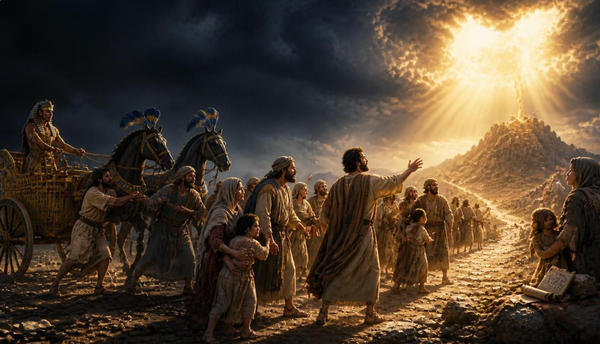
Exodus 2:24 - “God heard their groaning, and God remembered His covenant with Abraham, Isaac, and Jacob.”
Then comes:
- Moses’ calling,
- plagues,
- Passover,
- Exodus,
- Sinai.
The remembrance activates redemptive history.
Importantly: God did not forget the covenant intellectually for 400 years. Rather, the appointed moment arrived for covenant fulfillment to move visibly into history.
Remembering Produces Movement Toward the Person
A striking biblical pattern emerges:
| God remembered… | Then… |
|---|---|
| Noah | waters receded |
| Abraham | Lot delivered |
| Rachel | womb opened |
| Hannah (implied theme) | son granted |
| Israel | redemption began |
| Covenant | promises advanced |
Biblical remembrance is dynamic.
When God remembers: barren things become fruitful, imprisoned things become liberated, judged things become restored, and delayed promises begin unfolding.
Nehemiah’s “Remember Me” in This Light
Now Nehemiah’s repeated prayer becomes far more profound.
“Remember me, O my God, for good.”
He is not merely asking:
“Please think kindly of me.”
He is asking:
“Act covenantally toward me.”
“Vindicate faithful labor.”
“Move toward me in mercy and reward.”
This aligns perfectly with Malachi 3:
“a book of remembrance was written…”
The remembrance implies future divine action: preservation, sparing, recognition, and inheritance.
The Opposite of Remembrance: Being “Forgotten” 🌑
In Scripture, to be forgotten is terrifying because it implies: abandonment, exclusion from covenant blessing, loss of inheritance, and removal from divine favor.
Thus the psalmists cry:
“Do not forget me!”
This is not anxiety over God’s memory capacity, its fear of divine distance.
Conversely, remembrance means God has turned His face toward someone, His covenant attention rests upon them, and action is coming.
Communion and “Do This in Remembrance of Me”
The New Testament deepens this theology. At the Last Supper, Jesus Christ says:
“Do this in remembrance of Me.”
This is not mere mental recollection either. Biblical remembrance in worship involves: covenant participation, renewed allegiance, active identification, and living response.
✨ Communion becomes enacted remembrance. Likewise, God remembering His people results in enacted salvation. ✨
The Thief on the Cross 🕊️
One of the most powerful examples comes from :
Luke 23:42 - “Jesus, remember me when You come into Your kingdom.”
The thief is not asking, “please keep me in Your thoughts,” He is pleading, “when You reign, act toward me in mercy.”
Jesus’ response confirms the active meaning:
“Today you will be with Me in paradise.”
Remembrance results in entrance into life.
Hebrews and Divine Reward
This brings extraordinary depth to Hebrews 11:6.
To believe God rewards those who seek Him is to believe:
- God sees hidden faithfulness,
- God remembers covenant loyalty,
- God acts at the proper time.
✨ Faith trusts divine remembrance even during apparent silence. That is why the faithful can endure long periods where nothing seems to happen externally. ✨
Because throughout Scripture: when God remembers, history changes.
Conclusion
From Noah emerging into a renewed world, to Rachel holding the son she longed for, to Israel walking free from Egypt, Scripture repeatedly shows that God’s remembrance is never static. When God remembers, He acts. His remembrance carries movement, intervention, deliverance, and fulfillment.
This transforms the prayers of the faithful throughout the Bible. When Nehemiah cries, “remember me, O my God, for good,” he is not asking for sentimental acknowledgment. He is asking for covenant vindication.
When the thief on the cross pleads, “Jesus, remember me,” he is asking to be received into the King’s mercy and kingdom. And when Malachi speaks of a “book of remembrance,” it becomes assurance that no act of reverent faithfulness escapes heaven’s notice.
This is why Hebrews says those who seek God must believe that He rewards those who earnestly seek Him. Faith depends upon trusting that God remembers—not as a distant observer, but as the living covenant Lord who moves toward His people in His appointed time.
The testimony of Scripture is clear: God’s remembrance changes realities. 📖🔥