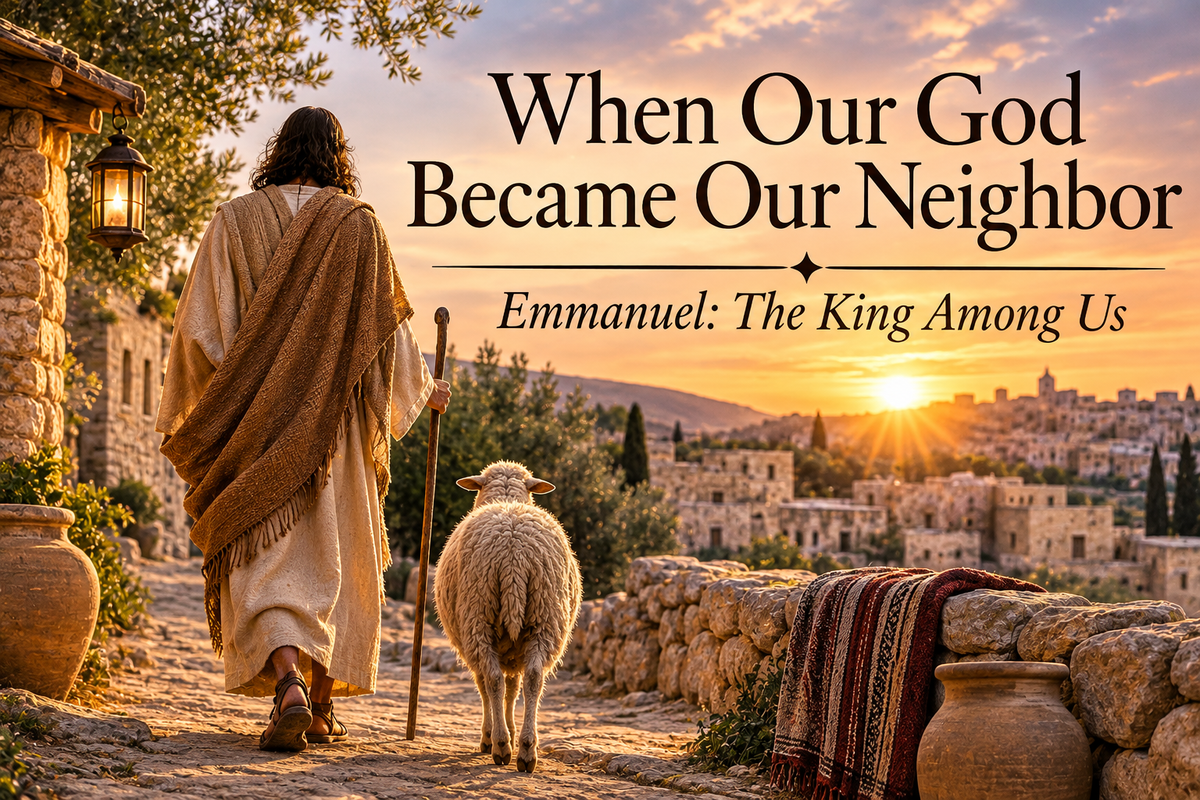
(B) 👑🐑🕊️🌿 🏡🌅 Emannuel: When Our King Became Our Neighbor [3 parts]
Introduction ✨
Fear is often intensified by the uncertainty of what lies ahead, the inability to see clearly through present circumstances, and the realization that some things are beyond our ability to control.
When the path becomes difficult, our attention can become consumed by the dangers surrounding us, causing us to lose sight of the One who is leading us.
Yet Scripture repeatedly presents an extraordinary alternative to living in fear: the assurance of God's presence, His faithfulness, and His personal involvement in the lives of those who belong to Him.
We know we will encounter valleys, opposition, and circumstances that threaten our sense of security, but where will our confidence rest when we do?
Psalm 23 offers a particularly beautiful expression of this reality, beginning with David's declaration that the LORD is his Shepherd and culminating in his confidence that he will dwell in the house of the LORD forever.
What makes this psalm so powerful is that David does not base his confidence on an absence of danger, but on the presence of the One who guides, provides, restores, protects, and accompanies him.
Even when walking through the deep darkness or shadow of death, David refuses to surrender to fear because he knows who is walking with him. His security is not found in knowing every turn in the path, but in trusting the character and faithfulness of the Shepherd who knows the way.
This understanding of God's nearness also connects with the larger biblical testimony concerning His desire to dwell among His people. Zephaniah declares that the LORD is in their midst and that they need not fear evil, while Jesus announces that the Kingdom of God has drawn near.
John then reveals the extraordinary fulfillment of this nearness as the Word becomes flesh and tabernacles among humanity, ultimately pointing toward Revelation's promise that God Himself will dwell with His people.
The Shepherd of Psalm 23 is therefore not an impersonal force or a distant protector, but the very God who has made His presence known and accessible through His Son.
As we explore these connections, we will consider the relationship between the Shepherd's presence and the absence of fear, the significance of His guidance through dangerous and uncertain territory, and the importance of keeping our attention fixed upon the One leading us rather than becoming consumed by what surrounds us.
We will discover that biblical faith does not require us to deny the reality of the valley, pretend that evil does not exist, or convince ourselves that we are capable of overcoming every danger independently. Rather, it calls us to give greater weight to the presence and character of our Shepherd than to the threats confronting us.
✨ The sheep do not find their security in knowing the valley; they find their security in knowing their Shepherd. ✨
I.✨ The King in Our Midst: The Nearness of God's Presence
Zephaniah 3:15 - "The King of Israel, the LORD, is in your midst; you shall never again fear evil."
- The Hebrew expression translated "in your midst" is beqirbek, incorporating qereb, a word conveying the interior, inward part, middle, or midst of something. It communicates more than the general proximity of two things; it describes a presence within the midst of another, not simply somewhere nearby.
Zephaniah announces that the King of Israel is not watching His people from a remote location, but is present among them. The removal of judgment and the defeat of their enemies accompanies this declaration.
The nearness of the King changes the circumstances of those who belong to Him because His presence means they need not continue living in fear.
Zephaniah 3:17 - "The LORD your God is in your midst, a mighty one who will save; He will rejoice over you with gladness; He will quiet you by His love; He will exult over you with loud singing."
The declaration becomes even more remarkable when we consider that the One occupying the center of their midst is not simply a ruler exercising authority, but a King who delights in His people.
The language moves from His location (qereb) to His disposition toward those among whom He dwells: He saves, rejoices, quiets, and sings.
His nearness is not an expression of reluctant obligation, but of loving commitment and personal delight. The King is not simply close enough to govern His people; He is close enough to rejoice over them.
This also provides an important backdrop for understanding the biblical theme of God's presence. From Eden onward, the story repeatedly confronts humanity with the question of whether God will dwell among His creatures and whether His creatures will welcome His presence.
Zephaniah's declaration anticipates a restoration in which the relationship is no longer characterized by separation and fear, but by the presence of the King in the very midst of His people.
The center of their life is occupied by the One who saves them.
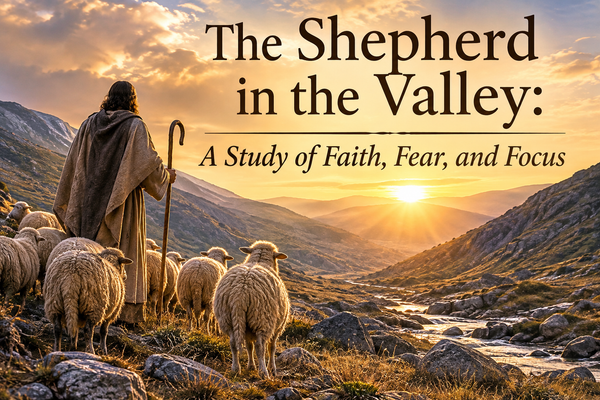
The Shepherd in the Valley: The Security of Being Led by God
One of the most remarkable features of Psalm 23 is that David's confidence is not rooted in the absence of danger, but in the identity of the One leading him through it. The valley is real, the darkness is real, and the possibility of encountering evil is real, yet David declares that he will not fear because the LORD is his Shepherd.
This connects beautifully with Zephaniah's declaration that the LORD is in the midst of His people and that they need not fear because their mighty King is present among them.
The biblical answer to fear is not always the removal of threatening circumstances; sometimes it is the assurance that we are being accompanied, protected, and led by Someone whose presence is greater than anything we might encounter.
Psalm 23:1 - "The LORD is my shepherd; I shall not want."
David begins with the relationship that establishes everything that follows: the LORD is his Shepherd.
- The Hebrew word for shepherd is ro'eh, from ra'ah, meaning to shepherd, tend, pasture, or care for a flock.
This is significant because David does not begin by declaring his own ability to navigate difficult circumstances, but by identifying the One responsible for leading and caring for him. His security is relational before it is circumstantial: he has no reason to live in fear because he belongs to the Shepherd.
For the sake of His Name
Psalm 23:2-3 - "He makes me lie down in green pastures. He leads me beside still waters. He restores my soul. He leads me in paths of righteousness for His Name's sake."
Notice how frequently David identifies the Shepherd as the One doing the leading: He makes, He leads, He restores, and He leads again.
The sheep's responsibility is not to independently discover the safest pasture, locate the best water, or determine the correct path, but to remain responsive to the Shepherd's direction. This is not an invitation to passivity, but to trustful dependence upon the One who knows where the flock needs to go.
✨ The Shepherd's leadership is purposeful: He leads in paths of righteousness for His own Name's sake, making the Shepherd's character the foundation of the sheep's confidence. ✨
Close enough to death as to be in it's shadow
Psalm 23:4 - "Even though I walk through the valley of the shadow of death, I will fear no evil, for You are with me; Your rod and Your staff, they comfort me."
Here David makes a subtle but important transition. In the first three verses, he speaks about God in the third person: He leads me, He restores me, He guides me; but when David enters the valley, he begins speaking directly to God:
✨ "You are with me." ✨
The darkness does not cause the Shepherd to disappear; instead, it becomes the setting in which David experiences the Shepherd's personal presence. The valley is not evidence that the Shepherd has abandoned the sheep, because the Shepherd is the One leading him through it.
The Hebrew expression translated "shadow of death" is tsalmavet, traditionally understood as deep darkness or the shadow of death. It communicates an environment in which visibility is limited, danger may be concealed, and the way forward is difficult to discern.
Yet David's confidence does not depend upon seeing what lies ahead, because he knows the One who is accompanying him. He does not need to know everything about the valley when he knows everything necessary about his Shepherd's faithfulness.
The expression "I will fear no evil" is especially important in light of Zephaniah 3:15 - "The King of Israel, the LORD, is in your midst; you shall never again fear evil." Both passages connect the absence of fear with the presence of God.
In Psalm 23, the Shepherd is with David; in Zephaniah, the King is in the midst of His people. The underlying reality is the same: the presence of God changes the relationship between His people and the threats surrounding them.
Comfort of the rod and staff
There is also a profound connection between the Shepherd's rod and staff. The rod communicates authority, protection, and the ability to defend the flock, while the staff is associated with guidance and the shepherd's care for individual sheep.
David finds comfort in both because he is not left to protect or direct himself. The One who leads him is also equipped to defend him, and the One who corrects his course is also committed to keeping him close.
This brings us back to the significance of the word qereb, the midst. God's presence is not simply an abstract assurance that He exists somewhere beyond the valley; it is the personal nearness of the One who walks with His sheep.
David's confidence is grounded in the Shepherd's proximity, not his own ability to control his surroundings. The sheep can walk through dangerous territory without surrendering to fear because the Shepherd has not surrendered His responsibility for the sheep.
God acts on behalf of His people
Psalm 23:5-6 - "You prepare a table before me in the presence of my enemies; You anoint my head with oil; my cup overflows. Surely goodness and mercy shall follow me all the days of my life, and I shall dwell in the house of the LORD forever."
The imagery now moves from the valley to a table prepared in the presence of enemies. The Shepherd is sufficiently present and powerful that David can receive His provision even while surrounded by opposition.
David does not describe a life in which enemies have ceased to exist, but one in which their presence no longer determines his experience of security, provision, or belonging.
The Hebrew word translated "follow" in verse 6 is radaph, meaning to pursue or chase, the same kind of language used when enemies pursue someone. There is a beautiful reversal: rather than being pursued by fear and danger, David describes goodness and covenant love pursuing him throughout his life.
The final destination is also significant: "I shall dwell in the house of the LORD forever." The Shepherd who accompanies David through the valley is leading him toward permanent life in God's presence. This connects directly with:
Revelation 21:3 - "Behold, the dwelling place of God is with man. He will dwell with them, and they will be His people, and God Himself will be with them as their God."
The end of the journey is not simply surviving the valley, but dwelling with the One who has faithfully led us through it.
The Shepherd, the King, and the Neighbor
Psalm 23 provides a beautiful lens through which to understand the larger biblical story of God's nearness.
The Shepherd is not distant from His sheep, the King is not absent from His people, and the One who calls humanity to draw near is the One who has repeatedly drawn near to humanity.
John 10:11 - "I am the good shepherd. The good shepherd lays down His life for the sheep."
Jesus does not simply announce that God is near; He embodies that nearness, taking upon Himself the responsibility and cost of shepherding His people. Consider how these passages converge:
- Zephaniah announces that the King is in the midst of His people
- Mark announces that His Kingdom has drawn near
- John announces that the Word has become flesh and has tabernacled among us
- Revelation announces that God's dwelling will be with humanity
Psalm 23 gives us the relational experience of that reality: we are not navigating the journey alone because the Shepherd Himself is with us. The One who occupies the center of His people's life is also the One who walks beside them through the darkest places.
✨ David's declaration is not that there is nothing to fear in the valley, but that there is Someone greater than anything the valley contains. ✨
Fear loses its authority when the Shepherd's presence becomes more substantial to us than the dangers surrounding us. We do not need to see the entire path, control every circumstance, or anticipate every threat; we need to remain responsive to the One who knows the way and has committed Himself to leading us.
II.✨ The Kingdom at Hand: The God Who Is Near Enough to Be Approached
Mark 1:14-15 - "Jesus came into Galilee, proclaiming the gospel of God, and saying, 'The time is fulfilled, and the kingdom of God is at hand; repent and believe in the gospel.'"
- The expression "at hand" translates the Greek verb ēngiken, from eggizō, meaning to approach, draw near, or come close.
It communicates movement toward proximity, the closing of distance, and the arrival of something that was previously farther away. Jesus does not announce that the Kingdom is an abstract possibility or a distant hope, but that it has drawn near.
The appropriate response is therefore repentance (metanoeite) and allegiance expressed through belief (pisteuete): the arrival of the King demands a change in orientation from those who would live under His reign.
There is a particularly interesting relationship between eggizō and the Hebrew concept of qarob, meaning near, close, or nearby. Both communicate proximity, although they are not identical grammatical forms or interchangeable lexical equivalents.
What makes their connection significant is that both appear in declarations concerning the extraordinary privilege of having God close to His people. In Mark, the Kingdom has drawn near; in Deuteronomy, Israel is reminded that no other nation enjoys the same extraordinary access to its God.
Deuteronomy 4:7 - "For what great nation is there that has a god so near to it as the LORD our God is to us?"
- The Hebrew word translated "near" is qarob, communicating closeness, nearness, and immediate proximity.
Moses presents Israel's relationship with YHWH as an unparalleled privilege: their God is not inaccessible, indifferent, or confined to some distant heavenly realm. He is near enough to hear when they call, and His nearness is demonstrated through His responsiveness to them.
Notice that the emphasis is not simply that Israel knows about God, but that Israel has access to God.
The question Moses asks is especially powerful when considered alongside Jesus' announcement in Mark. The God whom Israel celebrated as uniquely near is now announcing the arrival of His Kingdom through His own Son, who has come among humanity.
The language of qarob describes the extraordinary closeness of Israel's God, while eggizō announces the arrival of His Kingdom within human history. The distance between the heavenly King and His subjects is being addressed in a way that will exceed even the expectations established by Israel's earlier experience of divine nearness.
There is also something worth considering about the proximity implied by the word neighbor. A neighbor is someone near enough to share the same surroundings, someone whose presence is not confined to distant communication or occasional encounters.
Although qarob is not the Hebrew word for neighbor (commonly rea), its language of closeness provides a meaningful conceptual connection. The biblical story is moving toward something extraordinary:
✨ the God who is near enough to hear His people will come near enough to live among them. ✨
III.✨ The King Becomes Our Neighbor: The Word Tabernacles Among Us
John 1:14 - "The Word became flesh and dwelt among us."
- The Greek word translated "dwelt" is eskēnōsen, from skēnoō, meaning to dwell or pitch one's tent.
The imagery is unmistakably associated with the tabernacle, the place where God's presence dwelt in the midst of Israel during their wilderness journey. John is communicating something far more significant than the fact that Jesus lived in the same geographical region as humanity.
The Word became flesh and pitched His tent among us, bringing the divine presence into immediate human proximity.
The connection to Zephaniah is particularly striking. Zephaniah declared that the LORD was qereb, in the midst of His people, while John announces that the Word became flesh and eskēnōsen, tabernacled among us.
The former communicates God's presence in the midst of His people; the latter describes that presence taking on human flesh and dwelling among humanity. What was proclaimed through the prophets now takes on a tangible, visible, and personal expression in Jesus.
The tabernacle itself provides important context for understanding the significance of John's language. In Exodus, God instructed Israel to construct a sanctuary so that He might dwell among them, establishing His presence at the center of their communal life.
Exodus 25:8 - "Let them make Me a sanctuary, that I may dwell in their midst."
The language of dwelling among Israel establishes a trajectory that reaches its extraordinary expression in John: the presence of God is no longer associated exclusively with a tent constructed by human hands, but with the Word who has become flesh. John also connects this dwelling with the revelation of God's glory.
John 1:14 - "And we have seen His glory, glory as of the only Son from the Father, full of grace and truth."
This recalls Moses' encounter with YHWH, when God's character was revealed through His proclamation of His own Name.
Exodus 34:6 - "The LORD, the LORD, a God merciful and gracious, slow to anger, and abounding in steadfast love and faithfulness."
John presents Jesus as the visible revelation of that divine character, making God's glory known not through an inaccessible display of heavenly majesty, but through the person and character of the Son.
The movement from tabernacle to incarnation also helps us appreciate the significance of Emmanuel, meaning "God with us."
Matthew 1:23 - "They shall call His name Immanuel" (which means, God with us).
The King does not simply send representatives to communicate His intentions, nor does He remain at a distance while demanding that His subjects approach Him.
He comes Himself, entering the human condition and sharing the world inhabited by those He came to save. The One who rules over all creation becomes our neighbor, making His presence accessible through the Son.
This movement reaches its climactic expression in Revelation.
Revelation 21:3 - "Behold, the dwelling place of God is with man. He will dwell with them, and they will be His people, and God Himself will be with them as their God."
The Greek expression translated "dwelling place" is hē skēnē, from the same word family as John's eskēnōsen. The tabernacle imagery that characterized God's presence among Israel and John's announcement of the Word dwelling among humanity now finds its ultimate expression in the renewed creation.
What began as a promise of divine presence becomes the defining reality of the world God has made new. Notice the progression:
- Zephaniah, the King is in the midst of His people
- Mark, the Kingdom has drawn near
- John, the Word becomes flesh and pitches His tent among us
- Revelation, God's dwelling is permanently with humanity
The language of proximity becomes increasingly tangible, moving from the declaration of nearness to the personal presence of God and ultimately to the complete restoration of His dwelling with His people.
✨ There is no longer a distance separating the dwelling place of God from the home of humanity. ✨
Conclusion: The King Who Came All the Way Near
The biblical story of God's nearness is not ultimately about humanity discovering a way to reach a distant King, but about the King making His way toward humanity.
The language of qarob and qereb establishes the extraordinary reality of a God who is near and present in the midst of His people, while eggizō announces that His Kingdom has drawn near in the ministry of Jesus.
Then eskēnōsen reveals the astonishing manner in which that nearness became tangible: the Word became flesh and pitched His tent among us. The King did not remain at the threshold of human existence; He entered our neighborhood.
This is what makes the biblical concept of Emmanuel so profound: God is not simply above us, watching over us, or available to us when we manage to reach Him. He has come among us, revealed His character, shared our human condition, and opened the way for humanity to dwell with Him.
Zephaniah's picture of a King rejoicing over His people anticipates the reality of Revelation, where God's presence is no longer interrupted by separation, corruption, or death. The One who came near in Jesus brings His people into the fullness of life in His presence.
There is also a beautiful reversal here: the King who invites us to draw near is the same King who first drew near to us.
His Kingdom is not an invitation to approach an indifferent ruler hoping to earn an audience, but an announcement that the rightful King has come and is calling people into allegiance, relationship, and life.
Revelation 21:3 - "Behold, the dwelling place of God is with man."
The King became our neighbor so that His people might ultimately dwell with Him. Emmanuel is not simply the announcement that God came close enough to be seen; it is the promise that humanity will know the fullness of life in the presence of the One who came near.
From the garden to the tabernacle, from the incarnation to the New Jerusalem:
✨ the story has always been moving toward this extraordinary reality- God with us, and us with God. ✨