🐪🪡🚪 Camel, Needle, Narrow: The Mercy of Unburdening (Part 1)
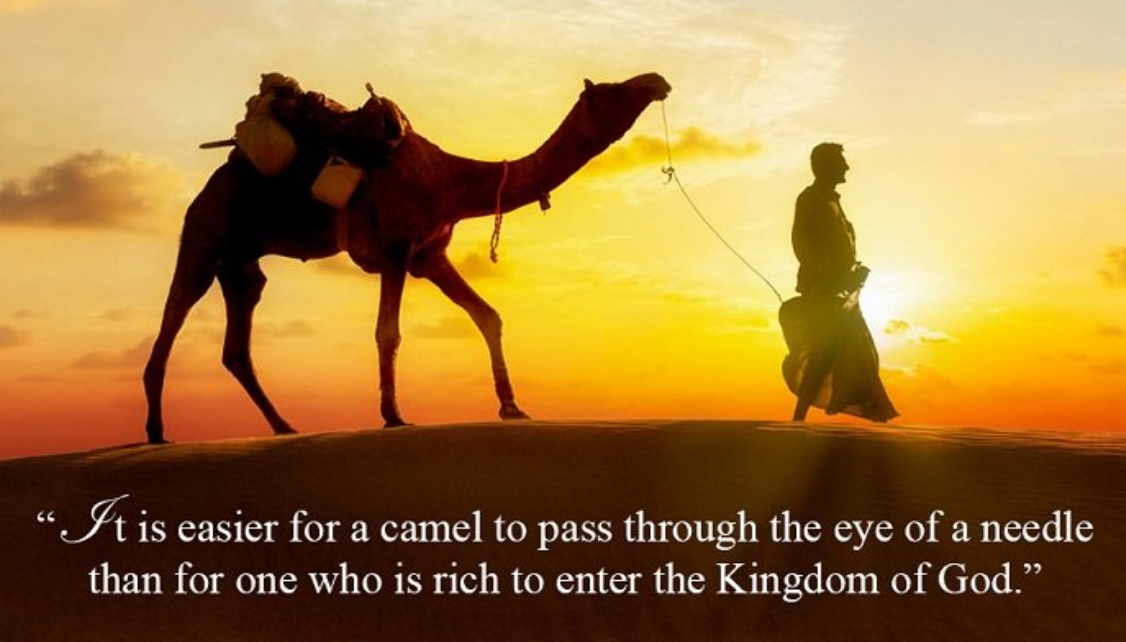
I. 🪞 The Visual Parable: The Man and the Camel
If we imagine the rich man of Matthew 19:24 as a camel, both are burdened by what they carry. The camel is loaded with goods; the man is laden with possessions, pride, and self-sufficiency. Both are too “large” to pass through the eye of the needle — the narrow opening into God’s Kingdom.
“Strive to enter through the narrow door. For many, I tell you, will seek to enter and will not be able." - Luke 13:24
It’s not the man himself who is too large, but what he insists on carrying.
🧳 The Burden: Possessions and Pride
- The “possessions” symbolize attachments — things that make one self-reliant rather than God-reliant.
- Pride, wealth, and independence expand the ego, swelling the person spiritually until he cannot fit through the narrow gate (cf. Matthew 7:14).
- Even good things, if clung to as personal merit, make us “too wide” to pass through.
🙌 What’s Impossible with Man
“With man this is impossible, but with God all things are possible.” (Matt. 19:26)
On his own, man cannot shed his inflated self. The self-deflating humility required for the Kingdom is not something we can achieve through effort — it’s something God does to us.
God, in His mercy, removes what we cannot. He humbles, prunes, and strips away to make passage possible.
This recalls:
- John 15:2 — “Every branch that bears fruit He prunes, that it may bear more fruit.”
- Philippians 2:7 — Jesus “emptied Himself” (ekenōsen), showing the model of humility required for Kingdom entry.
- Matthew 5:3 — “Blessed are the poor in spirit, for theirs is the kingdom of heaven.”
🧵 The Eye of the Needle as Spiritual Gate
The eye of the needle is not just a metaphor for difficulty — it represents the constricted passage of transformation, where everything that is not of God must be left behind.
- To enter, one must become small enough — reduced to the essence of trust and love.
- What swells us — ego, possessions, control — must be stripped away.
- The camel must be unloaded; the man must be emptied.
✝️ The Divine Possibility
When God intervenes:
- He takes on our burdens (Cast your burden on the Lord, and He will sustain you - Psalm 55:22).
- He humbles the proud (He has brought down the mighty from their thrones and exalted those of humble estate - Luke 1:52).
- He clothes us anew (white garments so that you may clothe yourself and the shame of your nakedness may not be seen - Revelation 3:18).
Through grace, God performs the impossible — transforming the swollen into the meek, the proud into the poor in spirit, and the rich man into a disciple who follows Jesus, not his own wealth, which is just a temporary gift from God.
II. 🌍 “What Good Is It…?”
“For what will it profit a man if he gains the whole world, and forfeits his soul?” — Matthew 16:26
The whole world represents everything the self can grasp — possessions, acclaim, control, even “religious success.” But the soul — the nephesh or psuchē — is the true life within us, the self that is meant to live in union with God.
So when a person gains the world but loses the soul, it’s not just tragic — it’s anti-good, a reversal of creation’s design.
Because God is good and does good (Ps. 119:68), He will not leave us to a prosperity that destroys us.
✂️ Divine Loss as Divine Love
In this light, the words of Psalm 119 become prophetic commentary on Jesus’ teaching:
“Before I was afflicted, I went astray,
but now I obey Your word.” (Ps. 119:67)
“It was good for me to be afflicted,
that I might learn Your decrees.” (Ps. 119:71)
Affliction, in the hands of a good God, is a form of mercy.
He strips the man of his false gains so that he can receive true life.
God takes away the world that was killing him to give him the Kingdom that will heal him.
This is divine surgery — painful but saving.
It’s what Jesus meant when He said,
“Every branch in Me that does not bear fruit He takes away, and every branch that does bear fruit He prunes, that it may bear more fruit.” (John 15:2)
🕊 The Goodness of God in Affliction
It’s as though God looks at the man who gained the whole world and says:
“This is not good for you. You are too full of dust to breathe My breath.
I will take away the weight that crushes your soul so that you can stand again in My image.”
When the rich man walks away sorrowful, God’s grace may follow him in disguise — as loss, illness, disappointment, or humbling — but these are not punishment.
They are the undoing of the false self so the true self can live.
💎 Redemptive Paradox
Thus, both sayings of Jesus come full circle:
- “It is hard for the rich man to enter the Kingdom.”
- “What does it profit a man to gain the world and lose his soul?”
And their fulfillment is found in Psalm 119’s confession:
“It was good for me to be afflicted.”
Because:
in being reduced, we are redeemed.
III. 🪡 Job: The Camel Through the Needle
1. The Blessed and Burdened Man
Job is perhaps the most vivid living parable of everything Jesus later articulates in His teachings about wealth, affliction, and entering the Kingdom through humility. Job’s story captures in real time what it means for God to strip a man of everything, not to destroy him, but to save his soul.
At the outset, Job is “the greatest of all the men of the east” (Job 1:3).
He has:
- immense wealth (livestock, servants, land),
- a large family,
- an upright reputation before God and men.
He is not portrayed as wicked or greedy. Yet even this good wealth, as with the rich young ruler, forms a spiritual circumference — it surrounds him, giving him stability and security.
In a sense, Job fits the profile of the rich man: not evil, but full — so full that suffering seems unnecessary, even unjust. His life, from human perspective, already looks like the reward of righteousness.
But the narrative is about to prove that prosperity can conceal dependency issues, even in the righteous.
2. The Stripping Begins
In a few devastating scenes, Job loses everything:
- His flocks, servants, and children.
- His health and dignity.
- His wife’s respect and his friends’ confidence.
The camel has been unburdened — violently.
He has been reduced to a man sitting in ashes, scraping sores, a hollow version of the man he was.
Yet it is here that the real Job begins to emerge.
3. The Wrestling: “Why?”
Job’s dialogues form a long wrestling match — not merely over the cause of suffering but over the nature of God’s goodness.
He demands justice, understanding, and vindication — all reasonable from the standpoint of a man who lived blamelessly.
But underneath, God is exposing Job’s subtle pride:
Job had known God truly, but only within the limits of prosperity and principle.
Now he must know God personally and humbly, without those supports.
In this sense, Job is undergoing the same transformation Jesus spoke of:
“With man this is impossible.” Job cannot, through intellect or moral reasoning, fit himself through this needle. He must be made small by encounter.
4. The Encounter: God Speaks from the Whirlwind
When God finally answers, He doesn’t explain the affliction — He reveals Himself.
The cure for Job’s confusion is not information, but revelation.
“Where were you when I laid the foundation of the earth?” (Job 38:4)
This isn’t cruelty; it’s divine humbling — the pruning of pride and presumption.
God brings Job face to face with reality: that all things are sustained by divine wisdom far beyond man’s comprehension.
In that confrontation, Job is stripped not just of possessions, but of his self-sufficiency.
He says:
“I have uttered what I did not understand… but now my eye sees You;
therefore I despise myself, and repent in dust and ashes.” (Job 42:3, 5–6)
5. The Restoration: “It Was Good for Me”
After Job’s humbling, God restores him — not as repayment, but as a symbol of transformation. Job now holds wealth as one who has died to it. He is no longer defined by abundance but by awe.
He could now echo the psalmist:
“It was good for me that I was afflicted, that I might learn Your decrees.” (Ps. 119:71)
Affliction became the needle’s eye — narrow, painful, but ultimately the passageway to true life.
6. Job’s Story as Gospel Parable
Job’s narrative, when read through the gospel lens, prefigures what Jesus reveals about:
- The rich man — that abundance can hide our need.
- Affliction as mercy — that God strips us to save us.
- The impossibility of self-salvation — that only divine grace can fit us through the narrow way.
Job’s “end” (42:12) is not about getting twice as much stuff back.
It’s about becoming twice as alive to the God who gives and takes away.
✝️ The Kingdom Principle
Job learned what every disciple must:
“Naked I came from my mother’s womb, and naked shall I return. The Lord gave, and the Lord has taken away; blessed be the Name of the Lord.” (Job 1:21)
That is the sound of a man who has finally fit through the eye of the needle.
IV. 🌑 1. Job’s Turning Point: Seeing God, Seeing Himself
When Job says,
“I despise myself, and repent in dust and ashes” (Job 42:6),
it follows immediately after,
“Now my eye sees You” (v.5).
Seeing God becomes the lens through which Job finally sees himself truly.
Before this vision, Job had spoken of God, debated about God, and defended his own righteousness — all within a framework that still centered around his understanding, his integrity, his case.
But once the I AM speaks from the whirlwind, Job’s categories collapse.
In the light of the Infinite, the finite self can only bow.
What he “despises” now is not his existence, but his inflated sense of proportion.
He recognizes that, compared with the glory, wisdom, and sovereignty of God, he is dust — not as a statement of self-hatred, but as an act of self-rightsizing.
It is the death of self-importance, not the denial of self-worth.
🕊 2. From Greatness to Smallness — A Good Exchange
Job’s earlier identity was bound up with greatness:
- great wealth,
- great reputation,
- great moral uprightness.
His afflictions tore those away, revealing how subtly even righteousness can make us self-reliant.
By the end, Job does not cling to his former grandeur. He calls it worthless because, in light of God’s presence, even his virtue cannot sustain him.
Now he sees that the good life is not measured by abundance, merit, or vindication — but by proximity to God Himself.
His “self-despising” is a confession of perspective:
“I am not the measure of good — You are.”
🔥 3. John the Baptist’s Echo: “He Must Increase, I Must Decrease” (John 3:30)
John’s words perfectly capture what Job experiences centuries earlier.
John had gained immense influence — people were coming to him in droves — but when Christ appeared, he joyfully stepped aside, saying,
“He must increase, but I must decrease.”
That statement is not self-contempt; it’s self-limitation for the sake of revelation. It’s what happens when one beholds the true Light — everything else must fade.
Likewise, Job’s “I despise myself” is the Old Testament version of “I must decrease.” His former self — the self that demanded, reasoned, and contended — must give way to the self that worships.
Both Job and John are humbled by vision:
- Job: “Now my eye sees You.”
- John: “Behold, the Lamb of God.”
When you truly see Him, self-importance withers like mist in the morning sun.
💎 4. The Transformation of Value
In this light, “I despise myself” can be read as:
“I now regard myself — my wisdom, my words, my righteousness — as worthless apart from You.”
It mirrors Paul’s later confession:
“Whatever gain I had, I counted as loss for the sake of Christ.” (Phil. 3:7)
This is not the despair of nihilism; it is the joy of revaluation.
Job does not find himself meaningless — he finds that his meaning exists only in relation to God’s glory.
His decrease is not destruction — it’s deliverance.
It’s how God saves a man from himself.
🌿 5. The Spiritual Principle
The paradox at the heart of Scripture:
“Whoever loses his life for My sake will find it.” (Matt. 16:25)
Job loses himself — his identity built on prosperity, moral superiority, and the need for answers — and in doing so, he finds life again in the pure gaze of God.
John steps aside so Christ may shine.
Job bows down so God may be exalted.
Both are acts of holy diminishment that result in fullness.
✝️ 6. The Pattern of Christ
Ultimately, this movement — from fullness to emptiness to glory — is the pattern Christ Himself embodies:
“He emptied Himself, taking the form of a servant… therefore God exalted Him.” (Phil. 2:7–9)
Job’s humbling anticipates this divine pattern.
He is a foreshadowing of the One who would lose all things and yet gain all things in resurrection.
🪞 In summary
When Job says, “I despise myself,” he’s saying, in essence:
“Now that I’ve seen You rightly, I see myself rightly —
small, dependent, dust. My former greatness means nothing beside Your glory.
I must decrease, and You must increase.”
This is not despair — it is the birth of humility.
The man who once defended his own righteousness now delights in God’s. The camel has finally passed through the eye of the needle — not destroyed, but freed.
Job’s humbled realization and John the Baptist’s confession is the perfect bridge between the Old and New Testament expressions of right-sized humanity before God.
![👑🍞🍷🎭💔🚪(B) The King’s ‘Friend’: Near the Table, Far from the Heart [5 parts]](/content/images/size/w600/2026/04/Screenshot-2026-03-31-7.03.14-PM-1.png)
![👁️ 👁️✨🧠👣 (A) Discernment Through Transformation: Why Right Action and Right Timing Require a Renewed Mind [3 parts]](/content/images/size/w600/2026/04/Screenshot-2026-03-31-7.03.14-PM.png)