🧔 🫅🤴Character Study: Jonadab, King David's Nephew and Prince Amnon's Adviser [2 parts]
👑🧠 Introduction: Jonadab - The Danger of Cleverness without Character
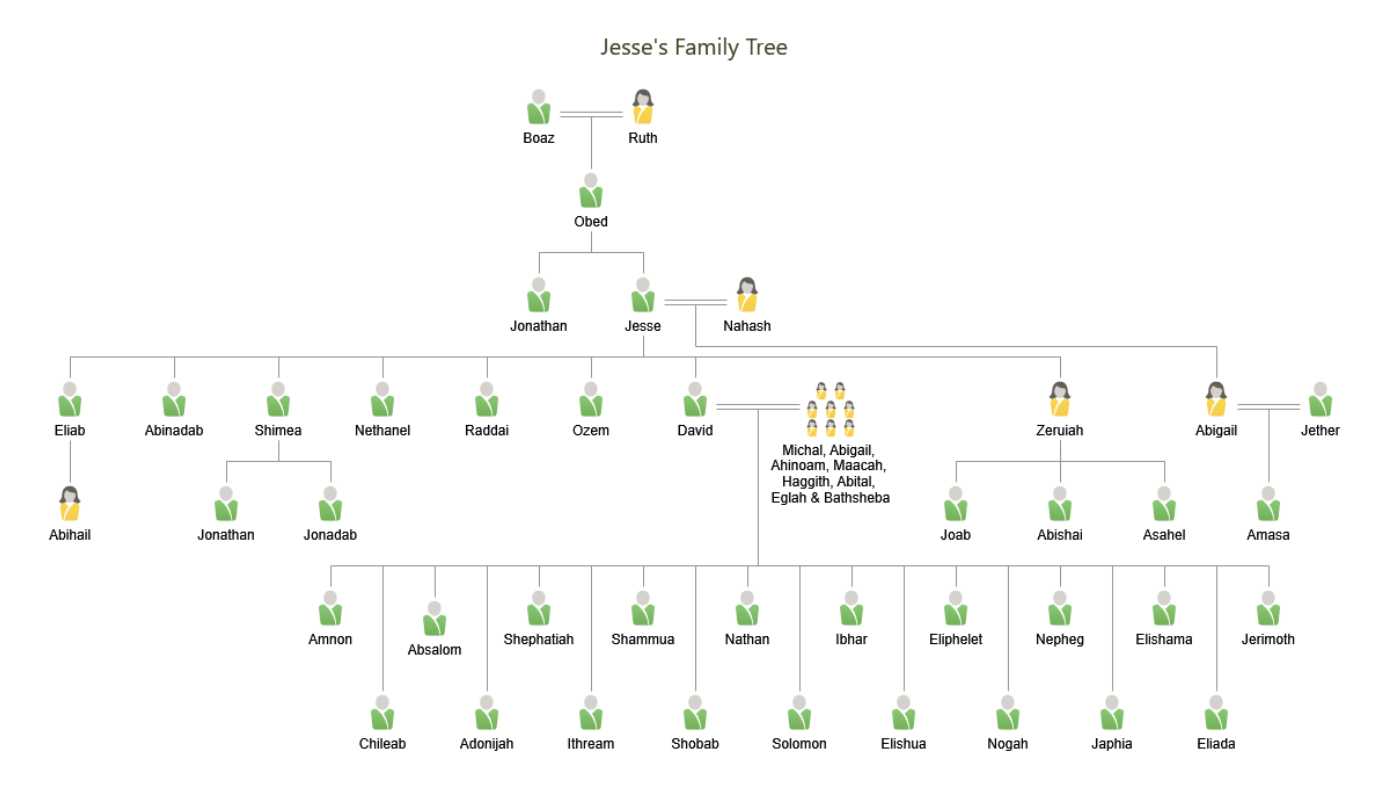
Some figures in Scripture occupy only a few verses, yet cast shadows far larger than the space they are given. Jonadab son of Shimeah, David's third eldest brother, is one such man.
Nephew of King David, cousin to Amnon, Tamar, and Absalom, and a trusted insider within the royal household, Jonadab stands near the center of one of the most devastating family collapses in David’s reign. Though he never raises a hand in violence himself, his influence quietly courses beneath the tragedy like an unseen current.
The biblical text introduces Jonadab as “a very shrewd man” (2 Samuel 13:3). Yet Scripture often treats shrewdness as a morally flexible quality—one capable of serving righteousness or rebellion depending on the heart guiding it. Jonadab possessed perception, strategy, and social awareness, but what he lacked was moral anchoring.
He recognized destructive desire in Amnon, but instead of restraining it, he enabled it. He foresaw Absalom’s revenge, yet appears unmoved by the devastation already set in motion.
This study explores Jonadab’s negative influence within King David’s household and the ripple effects of ungodly counsel. Through his actions we will examine the corruption of wisdom, the danger of detached intelligence, the destructive power of bad counsel, and the unsettling reality that some of the gravest threats to God’s people arise not from enemies outside the gates—but from compromised voices within the house. 👑⚖️🧠
- Jonadab - Nephew, son of David’s brother (3rd eldest), Shimeah. Cousin of Amnon, Tamar, and Absolom.
I. The History in Scripture
2 Samuel 13:1-15 - Amnon son of David fell in love with Tamar, the beautiful sister of Absalom son of David.
Amnon became so obsessed with his sister Tamar that he made himself ill. She was a virgin, and it seemed impossible for him to do anything to her.
Now Amnon had an adviser named Jonadab son of Shimeah, David’s brother. Jonadab was a very shrewd man. He asked Amnon, “Why do you, the king’s son, look so haggard morning after morning? Won’t you tell me?”
Amnon said to him, “I’m in love with Tamar, my brother Absalom’s sister.”
“Go to bed and pretend to be ill,” Jonadab said. “When your father comes to see you, say to him, ‘I would like my sister Tamar to come and give me something to eat. Let her prepare the food in my sight so I may watch her and then eat it from her hand.’”
So Amnon lay down and pretended to be ill. When the king came to see him, Amnon said to him, “I would like my sister Tamar to come and make some special bread in my sight, so I may eat from her hand.”
David sent word to Tamar at the palace: “Go to the house of your brother Amnon and prepare some food for him.” So Tamar went to the house of her brother Amnon, who was lying down. She took some dough, kneaded it, made the bread in his sight and baked it. Then she took the pan and served him the bread, but he refused to eat.
“Send everyone out of here,” Amnon said. So everyone left him. Then Amnon said to Tamar, “Bring the food here into my bedroom so I may eat from your hand.” And Tamar took the bread she had prepared and brought it to her brother Amnon in his bedroom. But when she took it to him to eat, he grabbed her and said, “Come to bed with me, my sister.”
“No, my brother!” she said to him. “Don’t force me! Such a thing should not be done in Israel! Don’t do this wicked thing. What about me? Where could I get rid of my disgrace? And what about you? You would be like one of the wicked fools in Israel. Please speak to the king; he will not keep me from being married to you.” But he refused to listen to her, and since he was stronger than she, he raped her.
- The word “refuse” denotes an unwillingness to be moved; a refusal is a matter of the will. Jesus said, “not My will, but Yours be done.” If ever there was a moment where refusal would be understandable from a human standpoint, Gethsemane was it! Yet, He suspended His own will and chose instead to follow the will of The Father.
- Amnon repeatedly chose his own will, regardless of how that affected others. Perhaps he was entitled because of his royal status. Jesus, as the King of Kings, has the most royal status there is, yet not only was an air of entitlement absent from Him, He was humble and served others, even to the point of taking their punishment for them.
2 Samuel 13:16-38 - Then Amnon hated her with intense hatred. In fact, he hated her more than he had loved her. Amnon said to her, “Get up and get out!”
“No!” she said to him. “Sending me away would be a greater wrong than what you have already done to me.”
But he refused to listen to her. He called his personal servant and said, “Get this woman out of my sight and bolt the door after her.” So his servant put her out and bolted the door after her. She was wearing an ornate robe, for this was the kind of garment the virgin daughters of the king wore. Tamar put ashes on her head and tore the ornate robe she was wearing. She put her hands on her head and went away, weeping aloud as she went.
Her brother Absalom said to her, “Has that Amnon, your brother, been with you? Be quiet for now, my sister; he is your brother. Don’t take this thing to heart.” And Tamar lived in her brother Absalom’s house, a desolate woman.
When King David heard all this, he was furious. And Absalom never said a word to Amnon, either good or bad; he hated Amnon because he had disgraced his sister Tamar.
Two years later, when Absalom’s sheepshearers were at Baal Hazor near the border of Ephraim, he invited all the king’s sons to come there. Absalom went to the king and said, “Your servant has had shearers come. Will the king and his attendants please join me?”
“No, my son,” the king replied. “All of us should not go; we would only be a burden to you.” Although Absalom urged him, he still refused to go but gave him his blessing.
Then Absalom said, “If not, please let my brother Amnon come with us.”
The king asked him, “Why should he go with you?” But Absalom urged him, so he sent with him Amnon and the rest of the king’s sons.
Absalom ordered his men, “Listen! When Amnon is in high spirits from drinking wine and I say to you, ‘Strike Amnon down,’ then kill him. Don’t be afraid. Haven’t I given you this order? Be strong and brave.” So Absalom’s men did to Amnon what Absalom had ordered. Then all the king’s sons got up, mounted their mules and fled.
While they were on their way, the report came to David: “Absalom has struck down all the king’s sons; not one of them is left.” The king stood up, tore his clothes and lay down on the ground; and all his attendants stood by with their clothes torn.
But Jonadab son of Shimeah, David’s brother, said, “My lord should not think that they killed all the princes; only Amnon is dead. This has been Absalom’s express intention ever since the day Amnon raped his sister Tamar. My lord the king should not be concerned about the report that all the king’s sons are dead. Only Amnon is dead.”
Meanwhile, Absalom had fled.
Now the man standing watch looked up and saw many people on the road west of him, coming down the side of the hill. The watchman went and told the king, “I see men in the direction of Horonaim, on the side of the hill.”
Jonadab said to the king, “See, the king’s sons have come; it has happened just as your servant said.”
As he finished speaking, the king’s sons came in, wailing loudly. The king, too, and all his attendants wept very bitterly.
Absalom fled and went to Talmai son of Ammihud, the king of Geshur. But King David mourned many days for his son.
After Absalom fled and went to Geshur, he stayed there three years. And King David longed to go to Absalom, for he was consoled concerning Amnon’s death.
- Absolom the third born whose mother was Maakah daughter of Talmai king of Geshur (1 Chronicles 3:2).
- Absolom, a prince in Benjamin, sought asylum with Talmai, a prince in Ephraim.
- He fled to an area where he was buffered from the land of the Philistines only by the territories of Dan. Reminiscent of when David fled from Saul.
Jonadab’s counsel led to: the disgrace of rape for a princess, (one relationship broken), hatred, resentment, and murder in the heart of a prince (another relationship broken), the actual murder of a prince, years in the making (a life lost).
In both instances Jonadab involved King David in his plots.
First, he advised Amnon to ask his father to have Tamar sent to him, and later he set himself up to appear to be bringing David good news (quite possibly after filtering false reports to him that were more dire).
II. Character Profile
1. “Crafty Wisdom” without Moral Anchoring
Jonadab is explicitly described as “very shrewd” (often translated as wise or subtle). In Hebrew narrative terms, this is not neutral praise—it is morally ambiguous intelligence.
His intelligence is:
- Observational (he reads Amnon correctly)
- Strategic (he constructs a workable plan)
- Detached (he does not intervene ethically)
This is wisdom untethered from righteousness—skill without conscience.
2. Catalyst, Not Primary Actor
Jonadab does not commit the violence, but he functions as a facilitator of sin.
His role is closer to:
- Architect of opportunity
- Enabler of desire
- Normalizer of manipulation
This makes him narratively similar to “advisor figures” who accelerate moral collapse without directly executing it.
3. Court Insider Dynamics
Jonadab is identified as a son of Shimeah (David’s brother), placing him within the extended royal household. This matters:
- He is not an outsider corrupting the court
- He is embedded within David’s family network
- His counsel reflects internal decay, not external attack
In other words, the problem is not enemies at the gates—it is wisdom gone wrong inside the palace.
4. Silence After Consequences Begin
After the tragedy escalates (Amnon’s death and Absalom’s flight), Jonadab’s presence fades. He does not repent, defend, or clarify his role. He simply disappears from the narrative.
This silence is itself telling:
- No accountability is recorded
- No moral reckoning occurs
- The text leaves him unresolved
Thematic Significance
1. The Danger of “Perceptive Evil”
Jonadab sees clearly—but does not see rightly.
This is one of Scripture’s recurring warnings: perception is not the same as righteousness. You can correctly diagnose desire and still incorrectly deploy your insight.
2. Counsel as Moral Force
Jonadab illustrates that advice is never neutral. In biblical theology, counsel functions as spiritual direction:
- It either restrains chaos
- Or structures it into execution
His counsel does the latter.
3. The Fragility of Royal Justice
His presence exposes something unsettling in David’s household:
- Amnon feels unrestrained enough to act
- Jonadab feels unrestrained enough to advise
- David is absent from early intervention
This creates a vacuum where strategy replaces righteousness.
4. Echo of Edenic Pattern
There is a subtle narrative echo: someone recognizes desire, reframes reality, and provides a pathway that leads to transgression.
Not identical to Eden, but structurally similar:
- Perception → Interpretation → Action pathway becomes corrupted through counsel
Moral Reading
Jonadab is not a “villain in armor.” He is something more ordinary and therefore more dangerous: a clever observer who does not resist the misuse of his insight.
His tragedy is not ignorance—it is indifference dressed as intelligence.
Jonadab was a royal advisor but he seemed more like a Machiavellian meddler.
⚖️👑 Conclusion: The Counselor in the Shadows
Jonadab’s story is brief, but its warning is profound. He was neither king nor prince, neither warrior nor rebel, yet his fingerprints remain on some of the darkest events in David’s family history.
A princess was disgraced, brothers became enemies, hatred matured into murder, and a royal house fractured under the weight of wounds left untreated. Jonadab did not commit every act, but his counsel opened doors that righteousness should have shut.
His life reminds us that intelligence alone is not wisdom. One may be perceptive and still profoundly dangerous. Jonadab could diagnose desire, anticipate outcomes, and navigate palace dynamics with unsettling precision, yet none of these abilities restrained evil.
Scripture presents him as a sobering example of cleverness divorced from conscience—wisdom that became manipulation rather than stewardship. Even more troubling, Jonadab operated from within the family of David. The threat was not foreign invasion or Philistine pressure, but corruption among trusted voices.
This reflects a recurring biblical pattern: kingdoms are often weakened more by compromised counsel than external enemies. Eden had its voice of persuasion. Rehoboam had foolish advisors. Judas moved among disciples. Jonadab belongs to this tragic lineage of those whose influence multiplies destruction while preserving plausible distance from accountability.
In the end, Jonadab vanishes from the biblical narrative without repentance, judgment, or resolution. The silence surrounding him almost amplifies the warning. Not every harmful influence announces itself loudly; some wear the appearance of wisdom, loyalty, or helpfulness.
2 Corinthians 11:14 - Satan himself masquerades as an angel of light.
His story presses an uncomfortable but necessary question upon us: Who is shaping our thinking, and what kind of wisdom are we allowing to guide our decisions?
✨ For Scripture repeatedly teaches that counsel is never neutral. It either moves us toward life (zoe) or quietly arranges the circumstances of corruption, un-vined withering, destruction, ruin, death, and decay. ✨