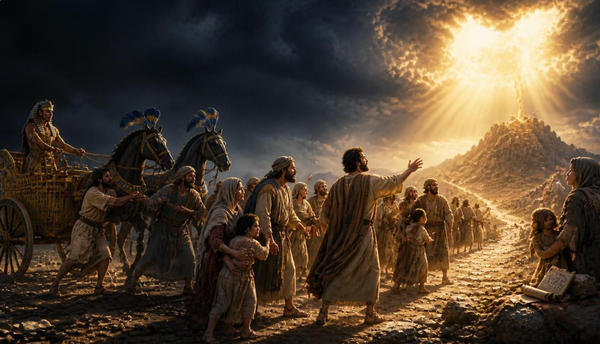
✝️🌳🔥 Jesus in Eden: The Guarded Tree and the Granted Way [3 parts]
Access to life is not assumed—it is granted and guarded. Scripture presents this pattern from Eden to the Kingdom parables, and Jesus stands at the center of it as both Tree and Gate.
I. 🔥 Eden: Life Guarded, Not Lost at Random
In Genesis 3:22–24, access to the Tree of Life is actively restricted:
- Cherubim are stationed
- A flaming sword turns in every direction
- The explicit purpose: to guard the way to the Tree of Life
This is not mere punishment—it’s controlled access.
👉 The implication: Life (Zoe) is not something humanity can seize once alienated—it must be re-authorized.
✝️ Jesus: The Tree Reintroduced… But Not Unlocked
Jesus presents Himself in terms that echo Eden:
- “I am the bread of life” (John 6)
- “I am the way” (John 14:6)
- “If anyone eats… he will live forever” (John 6:51)
He is not merely pointing to life—He is the Tree of Life embodied.
But then comes the tension:
John 6:65 - “No one can come to Me unless it is granted by the Father.”
The same way access to the Tree of Life was restricted, access to Jesus is also.
⚖️ Granting vs. Grasping
| Eden | John 6 |
|---|---|
| Tree of Life present | Jesus present |
| Humanity barred from access | People unable to come unless granted |
| Cherubim guard the way | Father grants the way |
👉 The cherubim are not just guards—they are heaven’s enforcement of divine permission.
So in John 6, the Father’s “granting” functions like a spiritual clearance.
🍞 The Scandal of Refusal
Right after Jesus says this, many disciples leave (John 6:66).
Why? Because He presents Himself as:
- Necessary for life
- Not universally accessible
- Spiritually discerned, not naturally embraced
This offends both self-sufficiency and religious presumption.
👉 The same way Adam could not force his way back to the Tree,
people cannot decide their way into Christ on their own terms.
👰 The Wedding Garment: Authorized Presence

In Matthew 22:1–14, a man enters the wedding feast—but without the proper garment.
He is:
- Not turned away at the door
- Not warned again
- Silent and cast out
Why? Because presence ≠ acceptance.
👉 The garment represents something granted, not self-produced.
Just like access to the Tree of Life:
- You don’t bring your own covering
- You don’t define your own terms
- You don’t bypass the requirement
🪞 A Pattern Emerges: Life Requires Alignment with Heaven
Across these passages, a unified structure appears:
1. Life is centrally located (Tree / Christ)
Not abstract. Not dispersed. Singular and embodied.
2. Access is guarded
Not everyone who approaches is permitted to partake.
3. Authorization is required
- Eden → Cherubim
- John 6 → Father granting
- Wedding → Proper garment
4. Unauthorized approach results in exclusion
- Adam expelled
- Disciples leave
- Guest cast out
🧠 Theological Tension: Divine Sovereignty vs. Human Response
This framework forces a hard question:
If access must be granted, what is the role of human will?
Scripture holds both:
- “Come to Me…” (invitation)
- “No one can come unless…” (limitation)
👉 This is not contradiction—it’s hierarchy.
Human response is real, but not ultimate. It operates within what has been revealed, drawn, and enabled by the Father. God reveals the terms, and if we don't agree we don't gain access. He works around our autonomy and choice, if we don't choose to abide by His terms He doesn't force the issue but He doesn't concede access either.
🌿 Re-framing “Coming to Christ”
“Coming” is not casual movement—it is:
- A granted drawing (John 6:44–65)
- A permitted approach (Eden pattern)
- A properly clothed entrance (Matthew 22)
🪞 So the diagnostic question becomes: Am I approaching Christ on His terms—or assuming access on mine?
🔥 Synthesis
Jesus as the Tree of Life means:
- He is the only source of eternal life (Zoe)
- He is not universally accessible by default
- He is approached only through what the Father grants and provides
The cherubim, the Father’s granting, and the wedding garment are not separate ideas—they are the same theological signal:
Life is not taken. It is given—on God’s terms.
II. 🌳 Revelation: The Tree Reopened - But Still Regulated

At the end of Scripture, the Tree of Life appears again—but notice carefully:
it is not suddenly “free-for-all access.” It is restored access under fulfilled conditions.
Key texts:
Revelation 2:7 - “To the one who conquers… I will grant to eat of the tree of life.”
Revelation 22:14 - “Blessed are those who wash their robes, so that they may have the right to the tree of life.”
👉 Two phrases matter:
- “I will grant” (again—permission language)
- “Right to the tree” (legal/authorized access)
This is Eden language, but upgraded:
| Eden | Revelation |
|---|---|
| Tree guarded by cherubim | Tree accessible in New Jerusalem |
| Humanity expelled | Overcomers admitted |
| Access denied | Access granted |
| No way back | A way reopened |
But notice—the cherubim logic hasn’t disappeared; it has been satisfied.
🔑 What changed?
Not God’s standards.
Not the nature of the Tree.
What changed is the qualification of the people.
- “Overcomes” → aligned loyalty
- “Washes robes” → granted purification
- “Right” → authorized standing
👉 The Tree is not less guarded—the people are now made fit to pass the guard.
👗 Priestly Garments: You Don’t Dress Yourself
The wedding garment from Matthew 22 doesn’t stand alone—it’s part of a much older pattern:
🧵 Garments in Scripture are never trivial—they signal status and access.
1. Priests and Access to God
In Exodus–Leviticus:
- Priests cannot enter God’s presence casually
- They must wear specific garments designed by God
👉 Why? Because clothing = qualification to approach holiness
Unauthorized approach = death (Leviticus 10, Nadab & Abihu)
2. Zechariah 3: The Garment Exchange
Joshua the high priest stands:
- In filthy garments (unfit for God’s presence)
- Satan accusing him
- God removes the filthy garments and replaces them
👉 Key insight: Joshua does not clean himself. He is re-clothed by divine action.
3. Righteousness as Clothing
Isaiah 61:10 - “He has clothed me with garments of salvation… robe of righteousness.”
This is not metaphor for effort—it’s imputed identity.
🔗 Connecting Back to the Framework
| Theme | Function |
|---|---|
| Cherubim (Eden) | Guard access to life |
| Father granting (John 6) | Authorizes who can come |
| Wedding garment (Matthew 22) | Determines who can remain |
| Priestly garments | Enable safe approach to holiness |
| Revelation robes | Grant right to the Tree |
👉 These are not separate doctrines—they are one continuous access system.
⚖️ Critical Insight: Access Requires Transformation, Not Admission
The modern instinct is:
“If I’m invited, I belong.”
Scripture says:
“If you are not transformed, you cannot remain.”
That’s why:
- The man without the garment is expelled
- Many disciples leave in John 6
- Eden remains guarded
- Revelation requires washed robes
🌿 Jesus as the Fulfillment of Both
Jesus is simultaneously:
- 🌳 The Tree of Life (source of life)
- 👗 The One who provides the garment (qualification for life)
He doesn’t just say “come eat”—He says (functionally): “You must be made able to eat.”
🪞 Synthesis
The system is internally consistent:
- Life is located in God alone (Tree / Christ)
- Access is guarded (cherubim / holiness)
- Authorization is granted (Father’s drawing)
- Qualification is provided (garments / righteousness)
- Participation is conditional on transformation (washed robes / overcoming)
The same God who restricts access is the only One who can make you fit to enter.
III. 🚪🌳 The Tree and the Way: Jesus as Life and Access
Jesus is not only the destination (Tree of Life)—He is the means of approach (the Way).
That collapses categories we usually keep separate.
🔑 “I Am the Way”: Not a Direction, but a Gatekeeping Reality
John 14:6 - “I am the way, the truth, and the life (zoe). No one comes to the Father except through Me.”
This is not guidance language (“follow these steps”). It is exclusivity of access.
- Not: I show the way
- But: I am the way
👉 So:
- If He is Life → He is the Tree
- If He is the Way to the Father → He is the guarded path through Eden
He doesn’t just stand at the end of the journey—He is the road you must be on.
🔥 Re-reading Eden: The Way Was Not Destroyed—It Was Blocked
In Genesis 3:24 Cherubim guard “the way to the Tree of Life.”
That phrase matters. 👉 It does NOT say: “they guard the tree” (object).
👉 It says: they guard the way (access route).
So what was lost? Not the existence of Life. Not even the location of Life.
What was lost was authorized passage.
✝️ The Cross: The Reopening of the Way Through Judgment

In Matthew 27:51:
- The veil of the temple is torn
That veil:
- Embroidered with cherubim (Exodus 26:31)
- Functioned as a barrier to God’s presence
👉 That veil is Eden architecture inside the tabernacle.
So when it tears:
- The cherubim barrier is symbolically opened
- The guarded way is no longer closed in the same way
📜 Explicit Interpretation: Jesus as the Opened Way
Scripture interprets this directly:
Hebrews 10:19–20 - “We have confidence to enter… by the blood of Jesus, by a new and living way that He opened for us through the veil, that is, His flesh.”
This is as precise as it gets.
| Element | Meaning |
|---|---|
| Veil | Barrier (cherubim / Eden guard) |
| Flesh of Jesus | The torn veil |
| Blood | Authorization |
| New and living way | Restored access route |
⚔️ The Flaming Sword and the Cross
There’s a deeper symmetry worth seeing:
- In Eden → a flaming sword blocks the way
- At the cross → judgment falls on Christ
👉 Functionally: The sword that guarded the way falls on Jesus.
Not literally described that way—but structurally:
- Justice is satisfied
- Holiness is upheld
- Access is reopened without compromise
🌿 John 15: Abiding in the Tree = Remaining in the Way
In John 15, Jesus = the vine (tree imagery), believers = branches.
👉 Key idea: You don’t visit the Tree then leave, you must remain (μένω / menō).
So Jesus is:
- 🌳 The life-source
- 🚪 The access point
- 🛤️ The ongoing pathway
⚖️ Bringing It All Together
| Concept | Fulfillment in Jesus |
|---|---|
| Tree of Life | He is the life itself |
| Way to the Tree | He is the path |
| Guarded access | He fulfills the requirements |
| Father granting | He is the one granted access is through |
| Wedding garment | He provides the righteousness needed to remain |
👉 This yields a powerful conclusion:
You don’t just come to Jesus for life—you come through Jesus in order to reach God, and you remain in Jesus to continue living.
🪞 Diagnostic Edge
This re-frames a critical assumption:
It’s possible to:
- Want life
- Seek God
- Desire the Kingdom
…and still reject the only authorized pathway.
That’s exactly what happens in John 6.
🔥 Final Synthesis
Jesus is not one piece of the system.
He is:
- The Tree (source)
- The Way (access)
- The Gate (entry)
- The Garment (qualification)
Which means:
There is no separation between access to life (zoe) and the person of Christ.
Not conceptually. Not spiritually. Not eternally.