🧗♂️🏗️🏠🚪The Ascent of the Dependent: Unless the LORD Builds the House You Will Never Enter the Kingdom of Heaven
I. 🏔 Structure: The Chiastic Arc
If Psalm 127 is indeed the center (the 8th of 15 psalms), then the collection forms a chiastic structure (A–B–C–D–E–F–G–H–G′–F′–E′–D′–C′–B′–A′).
Thematically, this would mean that the psalms mirror each other around Psalm 127—the hinge.
Here’s a conceptual outline:
| Pair | Psalms | Themes | Notes |
|---|---|---|---|
| A | 120 ↔ 134 | Departure and Arrival | From exile to the blessing in Zion. “Woe to me” (120:5) vs. “Bless the LORD in Zion” (134:3). |
| B | 121 ↔ 133 | The LORD’s Protection / Unity | “The LORD watches over you” mirrors “how good and pleasant it is when brothers dwell in unity.” Both reveal divine security. |
| C | 122 ↔ 132 | The House of the LORD | 122 prays for Jerusalem’s peace; 132 recounts David’s oath and the LORD’s choice of Zion. Both center on the temple. |
| D | 123 ↔ 131 | Humility and Dependence | Eyes lifted to God for mercy (123) and the quieted soul like a weaned child (131). Both express humble trust. |
| E | 124 ↔ 130 | Deliverance from Trouble | “If the LORD had not been on our side” (124) parallels “Out of the depths I cry to you” (130). Both deal with salvation from peril. |
| F | 125 ↔ 129 | The LORD’s Justice | 125 contrasts the security of the righteous with the wicked’s fate; 129 reflects on oppression and God’s righteous vindication. |
| G | 126 ↔ 128 | Fruitfulness and Restoration | 126 rejoices in restoration (“those who sow in tears…”) and 128 celebrates family and prosperity from fearing the LORD. |
| H (Center) | 127 | Dependence on the LORD | “Unless the LORD builds the house…” stands as the theological heart: all labor, protection, and fruitfulness depend entirely on God. |
🧭 The Central Revelation (Psalm 127)
Psalm 127—attributed to Solomon—marks the pivot point. It speaks of:
- God as the true Builder, Watchman, and Provider.
- The futility of self-reliance.
- Fruitfulness and legacy as gifts from the LORD.
This center reveals the entire collection’s message:
All ascent, all progress, all blessing—whether in labor, family, nation, or worship—depends wholly on the LORD’s gracious work.
🌿 Thematic Arc: From Alienation to Communion
- Psalms 120–124: Pilgrim journeying from exile toward Zion.
– The traveler cries out, trusts, and moves upward under God’s protection. - Psalm 125–129: Pilgrim maturing in faith and fruitfulness.
– The themes move from security and justice to restoration and blessing. - Psalm 130–134: Pilgrim arriving in worshipful communion.
– Repentance, humility, brotherly unity, and blessing culminate in temple praise.
The chiastic reading underscores that the journey’s center is not the destination but dependence—learning that “unless the LORD builds,” even the pilgrimage itself would fail.
✡️ Spiritual Implication
If we interpret the Songs of Ascents as a spiritual map:
- The outer psalms (120, 134) show distance and communion.
- The inner psalms (127) teach dependence and grace.
- The mirrored pairs trace how trust, humility, and faithfulness mature in the life of a worshiper.
In short:
The Songs of Ascents teach that the journey upward is really a descent into reliance—into grace. The closer we get to Zion, the less we build for ourselves.
II. 🧱 I. Psalm 127 as the Structural and Theological Center
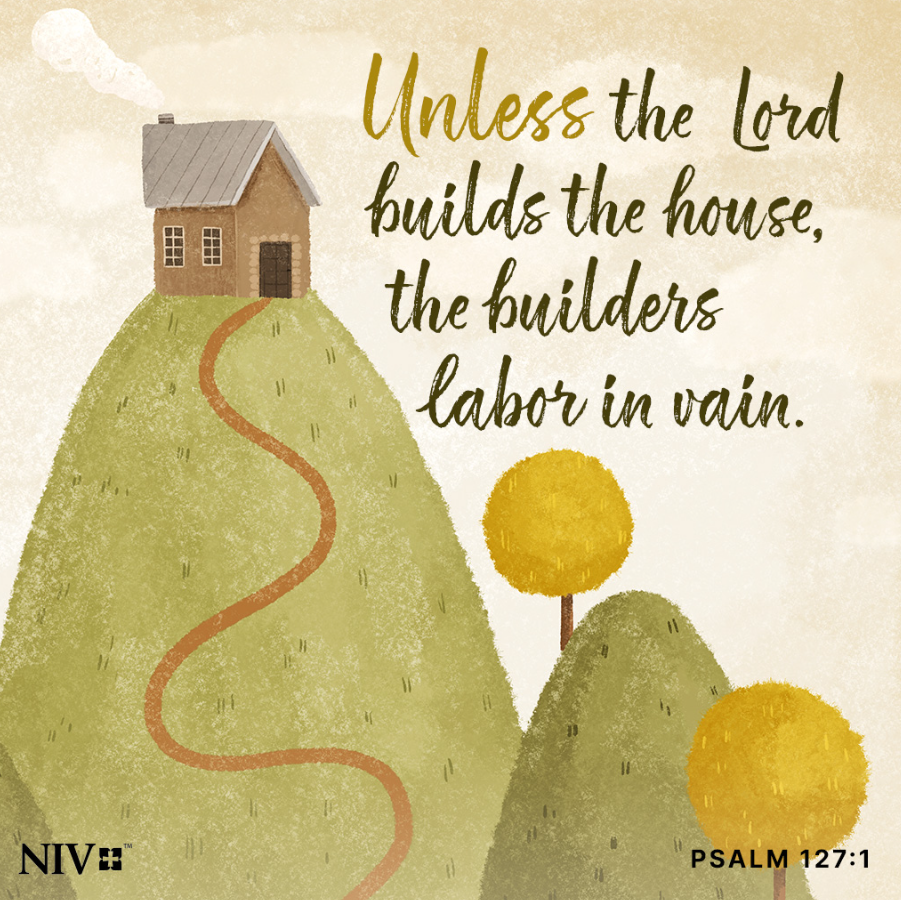
“Unless the LORD builds the house, the builders labor in vain.
Unless the LORD watches over the city, the watchmen stand guard in vain.” (Ps 127:1)
The psalm teaches that all human effort — building, guarding, producing, providing — is meaningless unless it is rooted in God’s work. It’s not anti-work; it’s anti-autonomy. It warns that the human project, even when religious, collapses if it is not aligned with the LORD’s design and timing.
In the chiastic sequence of the Songs of Ascents:
- The first half (Pss 120–126) moves toward Zion — journeying from exile, trusting, praying for peace, seeking God’s help.
- The second half (Pss 128–134) flows from Zion — living fruitfully, humbly, unitedly, and in continual worship.
At the midpoint, Psalm 127 says: everything hinges on Who is doing the building. It’s the keystone of the ascent — the revelation that progress without Presence is futility.
🪨 II. The Wise and Foolish Builders (Matthew 7:24–27)
Jesus closes the Sermon on the Mount with:
“Everyone who hears these words of Mine and puts them into practice
is like a wise man who built his house on the rock…
but everyone who hears these words and does not put them into practice
is like a foolish man who built his house on sand.”
The parallel is striking:
| Psalm 127 | Matthew 7 |
|---|---|
| “Unless the LORD builds…” | “Everyone who hears and does My words…” |
| God’s building vs. vain human effort | Rock vs. sand |
| Sleep given by God (rest) | Stability through obedience |
| House and city imagery | House imagery |
| Dependence leads to endurance | Obedience leads to endurance |
Both passages define wisdom as alignment with God’s action and instruction, not merely moral effort. Both reject self-sufficient building. Both use the image of a house as the testing ground of true discipleship.
🕊 III. The Center and the Sermon: Hearing and Doing
In the chiastic ascent, Psalm 127’s placement mirrors Jesus’ own teaching structure:
- The Sermon on the Mount ends with a call to build on the right foundation.
- The Songs of Ascents culminate (structurally) in a call to let the LORD build.
Psalm 127 therefore prefigures the spiritual architecture of the kingdom Jesus announces.
It’s as though the entire ascent toward Zion leads to this moment of realization:
“All my striving must yield to His constructing.”
Only then does the journey continue into unity (Ps 133) and blessing (Ps 134).
🌿 IV. The Builders in Context
- The Wise Builder corresponds to the pilgrim who trusts the LORD to build, who walks by faith, and who ascends with humility (Ps 123; 131).
- The Foolish Builder is the one who tries to secure blessing through toil, walls, and self-effort — echoing Babel, not Zion.
Psalm 127 subtly contrasts both:
- “In vain you rise early and stay up late, toiling for food to eat…” (v. 2) — the foolish builder’s anxiety.
- “…for He grants sleep to those He loves.” — the wise builder’s rest.
Thus the wisdom-foolishness dichotomy is embedded at the very heart of the ascent.
✡️ V. The Broader Pilgrimage Message
When read chiastically:
- The outer psalms (120 ↔ 134) show movement from exile to blessing.
- The inner psalm (127) decides the fate of the journey:
- Either one ascends in faith (building with God),
- Or labors in futility (building without Him).
Psalm 127 becomes a covenantal crossroad—
the moment when the pilgrim must choose whether the “house” being built is the LORD’s or one’s own.
🔑 VI. Spiritual Application
- The wise builder allows God to construct the interior temple — the heart.
1 Cor 3:9 - We are God's fellow workers. You [all] are God's building.
1 Cor 3:16 - You [all] are God's temple and God's Spirit dwells in you.
- The foolish builder fills his ascent with effort but not obedience.
- The storm of Matthew 7 corresponds to the testing of faith throughout the Songs — persecution, exile, enemies, pride — revealing what the heart is built upon.
In both the Psalm and the Parable:
Stability, fruitfulness, and legacy are not rewards for labor,
but results of alignment with the LORD’s foundation.
🪨 Summary Insight
If Psalm 127 is the center of the Songs of Ascents,
then the entire pilgrimage is framed by the question:
“What kind of house are you building?”
The ascent is not only toward Jerusalem, but toward becoming a dwelling of God Himself.
Ephesians 2:19-22 - You are no longer strangers and aliens, but you [all] are fellow citizens with the saints and members of the household of God, built on the foundation of the apostles and prophets, Christ Jesus Himself being the cornerstone, in whom the whole structure, being joined together, grows into a holy temple in the Lord.
In Him you also are being built together into a dwelling place for God by the Spirit.
Thus, the “wise builder” of Jesus’ parable is the pilgrim of Psalm 127 —
one who rests while God builds, and whose house endures because its foundation is the LORD.
III. 🏔️ I. The Chiastic Shape of the Sermon on the Mount (Matthew 5–7)
Many scholars and literary theologians have recognized that the Sermon on the Mount, like much of ancient Hebrew rhetoric, forms a chiastic structure—a symmetrical design that reveals its theological center.
Here’s a common and well-supported pattern:
| Section | Passage | Theme |
|---|---|---|
| A | 5:3–16 | The Blessed and the Light of the World — identity and witness of the Kingdom |
| B | 5:17–48 | The Fulfillment of the Law — true righteousness surpassing the Pharisees |
| C | 6:1–18 | Spiritual Practices — giving, praying, fasting in secret before the Father |
| D (Center) | 6:19–34 | Treasure in Heaven / Eye of the Heart / Trust in the Father — the inner orientation of trust |
| C′ | 7:1–12 | Relationships — judgment, discernment, and the Golden Rule before the Father |
| B′ | 7:13–23 | True and False — narrow gate, true prophets, genuine obedience |
| A′ | 7:24–27 | The Wise and Foolish Builders — the test of the foundation |
This structure places Matthew 6:19–34 — the teaching about where your treasure is, the eye as the lamp of the body, and trusting God for daily provision — right at the center.
🪞 II. The Central Message: Undivided Trust in the Father
The heart of the Sermon’s chiasm is this:
“Seek first His kingdom and His righteousness, and all these things will be given to you as well.” (6:33)
This section contrasts:
- Two treasures — earth vs. heaven
- Two eyes — generous (haplous, “single, whole”) vs. stingy (ponēros, “evil, divided”)
- Two masters — God vs. Mammon
And it culminates with freedom from anxiety — the rest that comes from trusting God as Provider and Builder.
Thus, the Sermon’s center is not about doing, but trusting.
The believer’s ascent is not achieved through performance, but through undivided devotion and dependence on the Father’s provision.
🧱 III. How That Mirrors Psalm 127
Now recall the chiastic center of the Songs of Ascents:
“Unless the LORD builds the house, the builders labor in vain…” (Ps 127:1)
This psalm—and the whole ascent built around it—teaches the same truth:
- Human effort, even religious effort, is vain apart from trust in the LORD’s building.
- Sleep and rest are gifts of grace: “He grants sleep to those He loves.”
- Children, inheritance, and legacy are likewise gifts, not achievements.
In other words, both centers—Psalm 127 and Matthew 6:19–34—proclaim:
Dependence, not performance, is the true posture of ascent.
Both oppose the illusion of self-sufficiency:
- The laborer who builds without God (Ps 127)
- The anxious disciple who seeks security without trust (Matt 6)
🔑 IV. Parallel Imagery: “House,” “Treasure,” “Eye”
| Psalm 127 | Sermon on the Mount (Matt 6) | Meaning |
|---|---|---|
| “Unless the LORD builds the house…” | “Lay up treasures in heaven…” | Building / storing = life direction; both reveal whom you trust. |
| “He grants sleep to those He loves.” | “Do not worry about tomorrow…” | Rest as divine gift; freedom from anxious toil. |
| “Children are a heritage from the LORD.” | “Seek first His kingdom…” | Future security comes from God, not from striving. |
| “Unless the LORD watches over the city…” | “If your eye is single, your whole body is full of light.” | Watchfulness and perception depend on right spiritual focus. |
Both passages teach that the “eye” or inner orientation determines the stability of the house—whether one’s spiritual house stands (Matt 7) or one’s labor is in vain (Ps 127).
🕊️ V. Thematic Connection: The True Ascent
The Songs of Ascents chart the journey of Israel from exile to Zion,
and the Sermon on the Mount charts the journey of the disciple from externals to inward transformation.
Their chiastic centers meet on the same summit:
The Kingdom is built not by anxious toil or empty religion, but by quiet, trusting participation in God’s building.
Thus:
- Psalm 127 is the architectural center of the pilgrim ascent.
- Matthew 6:19–34 is the spiritual center of the kingdom ascent.
- Both declare that rest, provision, and permanence come from trust in God’s work, not human effort.
✡️ VI. The Mount and the Ascent: A Unified Theology
Consider this striking parallel:
| Songs of Ascents | Sermon on the Mount |
|---|---|
| Physical ascent to Jerusalem | Spiritual ascent to the Kingdom |
| Pilgrims moving upward through dependence | Disciples moving inward through obedience |
| Center: Psalm 127 — God builds | Center: Matthew 6 — God provides |
| Climax: Psalm 134 — Bless the LORD in Zion | Climax: Matthew 7:24–27 — House built on the Rock |
The two are mirror journeys:
The pilgrim climbs to Zion’s temple; the disciple climbs to the Father’s heart.
🌿 VII. The Summit: Dependence → Rest → Worship
In both chiastic journeys, the pattern is this:
- Exile / Humility — realizing our need (Matt 5:3–6, Ps 120–121)
- Trust / Dependence — resting in the LORD’s building and provision (Ps 127, Matt 6:19–34)
- Communion / Worship — blessing the LORD in Zion (Ps 134) / doing the will of the Father (Matt 7:21–27)
Both end in a house built securely —
whether the temple on Zion or the life founded on the Rock.
🧭 Summary Insight
If the Songs of Ascents are the pilgrim’s songbook and the Sermon on the Mount is the disciple’s charter, then both reveal the same heartbeat:
The true ascent is not self-elevation, but surrender.
The house of the LORD and the house of the heart stand firm only when the LORD builds them.
In other words: The center of both chiasms is faith — the quiet confidence that the Father’s hands are stronger than ours.
IV. 🧒 I. The Saying in Context
“Truly I tell you, unless you turn and become like little children,
you will never enter the kingdom of heaven.” — Matthew 18:3
In that scene the disciples are arguing about greatness. Jesus calls a child to stand in their midst — the visual inversion of status.
The Greek verbs are vivid:
- στραφῆτε (straphēte) = turn around, be converted — a reversal of direction.
- γένησθε (genēsthe) = become, come into being — an identity transformation.
So the entry condition is not achievement but reversal: abandoning self-importance and embracing need.
🏗 II. The Psalm 127 Connection — “Unless the LORD Builds”
“In vain you rise early and stay up late… for He grants sleep to those He loves.”
The child image embodies that very posture:
- A child rests in what the father builds.
- A child receives rather than produces.
- A child’s security depends entirely on the parent’s presence, not the walls he constructs.
Psalm 127 defines spiritual adulthood as realizing one’s helplessness.
Thus Jesus’ command to “become like children” is the human echo of Psalm 127’s refrain:
“Unless the LORD builds the house…”
To enter the Kingdom, one must let God be the Builder — of the house, the city, and the self.
💎 III. The Sermon on the Mount Center — “Do Not Worry”
At the Sermon’s midpoint (Matt 6 :19-34) Jesus describes the child-like spirit in practice:
- Do not worry about your life…
- Your heavenly Father knows that you need them.
- Seek first His kingdom…
This is dependence distilled. The Father/child relationship is the structural core of the sermon — just as builder/house is the core of the ascents. Faith here is not intellectual assent but trustful rest — the capacity to sleep while the storm rages because the Father watches.
🪨 IV. The Architecture of Dependence
| Image | Psalm 127 | Matthew 6 | Matthew 18 | Meaning |
|---|---|---|---|---|
| House | “Unless the LORD builds…” | “Treasures in heaven” / “Seek first…” | “Enter the kingdom” | The dwelling built by God, not self |
| Rest | “He grants sleep…” | “Do not worry…” | The calm of a child’s trust | Freedom from anxious toil |
| Watch/Parent | “Unless the LORD watches…” | “Your heavenly Father knows…” | “Whoever humbles himself like this child…” | God as vigilant Father-builder |
| Outcome | Enduring legacy | Daily provision | Kingdom entrance | Life that lasts because it rests |
All three scenes describe being built upon, provided for, and protected by Another.
🌿 V. The Paradox of Ascent
The pilgrim “ascends” by becoming small.
- The builders in vain strive upward; the child simply is lifted.
- The anxious disciples seek greatness; the child stands quietly in the midst.
- The foolish builder trusts his technique; the child trusts his Father.
This inversion is the essence of Jesus’ Kingdom:
The highest mountain is reached by those who have learned to crawl into the Father’s arms.
✡️ VI. Spiritual Implication
Becoming child-like is not regression but restoration — the recovery of right dependence lost in Eden. Where Adam sought autonomy (“to be like God”), the second Adam models sonship:
“the Son can do nothing by Himself.” - John 5:19
To become a child is therefore to return to the original design:
the house built by God, inhabited by His Spirit, resting in His peace.
🕊 Summary Insight
- Psalm 127 → Unless the LORD builds.
- Matthew 6 → Unless the Father provides.
- Matthew 18 → Unless you become a child.
Each declares that:
the Kingdom belongs to the dependent.
The wise builder, the worry-free disciple, and the trusting child are one and the same soul —the one who has stopped constructing towers (Babel) and begun dwelling in grace.
![👑🍞🍷🎭💔🚪(B) The King’s ‘Friend’: Near the Table, Far from the Heart [5 parts]](/content/images/size/w600/2026/04/Screenshot-2026-03-31-7.03.14-PM-1.png)
![👁️ 👁️✨🧠👣 (A) Discernment Through Transformation: Why Right Action and Right Timing Require a Renewed Mind [3 parts]](/content/images/size/w600/2026/04/Screenshot-2026-03-31-7.03.14-PM.png)