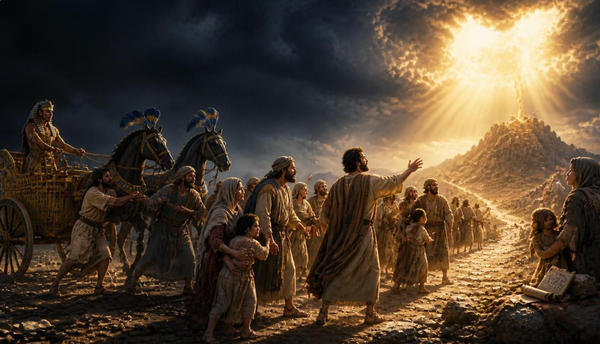
🌬️🌊🌳🏜️🪦 The Genesis of Israel: Living in The Land Wedged Between The Chaos of the Deep and the Chaos of the Wilderness [4 parts]
![🌬️🌊🌳🏜️🪦 The Genesis of Israel: Living in The Land Wedged Between The Chaos of the Deep and the Chaos of the Wilderness [4 parts]](https://storage.ghost.io/c/ab/d8/abd818ed-d1c7-4d9a-800d-8de8bae8d50c/content/images/size/w1200/2026/04/Screenshot-2026-04-13-5.00.59-PM.png)
I. 🌊 The World Before Order
Genesis 1:2 - “The earth (ha’aretz) was tohu va-bohu, and darkness was over the face of the tehom…”
Key Hebrew Terms
- Tohu → wasteland, desolation, uninhabitable desert
- Bohu → emptiness, void (paired intensifier)
- Tehom → the deep, primeval waters (not just “sea,” but chaotic abyss)
What’s striking:
This is not “nothingness.” It’s unordered territory.
Think in ANE (Ancient Near Eastern) spatial categories:
- Tohu = desert wilderness (like the Arabian steppe) 🏜️
- Tehom = chaotic sea (like the Mediterranean) 🌊
- Ha’aretz (the land) = the inhabitable zone between them 🌍
So Genesis 1:2 is not abstract—it’s geographic-symbolic:
The land exists, but it is trapped between two hostile realms:
- Chaos waters (west)
- Trackless wasteland (east)
This mirrors Israel’s actual geography:
- West → Mediterranean Sea
- East → Arabian Desert
- Middle → the ordered land where life can exist
👉 Creation, then, is God imposing structure between chaos and desolation.
🌊 The World Un-Created
Genesis 7:11 - “All the fountains of the great deep (tehom rabbah) burst forth, and the windows of the heavens were opened.”
This is not just rain. This is a reversal of Genesis 1.
Hebrew intensification:
- Tehom rabbah = “the great deep” (amplified chaos)
- Fountains burst = violent splitting, like tectonic rupture
What’s happening cosmically:
In Genesis 1:
- Waters are separated (above/below)
- Land is stabilized between chaos zones
In Genesis 7:
- Boundaries collapse
- The deep returns from below
- The heavens pour from above
👉 The ordered “middle space” (the land) is overwhelmed from both directions.
🧭 The Land Between: A Theological Geography
The land is not random—it is a narrow corridor of life between:
- Tehom (Sea / Chaos / Death) 🌊
- Tohu (Desert / Emptiness / Curse) 🏜️
This becomes a recurring biblical pattern:
1. Israel’s Story
- Delivered through the sea (chaos restrained)
- Tested in the wilderness (tohu encountered)
- Brought into the land (ordered life under God)
2. Jesus’ Pattern
- Passes through waters (baptism)
- Driven into wilderness
- Announces the Kingdom (restored order)
3. Spiritual Reality
The “land” represents:
The space where God’s order holds back both chaos and emptiness.
Without God:
- Chaos floods in (tehom)
- Meaning collapses into barrenness (tohu)
🔁 Flood as De-Creation
Genesis 7 is not just judgment—it is creation undone:
| Creation (Gen 1) | Flood (Gen 7) |
|---|---|
| Waters separated | Waters collapse |
| Land emerges | Land disappears |
| Life formed | Life erased |
| Order established | Chaos returns |
👉 The flood is a return to Genesis 1:2 conditions.
🪞 A Deeper Spiritual Layer
- Tehom = overwhelming external chaos (fear, disorder, deception)
- Tohu = internal emptiness (meaninglessness, spiritual barrenness)
The “good land” is where:
God’s Word creates clarity, boundaries, and life.
Remove His ordering presence, and reality collapses back into:
- confusion (darkness over the deep)
- emptiness (tohu).
🔥 Synthesis
Genesis is not just telling us what happened—it’s teaching where we live:
Humanity exists in a fragile, God-sustained middle space—
held between chaos and desolation.
- Creation = God holding back both
- Flood = God releasing both
- Redemption = God re-establishing both boundaries
II. 🏗️ The Parable as Creation Theology
Matthew 7:24–27 - “Everyone who hears these words of Mine and puts them into practice is like a wise man who built his house on the rock. The rain came down, the streams rose, and the winds blew and beat against that house; yet it did not fall, because it had its foundation on the rock.
But everyone who hears these words of Mine and does not put them into practice is like a foolish man who built his house on sand. The rain came down, the streams rose, and the winds blew and beat against that house, and it fell with a great crash.”
Jesus contrasts:
- House on rock
- House on sand
- Assault by rain, floods, and winds
This is not random imagery—it maps directly onto:
- Tohu (desert / instability)
- Tehom (waters / chaos)
- God’s ordering Word (creation stability)
🏜️ Sand = Tohu (Unstable Ground)
The “sand” isn’t just weak engineering—it’s theological terrain.
Hebrew backdrop:
- Tohu = trackless wasteland, shifting, unproductive
- No roots, no boundaries, no permanence
👉 Building on sand =
constructing a life on what is formless, unanchored, and ultimately uninhabitable
It’s existence without structure, like Genesis 1:2 before God speaks.
This ties to wilderness themes:
- Israel in the desert (testing, instability)
- Human tendency to live without divine ordering
🪨 Rock = Ordered Creation Under God
Psalm 18:2 — “The Lord is my rock, my fortress and my deliverer;
my God is my rock, in whom I take refuge.”
Psalm 91:1-2 — Whoever dwells in the shelter of the Most High will rest in the shadow of the Almighty. I will say of the Lord, “He is my refuge and my fortress, my God, in whom I trust.”
- Rock (Hebrew: tsur / sela‘)
- Stability
- Permanence
- Defensive strength
- A place that resists both desert erosion and floodwaters
👉 Building on the rock =
aligning with God’s established order—His Word, His ways, His structure.
This is Genesis 1 completed:
- Chaos restrained
- Land made livable
- Life able to endure
🌊 Storms = Tehom Breaking In
Jesus’ storm language is precise:
- Rain falls (waters above)
- Floods rise (waters below)
- Winds (violent forces, often tied to chaos imagery)
This is Genesis 7 language:
- The tehom bursting upward
- The heavens opening downward
👉 The storm is not just bad weather:
It is a miniature uncreation event.
🔁 The Parable as a Flood Test
Now the full picture:
| Element | Genesis Frame | Parable |
|---|---|---|
| Tohu | Desert chaos | Sand foundation |
| Tehom | Watery abyss | Floodwaters/storm |
| God’s order | Structured land | Rock foundation |
| Flood | Uncreation | House collapse |
Outcome:
- House on sand → collapses (returns to chaos)
- House on rock → stands (remains in ordered creation)
🧭 The Critical Pivot: “Hears and Does”
Jesus defines the difference:
Not hearing vs. ignoring
but hearing and doing vs. hearing without obedience.
This is massive.
👉 The “rock” is not just knowledge:
It is embodied alignment with God’s ordering Word.
Without obedience:
- You are standing in creation
- but building in tohu.
🪞 Spiritual Architecture
- A “bad eye” builds on sand—misjudges reality, trusts instability
- A “good eye” sees where true structure lies—builds on rock
👉 The issue is not storms coming
👉 The issue is whether your structure belongs to creation or pre-creation
🔥 Synthesis
Jesus is essentially saying:
“When the waters of uncreation come—and they will—
only what is built on God’s established order will remain.”
- Sand (tohu) cannot withstand tehom.
- Only what is anchored in God as Rock survives the collapse of false order.
⚔️ One Step Further
This re-frames the parable in a sobering way:
The foolish builder doesn’t fail because of ignorance—
but because they tried to build something meaningful in a place God never ordered.
That’s why the fall is described as:
“great”
Not just structural failure—but total collapse back into Genesis 1:2.
III. 🏚️ Isaiah 24:10 - “The City of Tohu”
“The city of chaos (qiryat tohu) is broken down; every house is shut up…”
- qiryat tohu→ city of formlessness / wasteland / uncreation
This is shocking language. A city is the pinnacle of human order:
- structure
- governance
- security
- identity
But Isaiah says:
The city has become tohu.
👉 Not just destroyed—uncreated.
What that implies:
- Social order collapses into pre-creation disorder
- Human systems revert to Genesis 1:2 conditions
- Houses exist—but are unusable (“shut up”)
It’s civilization returning to desert.
🌊 Mark 4:35–41 - Tehom Unleashed
Jesus crosses the sea, and:
- A “great storm” arises
- Waves break into the boat
- The boat is being overwhelmed
Greek detail:
- (lailaps megale) = a violent, chaotic storm
- The sea behaves like tehom breaking loose
👉 This is not just weather:
It is a localized uncreation event
The disciples’ terror reveals what they perceive:
“We are going back to Genesis 1:2.”
🗣️ Jesus’ Response - Creation Authority
Jesus rebukes:
- The wind
- The sea
“Peace. Be still.”
This echoes not sailors—but Creator language seen in:
- Job (God restraining the sea)
- Psalm 89 (stilling the raging waters)
👉 Jesus is not surviving chaos
👉 He is re-imposing creation order on tehom
🪦 Mark 5:1–20 - A Human “City of Tohu”
Immediately after, they land in the Decapolis.
And what do we find?
A man:
- Living among tombs (death space)
- Isolated from society (anti-city)
- Uncontrollable, fractured identity (“Legion”)
- Self-destructive
👉 This man is:
A living qiryat tohu
He is what Isaiah 24:10 describes:
- A “house” (human life) that is shut up
- Order collapsed into chaos
- Humanity reverted to uninhabitable state
🐖 Legion and the Deep
When Jesus casts out the demons:
- They beg not to be sent away (Luke adds “into the abyss” = tehom conceptually)
- They enter pigs
- The pigs rush into the sea and drown
This is symbolic precision:
- Chaos spirits → return to the waters
- The sea reclaims what belongs to it
👉 It’s a reverse exodus / anti-creation moment
—but under Jesus’ authority
🔁 Full Pattern Alignment
| Theme | Isaiah 24:10 | Mark 4 | Mark 5 |
|---|---|---|---|
| Tohu | City becomes chaos | Implied threat | Man as living wasteland |
| Tehom | Implied judgment | Storm/sea | Demons return to waters |
| Collapse | Houses shut | Boat filling | Man fragmented |
| Restoration | (future hope) | Sea calmed | Man restored, seated |
🧭 The Movement: Sea → Shore → Soul
Mark intentionally sequences this:
- Cosmic chaos (sea storm) 🌊
- Geographical chaos (Gentile territory, unclean space) 🌍
- Personal chaos (demonized man) 🧠
👉 Jesus brings order at every level:
- Nature
- Territory
- Humanity
🪨 Hidden Connection to Earlier Thread
Now link back:
- Isaiah 24 → society becomes tohu
- Mark 4 → creation threatens to revert to tehom
- Mark 5 → a human life embodies both
And Jesus:
Rebuilds what has collapsed—like the true builder on the rock.
🔥 Synthesis
Isaiah warns:
Even the strongest human systems can become tohu
Mark reveals:
When that happens, the chaos is not theoretical—it is spiritual, cosmic, and personal
And Jesus demonstrates:
When God’s order is rejected, creation itself begins to unravel into tohu and tehom—and Jesus steps directly into that collapse.
He is not merely teaching about stability—
He is the One who stands at the boundary of creation and uncreation and commands both.
⚔️ Insight (and examples)
The “city of tohu” and the “man of Legion” are the same reality at different scales:
- One is a society that has lost God’s order
- The other is a person who has lost internal order
👉 In both cases: Without God, what looks structured eventually collapses into chaos.
Ezekiel 13:10-16 - “‘Because they lead My people astray, saying, “Peace,” when there is no peace, and because, when a flimsy wall is built, they cover it with whitewash, therefore tell those who cover it with whitewash that it is going to fall.
Rain will come in torrents, and I will send hailstones hurtling down, and violent winds will burst forth. When the wall collapses, will people not ask you, “Where is the whitewash you covered it with?”
“‘Therefore this is what the Sovereign Lord says: In My wrath I will unleash a violent wind, and in my anger hailstones and torrents of rain will fall with destructive fury. I will tear down the wall you have covered with whitewash and will level it to the ground so that its foundation will be laid bare.
When it falls, you will be destroyed in it; and you will know that I am the Lord. So I will pour out My wrath against the wall and against those who covered it with whitewash. I will say to you, “The wall is gone and so are those who whitewashed it, those prophets of Israel who prophesied to Jerusalem and saw visions of peace for her when there was no peace, declares the Sovereign Lord.”’
Matthew 25:27-28 - “Woe to you, teachers of the law and Pharisees, you hypocrites! You are like whitewashed tombs, which look beautiful on the outside but on the inside are full of the bones of the dead and everything unclean. In the same way, on the outside you appear to people as righteous but on the inside you are full of hypocrisy and wickedness.
IV. 🌊➡️🚫 “The Sea Was No More” - The End of Tehom
Revelation 21:1 - “And I saw… and the sea was no more.”
In biblical thought, this is not about missing oceans.
“Sea” = tehom logic
- Chaos
- Threat
- Unbounded, anti-creation forces
- The source domain of beasts (Daniel, Revelation 13)
👉 This is the final statement: The possibility of uncreation is gone.
Not restrained. Not rebuked. Removed.
🏙️ “The Holy City” - The End of Tohu
Revelation 21:2 - “I saw the holy city, new Jerusalem, coming down…”
Now contrast directly with Isaiah 24:10 (city of tohu):
| Isaiah 24 | Revelation 21 |
|---|---|
| City of chaos | Holy city |
| Broken down | Descending complete |
| Houses shut | Dwelling open |
| Uninhabitable | God dwells with man |
👉 This is not just restoration: It is the anti-tohu city
A city that can never collapse back into formlessness.
🌳 Eden + City + Temple = One Reality
Revelation 21–22 fuses three streams:
1. Eden 🌿 (Genesis 2)
- Tree of life
- River flowing
- God’s presence
2. City 🏙️ (human order redeemed)
- Structure, culture, community
3. Temple ⛪
“I saw no temple… for the Lord God… and the Lamb are its temple”
👉 Meaning: God’s ordering presence is no longer localized—it fills everything
💡 Light Without Darkness
Revelation 22:5 - “Night will be no more…”
Back to Genesis 1:2:
- Darkness over the deep
Now:
- No darkness
- No deep
- No threat of reversal
👉 Creation is no longer contingent. It is permanently established
🔁 Full Arc: From Edge to Elimination
| Stage | Condition | Status of Chaos |
|---|---|---|
| Genesis 1 | Ordered world | Chaos restrained |
| Genesis 7 | Flood | Chaos released |
| Isaiah 24 | Society collapses | Chaos internalized |
| Mark 4–5 | Jesus confronts chaos | Chaos rebuked |
| Revelation 21–22 | New creation | Chaos eliminated |
🪞 The Deep Personal Layer
This isn’t just cosmic—it’s anthropological.
Earlier:
- Humans = fragile “houses”
- Vulnerable to:
- Tohu (emptiness, misalignment)
- Tehom (overwhelming forces)
Now:
Revelation 22:4 - “His servants will see His face…”
That’s the ultimate reversal of:
- distorted perception
- the “bad eye”
- mis-seeing reality
👉 Nothing in us remains:
- disordered
- divided
- vulnerable to collapse
🪨 The Rock Fully Realized
What Jesus described in Matthew 7 becomes permanent reality:
- No more storms
- No more floods
- No more sand
Because:
Everything is now built on the Rock by default.
🔥 Synthesis
What began in Genesis as:
A world suspended between tohu (desert) and tehom (sea)
Ends in Revelation as:
A world where neither exists anymore.
⚔️ The Striking Conclusion
All of Scripture can be read as this tension:
Will creation hold… or collapse back into Genesis 1:2?
And the answer, finally, is:
Through the Lamb, God does not merely hold it together—
He remakes it so it can never fall apart again.