(B) 🏠🧠❤️⚡🚨🛡🕊 The House Inside Your Head: The Three-Story Brain
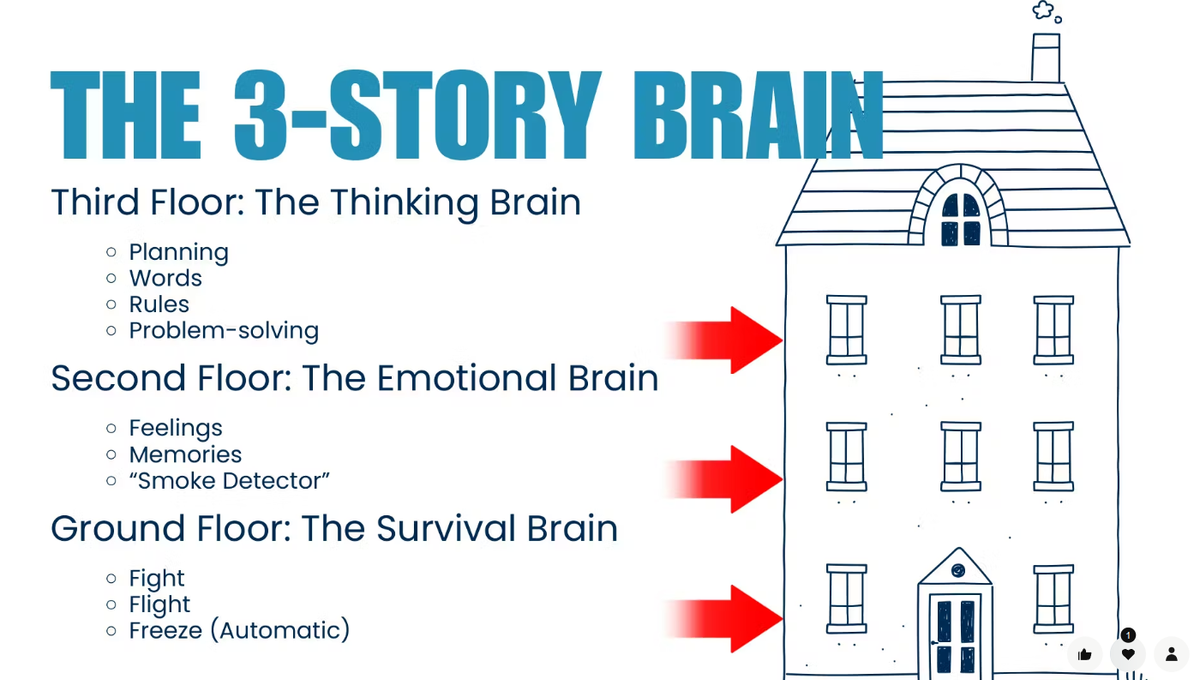
I. The Three-Story Brain Model
This model (popularized by Dan Siegel) is a useful functional framework for understanding emotional dysregulation without pathologizing it. In brief:
- Upstairs brain (prefrontal cortex): reasoning, empathy, moral judgment, impulse control, long-range vision.
- Downstairs brain (limbic system): emotions, memory, attachment, threat detection.
- Smoke detector (amygdala): rapid, non-verbal alarm system designed for survival, not accuracy.
When someone “goes downstairs,” the initial issue is not sin, weakness, or lack of intelligence—it is that the alarm system has temporarily overridden the executive suite.
The elevator does not respond to logic commands while the fire alarm is blaring.
So the real question becomes: How does one re-engage the upstairs brain without fighting the alarm?
First Principle: You Cannot Think Your Way Out of an Alarm
When the amygdala is active, rules-based problem solving is neurologically offline. Attempts to reason, debate, or self-lecture typically escalate the alarm rather than quiet it.
The goal is not to suppress emotion but to signal safety.
Step 1: Pause and Name the State (Containment Before Correction)
Naming activates the prefrontal cortex.
- “I am feeling threatened.”
- “My smoke detector is on.”
- “This is fear/anger/shame, not a verdict.”
This is not denial; it is orientation. Research consistently shows that affect labeling reduces amygdala activation. (This keeps us upstairs, away from the non-thinking, reactive, ground floor).
Spiritually speaking: this is the modern equivalent of watchfulness—observing the heart rather than being dragged by it.
Step 2: Regulate the Body Before Addressing the Mind
The downstairs brain listens to physiology, not propositions.
Effective tools:
- Slow exhale breathing (longer out-breath than in-breath)
- Grounding through temperature (cool water, firm contact with a chair or floor)
- Gentle bilateral movement (walking, rocking, alternating taps)
It is important to note that just walking isn't helpful if on that walk your mind is racing through catastrophic possibilities, the focus should be on the sensation of walking.
Why this works: the vagus nerve communicates safety upward.
Calm the body, and the brain follows. If you skip this step, you are arguing theology with a fire alarm.
Step 3: Restore Relational Safety
The upstairs brain is relationally dependent. Isolation keeps the alarm active.
- A calm, attuned presence—another person or even remembered attachment—signals safety.
- Self-compassion works because it mimics secure attachment internally.
This is why Scripture repeatedly frames peace as something received, not manufactured:
“Be still, and know…”
Stillness comes before knowing.
Prayer that "fails" is asking for strength when on the ground floor, or trying to recall rules that you should be following. Prayer that is powerful and effective remembers attachment to a trustworthy Father, who protects His children and grants them grace and peace.
Rather than recalling Scripture rules to help buffer against sin, recall Scripture that details God's faithfulness. Prepare in advance to either recite or read about narrative examples of God's goodness.
Step 4: Curiosity Reopens the Staircase
Once the alarm volume drops, curiosity becomes possible.
Ask non-accusatory questions:
- “What does my smoke detector think it is protecting?”
- “What past experience might this resemble?”
- “What feels at stake right now?”
Curiosity is the opposite of threat. It is the cognitive posture that reactivates the upstairs brain.
Step 5: Reintroduce Meaning, Not Rules
Only now is it appropriate to return to reasoning—but not rule enforcement.
Rules say: “You shouldn’t feel this way.”
Meaning says: “This reaction makes sense in context.”
Meaning integrates emotion; rules attempt to dominate it.
From a theological lens, this mirrors the difference between law and wisdom:
Law simply states boundaries, wisdom discerns timing.
A Crucial Re-frame: The Smoke Detector Is Not the Enemy
The amygdala is often wrong—but never malicious.
It errs on the side of survival. Treating it as an adversary teaches the brain that internal experience itself is dangerous, which guarantees repeat alarms.
Integration—not suppression—is the goal.
Summary: How One “Goes Back Upstairs”
- Name the state (orientation)
- Calm the body (physiological safety)
- Restore connection (relational safety)
- Engage curiosity (meaning-making)
- Return to reason gently (integration, not control)
Or more simply:
Safety → Connection → Curiosity → Clarity
Once upstairs, problem-solving resumes—but now it is informed by emotion rather than hijacked by it.
The goal is not perfection; it is faster recovery and deeper integration.
II. I. Three-Story Brain as a Framework for Spiritual Formation
Spiritual formation is not primarily about acquiring information; it is about training the nervous system to recognize safety in God’s presence.
Upstairs Brain → Renewed Mind
- Discernment
- Moral reasoning
- Long-term obedience
- Love of neighbor
- Wisdom over impulse
Scripture calls this phronesis (sound-mindedness) and metanoia (transformed thinking). However, Scripture never assumes this operates independently of the heart or body.
Romans 12:2 - “Be transformed by the renewing of your mind”
This presupposes the mind can function—which it cannot when the smoke detector is blaring.
Downstairs Brain → Heart (Lev / Kardia)
- Desire
- Fear
- Attachment
- Memory
- Longing
Biblically, the “heart” is not irrational—it is pre-rational. It must be formed, not scolded.
Spiritual disciplines (prayer, fasting, Sabbath, worship) work because they train the downstairs brain to associate God with safety rather than threat.
Smoke Detector → Fear of Death, Loss, Exposure
The amygdala reacts to:
- perceived abandonment
- loss of control
- shame or humiliation
- scarcity
- threat to identity
These are precisely the categories Scripture repeatedly addresses. Formation is slow because fear learns slowly.
II. Temptation and Impulse Control Through This Lens
Why Temptation Feels Urgent
Temptation almost always occurs downstairs.
The brain says: “This will make the alarm stop.”
Lust, rage, greed, escape behaviors—these are regulation strategies, not merely moral failures.
This explains why:
- temptation escalates under stress
- isolation increases vulnerability
- willpower collapses under fatigue
Why Willpower Fails
Willpower is an upstairs function. Temptation is a downstairs event. That mismatch guarantees failure.
This is why Paul does not say, “Try harder,” but:
“Walk by the Spirit.”
Walking implies pace, presence, and ongoing regulation, not emergency control.
III. Flesh vs. Spirit: A Neuro-Spiritual Alignment
This distinction becomes far clearer when viewed neurologically.
Flesh (Sarx)
Not the body itself, but unintegrated desire under threat.
Characteristics:
- Reactivity
- Short-term relief seeking
- Defensive justification
- Loss of empathy
- Binary thinking (fight / flee / freeze)
This aligns precisely with amygdala-driven behavior.
“The flesh desires what is contrary to the Spirit” because fear cannot see beyond the moment.
Spirit (Pneuma)
The Spirit does not bypass emotion; He integrates it.
Characteristics:
- Self-control (enkrateia)
- Patience under pressure
- Love even when threatened
- Discernment rather than urgency
Self-control is not suppression—it is regulated freedom.
The Spirit restores access to the upstairs brain by first bringing peace downstairs.
IV. Practically: What To Do When You’ve “Gone Downstairs”
Here is the integrated sequence—spiritually and neurologically sound.
1. Recognize Without Condemnation
“This is my smoke detector.”
Condemnation intensifies threat.
Conviction clarifies without panic.
2. Regulate the Body (Humility Before Control)
Slow your breathing. Ground your body.
Biblically:
“Be still.”
Stillness is not inactivity; it is physiological submission.
3. Re-establish Presence
God is not waiting upstairs for you to behave your way back.
Presence precedes obedience.
“The Lord is near.”
Nearness quiets alarms.
4. Get Curious, Not Rigid
“What am I trying to protect?”
“What feels at risk?”
This mirrors the psalmist’s practice:
“Search me, O God…”
Search implies patience, not interrogation.
5. Choose the Next Faithful Step (Not the Perfect One)
Once upstairs function returns, choose the smallest act of obedience that aligns with love.
The Spirit leads in steps, not leaps.
V. An Integrative Insight
The gospel does not merely forgive sin; it re-trains fear.
Sanctification is not the eradication of desire—it is the re-ordering of desire under safety.
Or stated plainly:
- The flesh panics and grabs.
- The Spirit calms and guides.
- The mind follows whichever one establishes safety first.
Sometimes the most spiritual thing you can do is drink water, slow your breathing, and stop arguing with yourself.
That is not weakness. That is wisdom—biblical, neurological, and deeply human.
III. 1. Eve (Genesis 3:1–6) — Anxiety Before Autonomy
Downstairs Indicators
- The conversation begins with doubt and uncertainty, not rebellion.
- God is subtly re-framed as restrictive (“Did God really say…?”).
- The fruit is seen as:
- good for food (bodily need)
- pleasing to the eye (desire)
- desirable for wisdom (threat of inadequacy)
This is not impulsive stupidity; it is threat-based reasoning.
The Descent
- The smoke detector activates: “What if God is withholding?”
- Emotional concern precedes moral violation.
- The upstairs brain (trust, long-term obedience) is bypassed.
Key Insight
Sin begins when security in God is replaced by self-provision.
2. Cain (Genesis 4:3–8) — Unregulated Shame
Downstairs Indicators
- “Cain was very angry, and his face fell.”
- God addresses Cain before the act, indicating awareness of the descent.
“Sin is crouching at the door; its desire is for you…”
This is not yet sin—it is emotional dysregulation.
The Descent
- Perceived rejection triggers shame and rivalry.
- Cain ruminates rather than regulating.
- Isolation replaces dialogue.
Key Insight
When shame is not metabolized, it seeks a target.
3. Saul (1 Samuel 13; 15) — Fear of Loss of Control
Downstairs Indicators
- “The people were scattering from him.”
- Saul panics over optics, timing, and authority.
- He performs priestly duties not out of devotion, but anxiety.
The Descent
- Fear of losing status overrides obedience.
- He justifies his actions after the fact—a classic downstairs defense.
“I felt compelled…”
Compulsion language is a red flag.
Key Insight
Fear-driven leadership always substitutes control for trust.
4. David (2 Samuel 11) — Dysregulated Desire Under Comfort
Downstairs Indicators
- David remains home during wartime.
- He is idle, unaccountable, and overstimulated.
- The text emphasizes seeing before taking.
The Descent
- Desire is unchallenged by purpose or presence.
- The upstairs brain never engages because the smoke detector says, “This will satisfy.”
Key Insight
Unchecked comfort dulls discernment.
5. Jonah (Jonah 4) — Emotional Absolutism
Downstairs Indicators
- Jonah is angry “enough to die.”
- Binary thinking: justice or nothing.
- He refuses dialogue and isolates himself.
The Descent
- His emotional narrative becomes totalizing.
- God’s mercy feels threatening to Jonah’s identity.
Key Insight
Moral rigidity often masks emotional fear.
6. Peter (Matthew 26:69–75) — Fear of Exposure
Downstairs Indicators
- Peter follows “at a distance.”
- The setting is cold, dark, and hostile.
- His responses escalate in intensity.
The Descent
- Fear of association triggers self-preservation.
- Each denial compounds the last—spiral behavior.
Key Insight
Fear fractures identity before it fractures speech.
7. The Israelites (Numbers 14) — Panic Memory
Downstairs Indicators
- The people catastrophize based on incomplete information.
- They long for Egypt despite slavery.
The Descent
- The smoke detector says: “We will die here.”
- Memory is rewritten by fear.
Key Insight
Fear rewrites the past to justify retreat.
A Pattern Scripture Repeats
Across these narratives, Scripture consistently shows:
- Emotion precedes action
- Perceived threat precedes sin
- Isolation accelerates descent
- God often intervenes before the act
- Sin follows when regulation fails
This strongly supports the claim that:
sin is rarely a cold, calculated rebellion—it is more often a hot, dysregulated response to perceived danger or unmet desire.
Theological Synthesis
What neuroscience calls “going downstairs,” Scripture calls:
- being “given over”
- being “hardened”
- being “led astray”
- walking “according to the flesh”
The Spirit’s role, therefore, is not merely to forbid sin, but to restore integration.
Romans 8:6 - “The mind governed by the Spirit is life and peace.”
Peace is not a reward for obedience; it is the condition that makes obedience possible.
IV. I. Shalom Is Not the Absence of Stress but the Presence of Order
The modern assumption is that peace means no disturbance. Biblically, shalom means wholeness, alignment, and stability under pressure. Shalom functions as a preventative regulator, keeping a person from automatically “going downstairs” when stressors arise.
Shalom is the state in which:
- relationships are rightly ordered,
- desires are integrated rather than competing,
- fear does not dominate perception.
This makes shalom neurologically significant: it reduces baseline threat sensitivity.
Psalm 119:165 - “Great peace have those who love Your law; nothing causes them to stumble.”
“Nothing” here does not mean no stressors; it means no automatic descent.
II. Peace as a Guard, Not a Reward
Paul’s language in Philippians 4 is unusually precise:
“The peace of God… will guard your hearts and your minds in Christ Jesus.”
“Guard” is a military term. Peace is depicted as a sentinel, not a feeling.
What Peace Guards Against
- Intrusive fear narratives
- Catastrophic interpretation
- Impulsive reaction
- Emotional hijacking
In neurological terms, peace keeps the amygdala from assuming command prematurely.
III. Shalom as Baseline Regulation
When peace is cultivated, the nervous system learns:
- “I am not alone.”
- “Provision exists beyond immediate control.”
- “Time is not collapsing.”
This shifts the threshold at which the smoke detector activates.
Scriptural Evidence
Isaiah 26:3 - “You keep him in perfect peace whose mind is stayed on You.”
“Stayed” implies anchored attention, not mental suppression. Anchoring reduces reactivity.
IV. Jesus as the Model of Regulated Presence
Jesus consistently encounters high-stress stimuli without descending.
Storm on the Sea (Mark 4)
- External chaos
- Internal calm
- Authority flows from peace, not urgency
“Why are you so afraid?”
Fear is not rebuked as emotion, but as misplaced control.
Gethsemane (Luke 22)
- Distress acknowledged
- Body regulated through prayer
- Obedience flows from surrendered peace
Jesus does not bypass the downstairs brain; He brings it into submission through remembering His relationship with our Father, who is faithful and trustworthy.
V. Shalom Interrupts the Automatic Sequence
Without peace:
Stressor → Threat → Reaction → Justification → Sin
With peace:
Stressor → Pause → Discernment → Faithful action
Peace inserts space. And space is where freedom lives.
VI. Old Testament Patterns: Peace as Stability Under Pressure
Gideon (Judges 6)
God declares peace before Gideon is courageous.
“Peace be to you. Do not fear.”
Courage follows peace, not the reverse.
David (Psalm 4)
“In peace I will lie down and sleep…”
Sleep in threat conditions is a sign of deep regulation, not denial.
VII. The Flesh Reacts; Shalom Responds
The flesh interprets stress as danger. Shalom interprets stress as information.
This is why Paul pairs peace with:
- self-control
- gentleness
- patience
These are not traits; they are regulated responses.
VIII. Cultivating Shalom as Preventative Formation
Scriptural practices that cultivate shalom:
- Sabbath (baseline restoration)
- Prayer (relational safety)
- Thanksgiving (threat re-frame)
- Scripture meditation (memory stabilization)
- Community (external regulation)
These practices lower the probability of descent, not just the severity.
Peace is not conjured in crisis; it is trained in advance.
IX. Theological Synthesis
Shalom is God’s answer to human reactivity.
It is the condition in which:
- the heart remains open under stress,
- the mind remains accessible,
- obedience remains possible.
Or stated plainly:
Peace does not eliminate the smoke detector.
It teaches it when not to scream.
V. Narrative-based Recall List
Below is a curated, narrative-based recall list specifically designed for moments of emotional dysregulation—when the smoke detector is loud and access to the “upstairs brain” is limited. These stories are chosen not for abstraction, but because they communicate safety, continuity, and faithfulness, which is exactly what helps a person go back upstairs.
Think of these as scriptural anchors—memories that stabilize perception under stress.
Why Narrative Recall Works
When someone is dysregulated, propositions fail but stories work. Scripture itself models this repeatedly:
“Remember… do not forget…”
Remembering is not nostalgia; it is nervous-system reorientation.
Core Category 1: God Shows Up When People Are Afraid
1. Hagar in the Wilderness (Genesis 16; 21)
- Abandoned
- Pregnant
- Powerless
God sees her, names her pain, and provides.
Recall line:
🕊 God sees me even when I feel discarded.
2. Israel at the Red Sea (Exodus 14)
- Trapped
- Accused Moses
- Certain of death
God makes a way where none existed.
Recall line:
🛣 God makes paths after panic peaks.
3. Elijah Under the Broom Tree (1 Kings 19)
- Suicidal ideation
- Exhausted
- Isolated
God gives food, rest, and gentle presence before correction.
Recall line:
🍞 God tends to my body before addressing my fear.
Core Category 2: God Is Faithful Despite Human Failure
4. Peter After Denial (Luke 22; John 21)
- Public failure
- Shame
- Fear-driven betrayal
Jesus restores him without interrogation.
Recall line:
🔥 Failure does not forfeit belonging.
5. David After Bathsheba (2 Samuel 12; Psalm 51)
- Serious moral collapse
- Confronted, not abandoned
- Restored through repentance
Recall line:
💧 God restores the repentant, not the flawless.
6. Israel After the Golden Calf (Exodus 32–34)
- Immediate covenant breach
- Severe consequences
- Covenant renewed
God reveals His Name as merciful and gracious.
Recall line:
🪞 God is faithful even when I am unstable.
Core Category 3: God Provides in Scarcity and Uncertainty
7. Manna in the Wilderness (Exodus 16)
- Daily uncertainty
- No stockpiling allowed
- Faith trained through rhythm
Recall line:
🍞 God provides one day at a time.
8. Widow of Zarephath (1 Kings 17)
- Last meal
- Dire scarcity
- God multiplies what is surrendered
Recall line:
🫙 Small obedience meets abundant faithfulness.
9. Feeding of the 5,000 (Matthew 14)
- Insufficient resources
- Human limitation acknowledged
- Divine abundance released
Recall line:
🐟 God works with what I bring, not what I lack.
Core Category 4: God Keeps His Promises Over Time
10. Joseph’s Story (Genesis 37–50)
- Betrayal
- False accusation
- Long delay
God weaves faithfulness through years of confusion.
Recall line:
🧵 God is working even when I cannot see it.
11. Abraham and Isaac (Genesis 22)
- Seemingly contradictory command
- Ultimate provision
- Trust vindicated
Recall line:
🐏 God provides what He requires.
12. Return from Exile (Ezra–Nehemiah)
- Long discipline
- Partial restoration
- Faithfulness across generations
Recall line:
🏗 God finishes what He begins—even slowly.
Core Category 5: God’s Nearness in Distress
13. Psalm 23 (David)
- Valleys acknowledged
- Presence emphasized
- Table set amid enemies
Recall line:
🌿 God is with me here, not waiting for me there.
14. Jesus in the Storm (Mark 4)
- Disciples panic
- Jesus remains present
- Peace precedes explanation
Recall line:
🌊 God’s presence is not shaken by my fear.
15. The Cross and Resurrection
- Apparent abandonment
- Ultimate faithfulness
- Life after loss
Recall line:
✝️➡️🌅 God brings life out of what feels final.
How to Use This List When Dysregulated
- Choose one story only (more is overwhelming).
- Recall the narrative image, not the doctrine.
- Repeat the recall line aloud or silently.
- Let the story do the work—do not argue with yourself.
This is not mental gymnastics; it is biblical remembrance.
Final Synthesis
Scripture repeatedly commands remembrance because:
- fear collapses time,
- dysregulation narrows perception,
- and memory restores perspective.
Or said simply:
When fear says “This has never been worse,”
remembrance says “God has always been faithful.”
And that reminder—quiet, steady, relational—is often enough to help the soul go back upstairs.
![👑🍞🍷🎭💔🚪(B) The King’s ‘Friend’: Near the Table, Far from the Heart [5 parts]](/content/images/size/w600/2026/04/Screenshot-2026-03-31-7.03.14-PM-1.png)
![👁️ 👁️✨🧠👣 (A) Discernment Through Transformation: Why Right Action and Right Timing Require a Renewed Mind [3 parts]](/content/images/size/w600/2026/04/Screenshot-2026-03-31-7.03.14-PM.png)