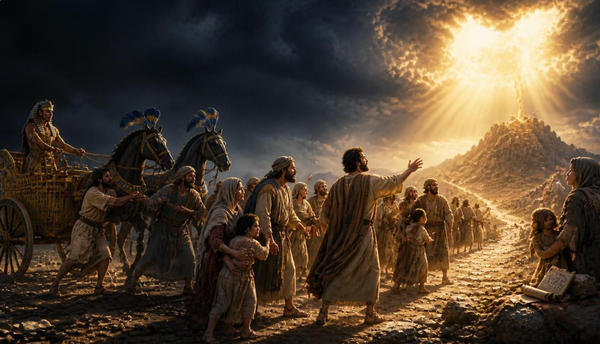
🌄🐑📜🧭✨The Shepherd Spirit and the Scroll: Being Led Beyond the Letter [3 parts]
There’s a pattern in Scripture that’s easy to miss if we only associate the Spirit with comfort, clarity, and immediate provision. The same Spirit who fills… also leads—and where He leads is often diagnostic before it is restorative. And the Spirit quietly asks, 'Would you rather have Instructions… or a Guide?'
I. 1. The Same Phrase, Same Pattern
When Paul says in Romans 8:14, “those who are led by the Spirit of God are sons of God,” the Greek verb (agō) implies being actively brought along, even carried into situations—not just gently nudged.
That exact dynamic shows up in Jesus:
Matthew 4:1 — Jesus is “led up by the Spirit into the wilderness to be tested.”
Luke 4:1 — He is “full of the Spirit… led in the wilderness.”
This is not accidental overlap. The Spirit’s leadership includes:
- Direction toward purpose
- Exposure of what is within
- Confrontation with what is lacking
Sonship is not proven in comfort—it’s revealed in testing environments.
2. The Wilderness as Revelation, Not Punishment
The wilderness is not primarily about deprivation—it’s about disclosure.
Consider Israel:
- Called God’s “son” (Exodus 4:22)
- Led by God into the wilderness
- There, they felt hunger, thirst, fear
- Their responses revealed what ruled their hearts: grumbling, fear, nostalgia for Egypt
Now Jesus:
- Declared “Son” at baptism
- Immediately led into the wilderness
- Feels hunger (very real deficit)
- But where Israel said, “Is God among us?” Jesus says, “It is written.”
Same Spirit. Same environment. Different internal reality revealed.
👉 The wilderness exposes whether we trust God or merely cling to His provisions.
3. Spirit-Led Into Lack 👀
This is the uncomfortable truth:
The Spirit may lead you somewhere your needs are not immediately met.
- Hunger is not instantly satisfied
- Clarity is not immediately given
- Relief is not quickly provided
Why? Because untested fullness is unproven.
Jesus was full of the Spirit—yet still hungry. That tension is intentional.
It reveals:
- Whether we define God by our conditions
- Or define our conditions by God’s Word
4. “Without Me You Can Do Nothing” Meets the Wilderness
When Jesus says in John 15:5, “apart from Me you can do nothing,” the wilderness becomes the lived experience of that statement.
In the wilderness:
- Your resources run out
- Your illusions of self-sufficiency collapse
- Your “strength” gets audited
And what’s left? Either:
- Dependence on God
- Or grasping for control (turn stones to bread prematurely 👀)
The test is not whether you have needs—
The test is how you respond when those needs are unmet.
5. Paul’s Layer: “Without Love, I Am Nothing”
Now bring in 1 Corinthians 13:1–3:
You can do impressive things—but without love, it’s nothing.
Combine that with the wilderness. The Spirit may lead you into situations where:
- You’re tired
- You’re strained
- You’re not being “poured into”
- You’re not being affirmed
Why? Because love is most clearly revealed when it is:
- Costly
- Unrewarded (in the moment)
- Unseen
The wilderness tests not just faith—but love.
6. Fire Reveals What Was Built (1 Corinthians 3:13)
Now layer in the idea of works being tested by fire:
The wilderness is like a preliminary burn test. 🔥 It reveals:
- What is built on dependence vs independence
- What is fueled by love vs ego
- What is anchored in God vs circumstances
Things done:
- With Christ (love, dependence) → endure
- Apart from Him (self-reliance, image) → collapse
7. The Deeper Thread: Spirit-Led Exposure Is Mercy
This is where the tone shifts from harsh to deeply compassionate.
The Spirit doesn’t lead you into lack to harm you—
He leads you there to tell you the truth about you before life does.
Because:
- Hidden deficits become destructive later
- Unseen hunger becomes misdirected desire
- Unacknowledged weakness becomes quiet corruption
The wilderness is where God says:
“Let’s deal with this together before it defines you.”
8. A Subtle but Critical Insight
The enemy tempts in the wilderness—but he does not lead there.
That distinction matters.
- The Spirit leads you into truth
- The enemy tries to distort what that truth means
Example:
- Hunger → real, Spirit-allowed condition
- Temptation → “God must not care… fix it yourself”
Same circumstance—two interpretations.
9. What This Means Practically
If you find yourself in a season where:
- Needs are visible but not met
- Weakness is undeniable
- God feels present but not intervening quickly
You may not be off track. You may be precisely where the Spirit has led you.
And the question isn’t: “Why am I lacking?”
But: “What is being revealed in me right now?”
10. Thread 🪞
The wilderness is a mirror. Not to shame—but to clarify.
Jesus walks out of the wilderness having proven dependence.
Israel walked out still wrestling with it.
And for us?
Being led by the Spirit doesn’t mean avoiding the wilderness—
It means entering it with Someone who intends to form something in you that cannot be formed anywhere else.
II. 1. Psalm 23 - Led Through, Not Around
Psalm 23 is explicitly about guidance:
“He leads me…” (Hebrew: nahal – to guide, conduct, bring along)
Where does that leadership go?
- Green pastures ✅
- Still waters ✅
- Valley of the shadow of death 👀
The same Shepherd leads to both.
This is critical:
- The valley is not a detour
- It is not evidence of failure
- It is part of the path of righteousness
👉 Meaning: right paths include dark valleys.
And in that valley:
- Provision is not removed (rod, staff, presence)
- But comfort is no longer circumstantial—it is relational
“I will fear no evil, for You are with me.”
The shift:
- From what God gives → to who God is
2. Psalm 91 - Protection Within Exposure
Psalm 91 is often read as if it promises avoidance of trouble.
But look carefully—it actually assumes exposure:
- “Pestilence”
- “Terror by night”
- “Arrow by day”
- “Lion and serpent”
These aren’t hypothetical—they’re present realities.
The promise is not:
“You won’t encounter these.”
But:
“They won’t ultimately overcome you.”
This aligns perfectly with the wilderness pattern:
Jesus is in the wilderness…
- Hungry
- Tempted
- With wild beasts (Mark 1:13)
And what does the tempter quote?
👉 Psalm 91.
But he misuses it—trying to turn trust into presumption:
“Throw Yourself down…”
In other words, Psalm 91 is not permission to force outcomes, it is assurance within obedience, not outside it.
3. The Overlap: Led + Tested + Kept
Now bring all three threads together:
| Theme | Psalm 23 | Psalm 91 | Jesus in Wilderness |
|---|---|---|---|
| Led by God | “He leads me” | “He will command His angels” | “Led by the Spirit” |
| Real danger | Valley of death | Pestilence, lions | Satan, hunger |
| Needs unmet | No mention of instant relief | No removal of threat | 40 days hungry |
| Security source | “You are with me” | “He is my refuge” | “It is written” |
| Outcome | Restoration | Deliverance | Victory |
👉 The pattern is consistent: God’s leading includes exposure—but also preservation.
4. The Hidden Thread: Abiding vs Escaping 🌿
Psalm 91 begins with:
“He who dwells in the secret place…”
This is not about visiting God occasionally—it’s about remaining.
Compare that with Psalm 23: The sheep doesn’t navigate the valley alone, it stays with the shepherd.
And with Jesus, He refuses to step outside the Father’s will to meet His own needs. So the real contrast isn’t danger vs safety, It’s abiding vs grasping
5. Needs, Timing, and Trust ⏳
Both psalms subtly challenge our expectations about timing.
Psalm 23: You’re in the valley… and still walking
Psalm 91: The threat exists… and yet you are kept
Jesus: Hungry for 40 days… then angels come
👉 Provision is often delayed, not denied
Why? Because immediate relief can prevent deeper trust from forming.
6. The Table in the Presence of Enemies 👀
This might be the most striking overlap:
Psalm 23:
“You prepare a table before me in the presence of my enemies”
Not after they’re gone.
Not once things calm down.
Right there.
This is Psalm 91 language:
- Surrounded, yet secure
- Exposed, yet sustained
And this is Jesus:
- Tempted, yet anchored
- Weak, yet unyielding
👉 God doesn’t always remove the environment—He establishes you within it.
7. The Serpent Connection 🐍
Psalm 91 says:
“You will tread upon the lion and the cobra…”
Now connect:
- Genesis 3 — the serpent
- Wilderness — Satan
- Psalm 91 — trampling serpents
Jesus fulfills this:
- Not by avoiding the serpent
- But by overcoming him in weakness
8. Synthesis 🪞
Psalm 23 and 91 don’t contradict the wilderness—they interpret it correctly.
They tell you:
- Being led by God doesn’t mean ease
- Being protected by God doesn’t mean absence of threat
- Being provided for doesn’t mean immediate satisfaction
Instead:
👉 You will walk through valleys
👉 You will face real threats
👉 You will feel real need
But:
- You are not alone
- You are not abandoned
- You are not ultimately overcome
9. A Quiet but Piercing Question
Both psalms—and the wilderness—ask the same thing:
Do you trust God’s presence… or just His provisions?
Because one keeps you steady when the other is delayed.
III. 1. “Nahal” — Guidance That Carries, Not Just Commands
(nahal) is often translated:
- lead
- guide
- conduct
- bring along
But its nuance is gentle, sustaining leadership—like:
- leading sheep to water (Psalm 23:2)
- guiding the weary along a safe path (Isaiah 49:10)
It’s not harsh direction—it’s attentive shepherding.
👉 Think less “orders from above”
👉 More “presence that escorts”
Exodus 13:21-22 - By day the Lord went ahead of them in a pillar of cloud to guide them on their way and by night in a pillar of fire to give them light, so that they could travel by day or night. Neither the pillar of cloud by day nor the pillar of fire by night left its place in front of the people.
Micah 6:8 - Walk humbly with your God.
So when Psalm 23 says, “He leads me…” it’s not, “Here’s the path, figure it out” it’s, “I’m taking you there Myself.”
2. What We Call “The Law” Isn’t One Word
Here’s where things get really interesting.
“The law” in English compresses multiple Hebrew concepts:
(Torah)
- Root: yarah — “to instruct,” “to point out,” “to aim”
- Not primarily legal code
- More like: directional teaching
👉 Like a guide showing you where life is found
(Mishpat)
- Justice, right judgment
- How things are set right in community
(Chok / Chukkim)
- Statutes, decrees
- Often beyond immediate human reasoning
(Mitzvah)
- Commandments
- Specific instructions
3. The Overlap: Torah and Nahal 🧭
Here’s the key connection:
- Torah = instruction that points the way
- Nahal = guidance that walks you along the way
👉 Torah without nahal becomes cold instruction
👉 Nahal without Torah becomes vague spirituality
Together, they form: a revealed path + a present Guide
This is exactly what Israel often missed: They had the Torah but resisted being led.
And it’s what Jesus embodies perfectly:
- He doesn’t just teach truth
- He is the Way—and walks it in dependence
4. Torah language (instruction revealed)
Micah 6:8 - “He has told you, O man, what is good...and what does the Lord require of you?”
Now the summary:
- Do justice (mishpat)
- Love mercy (hesed)
- Walk humbly with your God
That last line is where everything converges.
5. “Walk” - Not Perform, Not Achieve
The Hebrew verb here (hatznea lechet) means:
- to walk
- to live in step
- to conduct your life
And paired with “humbly,” it implies:
- dependence
- attentiveness
- yieldedness
👉 This is nahal language in response form
God leads (nahal). We walk with Him (Micah 6:8).
6. The Shift: From External Law to Relational Movement
People were asking:
- “What offerings does God want?”
- “How do we satisfy Him?”
Micah is quietly correcting a misunderstanding.
He answers, you’re thinking in transactional terms but God is after transformational walking.
7. Re-framing “Law” Through This Lens 🪞
When you combine everything:
“The law” is not:
- a checklist
- a performance system
- a way to earn favor
It is:
👉 Instruction that reveals the path of life
👉 Given so you can walk with the One who leads you on it
And that walking:
- produces justice (mishpat)
- is fueled by mercy (hesed)
- is sustained by humility (dependent trust)
8. Back to the Wilderness Thread 👀
In the wilderness:
- Israel had Torah
- But resisted nahal (they didn’t trust God’s leading)
Jesus:
- Trusts the Father’s leading (nahal)
- Uses Torah (“it is written”) rightly
👉 He embodies Micah 6:8 perfectly:
- Justice — rightly aligned with God
- Mercy — not grasping, not self-serving
- Humility — total dependence
9. Final Synthesis 🌿
- Torah shows you where life is
- Nahal brings you into that life
- Micah 6:8 describes what it looks like to live there
And the danger is always the same: 👉 Replacing being led with merely being informed.