🌧️🌧️🌊🛟👑⬇️🕊️ What God Teaches Us Through Storms: Perishing, Perception, and the Presence of God [3 parts]
![🌧️🌧️🌊🛟👑⬇️🕊️ What God Teaches Us Through Storms: Perishing, Perception, and the Presence of God [3 parts]](https://storage.ghost.io/c/ab/d8/abd818ed-d1c7-4d9a-800d-8de8bae8d50c/content/images/size/w1200/2026/05/Screenshot-2026-05-02-11.02.01-AM.png)
🌊 Introduction
Across the storm-tossed sea, the trembling steps on water, and the houses battered by wind and rain, a single question rises to the surface: what does it mean to truly perish—and who has the authority to prevent it?
In passages like Mark 4:35–41, Matthew 14:22–33, and Matthew 7:24–27, the storm is not merely a backdrop but a revealer—of perception, trust, and foundation. When the disciples cry out that they are “perishing,” their words echo forward into Luke 13:3–5 and 2 Peter 3:9, where perishing is re-framed as something deeper than physical danger.
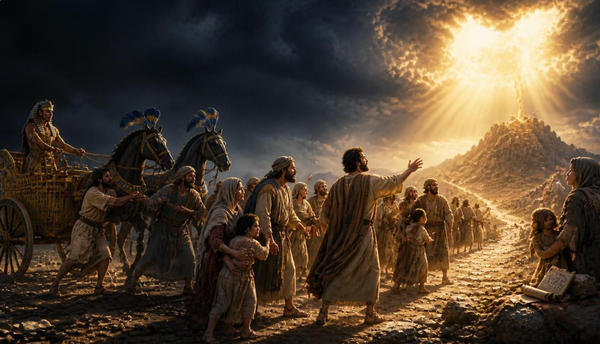
And when set against Exodus 3:7–8, the scene in the boat becomes more than a moment of fear—it becomes a test of whether the disciples recognize that the God who once “came down” to deliver Israel is now present with them in the storm.
Together, these passages form a unified vision: storms expose what we believe about destruction, about God’s care, and about where true rescue is found.
I. 🌊 1. The King Sleeping in the Storm
(Mark 4:35–41; cf. Matt 8:23–27; Luke 8:22–25)
Jesus asleep in the boat is intentionally jarring. In ANE thought, the sea represents disorder, threat, and untamed power. Yet:
- The disciples interpret the storm as immediate danger
- Jesus embodies untroubled authority
The tension is not just “storm vs calm”—it’s fear vs relational knowing.
“Do you not care that we are perishing?”
That question reveals their internal narrative: circumstances are defining reality.
Jesus’ rebuke of the wind is followed by a rebuke of them:
“Why are you afraid? Have you still no faith?”
📌 Insight: Faith here is not abstract belief—it is alignment with Jesus’ perception of reality. He doesn’t deny the storm’s existence; He denies its authority.
🌊🚶♂️ 2. Walking on Water: The Fracture of Attention
(Matthew 14:22–33)
This scene escalates the theme:
- Jesus walks on what others fear
- Peter participates in that reality—for a moment
The key turning point:
“When he saw the wind, he was afraid…”
Notice the shift:
- He was already in the storm
- But what he attends to changes his stability
📌 The Greek nuance: blepō (“to see”) implies perceptive focus, not mere sight.
Peter doesn’t sink because the storm got worse—he sinks because his interpretive center shifted.
Jesus’ response is surgical:
“O you of little faith, why did you doubt?”
✨ The word for doubt (distazō) suggests divided stance, like trying to stand in two realities at once. ✨
📌 Insight: Faith is not denying waves—it is refusing to grant them interpretive supremacy.
🏠🌧️ 3. The Builders: Storm as Revealer, Not Exception
(Matthew 7:24–27)
Here the storm is no longer surprising—it’s assumed.
Both houses:
- Hear the same words
- Face the same storm
- Experience the same external pressure
But the outcome differs based on foundation.
Structural Contrast:
| Wise Builder | Foolish Builder |
|---|---|
| Hears and does | Hears but does not do |
| Built on rock | Built on sand |
| Withstands collapse forces | Disintegrates under them |
📌 Critical detail: The storm does not create the weakness—it reveals what was already true.
🔗 Integrated Theology: Storms, Sight, and Stability
When read together, these passages form a progression:
1. Storms test perception
- The disciples panic because they misread reality
- Jesus operates from a deeper authority structure
2. Focus determines participation
- Peter walks when aligned with Jesus
- He sinks when he re-centers the storm
3. Foundation determines endurance
- The storm exposes whether obedience has become structural, not theoretical
🪞 Deeper Layer: The “Eye” and the Heart
These passages connect tightly to the theme of perception (eye) and inner orientation (lev):
- A “bad eye” (ayin ra’ah) magnifies threat, scarcity, instability
- A “good eye” (ayin tovah) perceives through trust and generosity toward God’s reality
Peter’s shift is essentially: from a good eye → to a storm-dominated eye
The builders reflect: inward formation → outward resilience
⚖️ Covenant Implication
All three scenes assume relationship:
- The disciples are already with Jesus
- Peter is already called out
- The builders have already heard the word
✨ This is not about outsiders vs insiders—it’s about those who internalize covenantal trust vs those who remain externally associated. ✨
🔥 Synthesis
Storms in these passages are not anomalies to be avoided—they are:
- Diagnostic tools (revealing foundation)
- Formation environments (training perception)
- Opportunities for participation (walking where only God walks)
✨ The storm doesn’t decide your fate—your relationship to Jesus within the storm does. ✨
🌱 Thought
The consistent question across all three is not:
“How severe is the storm?”
But rather:
“Where is your attention anchored, and what have you built your life upon?”
Because in the Kingdom economy:
- Peace is not the absence of waves 🌊
- Stability is not the absence of pressure 🌧️
It is the presence of a Person—and the decision to trust Him enough to stand, walk, or rest accordingly.
II. 🌊 The Word: apollymetha
The disciples’ cry in the boat becomes much more interesting when you trace the word beneath “perishing.”
In the storm narrative they ask:
Mark 4:38 - “Teacher, do you not care that we are perishing?”
At first glance, it sounds like ordinary panic: “We’re going to die!” But the Greek term opens a wider theological frame.
The word translated “we are perishing” is from: apollymi
Core semantic range:
- to destroy
- to ruin
- to lose
- to perish
- to be ruined or brought to utter loss
Importantly, this word often means more than physical death.
Physical death is common and inevitable; apollymi often carries the sense of ultimate ruin, loss, destruction, or being cut off from life as God intends it.
The disciples are not merely saying, “we might drown,” their language evokes, “we are being undone. We are coming to ruin.”
That is a far deeper cry.
I. “Unless you repent, you will all likewise perish”
(Luke 13:3–5)
Jesus says twice:
“Unless you repent, you will all likewise perish.”
Here, apoleisthe (future of apollymi) clearly exceeds simple physical death.
Why? Because Jesus references two incidents:
- Galileans murdered by Pontius Pilate
- people killed by the tower in Siloam
His point is not, “bad things happen, so avoid accidents.” That would be a rather grim safety seminar.
Instead:
Everyone dies physically (their bios comes to an end). The real issue is whether one comes to ultimate ruin apart from repentance (separated from the zoe found in Christ).
Thus in Luke 13:
- physical death ≠ necessarily perishing
- perishing = destruction tied to being misaligned with God
This is crucial for Mark 4.
The disciples think: “Storm = perishing.” But Jesus later teaches: storms, towers, and violence are not the deepest threat.
✨ The greater danger is a heart unreconciled to God. ✨
So already we see irony: the disciples fear the wrong kind of destruction.
2. God sees Israel’s affliction
(Exodus 3:7–8)
God says to Moses:
“I have surely seen the affliction of My people… and have heard their cry…and I am concerned about their suffering. So I have come down to rescue them...to bring them up out of that land into a good and spacious land....”
This passage illuminates the disciples’ accusation: “Do you not care that we are perishing?”
Compare:
Israel in Egypt
- oppressed
- crying out
- God hears
- God descends to deliver
Disciples in storm
- oppressed (by their perception of the storm that threatens them)
- crying out
- God has already heard so sent His Son (Emmanuel) to save them (Jesus)
- Jesus appears asleep (but He is the same God with the same ears, eyes, concern, plan, and compassionate action)
Their question is not merely logistical. It is theological:
“Are You like the God who sees and delivers, or are we abandoned?”
This makes the question heavier. The disciples are, perhaps unknowingly, testing Jesus’ divine identity. Do you see? Do you care? Will you deliver?
It's the same question we ask God in our hearts when we see storms in our own lives. But He answered our questions long before we asked them. The answer hasn't changed because the One who answers doesn't change.
Malachi 3:6 - "I, the Lord, do not change."
Hebrews 13:8 - Jesus Christ is the same yesterday and today and forever.
3. God not wishing any should perish
(2 Peter 3:9)
“The Lord is not slow concerning His promise… but is patient toward you, not wishing that any should perish, but that all should come to repentance.”
Again: apolesthai (apollymi). This is nearly a direct conceptual parallel to Luke 13 (unless you repent, you will all likewise perish).
Perishing here is clearly contrasted with:
- repentance
- patience
- salvation
Thus: perishing = final ruin through refusal to turn toward God.
Now connect this back to the boat. The disciples fear immediate destruction, but the broader NT re-frames perishing as something deeper than drowning.
This makes the boat scene almost symbolic:
- sea = chaos/death/threat
- disciples = humanity fearing destruction
- Jesus = divine presence apparently inactive
- awakening = revelation of authority over all forces of undoing
Their cry, “we are perishing!” becomes humanity’s cry in miniature.
The Deeper Irony in Mark 4
The disciples say:
“Do you not care that we are perishing?”
His very presence is already proof that He does care, as He has "come down" once again to rescue us and led us through an exodus, this time not from Egypt but from sin and death.
The One asleep in the boat is:
- greater than the storm
- greater than the sea
- greater than death itself (He is Zoe, the Life that death cannot extinguish - John 14:6).
- the One through whom God prevents ultimate ruin
So their question exposes limited perception.
They correctly identify danger, but incorrectly locate ultimate threat.
They think, “the storm can destroy us.”
Jesus reveals: “You are more endangered by fear and unbelief than by these waves.”
This fits His rebuke, “why are you afraid? Have you still no faith?”
Not because storms are fake, but because they have mistaken circumstantial threat for ultimate destruction.
Biblical Pattern: What Actually Causes Perishing?
Across these passages:
Not what humans instinctively fear:
- storms
- towers falling
- political violence
- temporary suffering
But rather:
- lack of repentance
- separation from God
- refusal of trust
- covenantal rupture
This is almost a biblical inversion of threat analysis.
Humans say, “danger is outside me.”
Scripture repeatedly says, “the deepest danger is misrelation to God.”
Storms can kill the body. But apollymi points to a deeper undoing.
Theological Synthesis 🌊⚖️
The disciples ask a legitimate but incomplete question:
“Do you not care that we are perishing?”
Exodus answers:
God sees, hears, and comes down to deliver.
Luke 13 answers:
Perishing is deeper than physical death; repentance matters more than accident avoidance.
2 Peter answers:
God’s desire is not human ruin but repentance and life.
Mark 4 then places Jesus at the center of all three truths. He is:
- the God who hears the cry
- the One who delivers from chaos
- the One confronting the deeper issue beneath panic
Thus the real question is transformed. Not, “will this storm make us perish?” But: “Do we understand what true perishing is, and do we trust the One who overcomes it?”
Closing Reflection 🪞
The disciples fear drowning.
Jesus addresses their fear as if something more fundamental is at stake.
Because in biblical thought, the greatest danger is rarely what appears most immediate.
✨ Waves are loud. Ruin is often quieter. ✨
A storm may threaten your body, your plans, your sense of control.
But Scripture keeps asking:
What can actually separate you from the life of God?
That is the deeper question hidden beneath the disciples’ cry.
And the answer in the boat is profound:
The One they fear has not noticed their danger is actually the very reason they will not ultimately perish.
III. 🔥 From Egypt to the Cosmos: The Pattern of Divine Descent
1. The Prototype: God “comes down” to deliver
(Exodus 3:7–8)
God’s self-description is deliberate:
- He sees affliction
- He hears the cry
- He knows (yada—relational awareness)
- He comes down
- He delivers
- He brings out → to bring in
That last movement matters:
✨ Deliverance is not merely escape—it is relocation into covenant life. ✨
Egypt → wilderness → promised land
Bondage → formation → inheritance
This becomes the theological blueprint.
🌍 2. The Expansion: A Greater Exodus in Jesus
The New Testament presents Jesus not as abandoning that pattern—but fulfilling and universalizing it.
A key textual signal: (Luke 9:30–31)
At the transfiguration, Moses and Elijah speak with Jesus about His coming “departure.”
The Greek word is exodos. Not subtle.
Jesus’ death is framed as a new Exodus event. Which means He is also going to bring us into something good.
🧩 Structural Parallels
| Exodus (Israel) | Jesus (Cosmic Exodus) |
|---|---|
| Slavery in Egypt | Bondage to sin and death |
| Pharaoh as oppressor | Sin, death, and the powers |
| God “comes down” | God incarnate in Christ |
| Passover lamb | John 1:29 |
| Red Sea crossing | Death → resurrection passage |
| Wilderness testing | Jesus’ temptation; believer formation |
| Covenant at Sinai | New Covenant |
| Promised land | Kingdom life / new creation |
This is not loose analogy—it’s intentional theological recapitulation.
🌊 3. Re-reading the Storm Through Exodus
Now bring this back to the disciples’ cry:
“Do you not care that we are perishing?”
Through an Exodus lens, that question echoes Israel’s wilderness complaints:
- “Did you bring us out here to die?”
- “Was Egypt better?”
- “Does God actually care?”
Same structure:
- delivered people
- encountering chaos
- questioning divine intent
But here’s the escalation:
In Exodus God parts the sea, in Mark 4 Jesus commands the sea. This is not just repetition—it’s intensification. This time, He doesn’t make a path through chaos;He silences chaos at its source.
⚖️ 4. The Nature of the Rescue
In Exodus, rescue is from external oppression.
In Jesus, rescue includes internal and cosmic oppression.
Scripture expands the problem:
Not just Egypt—but:
- Sin (internal corruption)
- Death (existential finality)
- Powers (spiritual opposition)
As described in passages like:
Colossians 2:15 - Having disarmed the powers and authorities, He made a public spectacle of them, triumphing over them by the cross.
🌱 5. The Goal of the Greater Exodus
(2 Peter 3:9)
If Exodus was God not abandoning Israel to slavery, then the larger Exodus is:
God not willing that humanity be abandoned to apollymi (ruin).
So the pattern becomes:
- Egypt = localized bondage
- Perishing (apollymi) = ultimate ruin
- Jesus = deliverer from both
🪞 6. The Irony in the Boat (Now Fully Exposed)
The disciples ask:
“Do you not care that we are perishing?”
But:
- The One in the boat is the God who hears cries in Egypt
- He is literally the One who has come down
- And He is enacting the greater Exodus in real time
So their question unintentionally misreads the moment:
They think, “we are about to be lost.”
Reality: They are in the presence of the One who has come precisely to ensure they are not.
🔥 7. Micro → Macro, But Also Type → Fulfillment
This isn’t just scaling—it’s fulfillment.
The Exodus is: a type (pattern, shadow)
Jesus is: the substance (fulfillment, reality)
Colossians 2:17 - These are a shadow of the things that were to come; the reality, however, is found in Christ.
So it’s not merely same thing, bigger size, it’s: same pattern, but deeper problem and more decisive solution.
🌊 Final Synthesis
The movement is consistent across Scripture:
- God sees human misery
- God hears the cry
- God is concerned
- God comes down
- God delivers
- God leads into life
Exodus shows it in history. Jesus embodies it in fullness.
🌱 Reflection
The disciples’ question echoes across the whole biblical story.
“Do you not care that we are perishing?”
And the answer, from Egypt to the cross, is consistent:
✨ God does not remain distant from human ruin. He moves toward us to prevent it. ✨
Not abstractly. Not symbolically. But by entering the storm Himself. 🌊
And in Jesus, the answer becomes unmistakable:
The God who once came down to lead a people out of Egypt
has now come down again—to lead humanity out of sin, death, and ultimate loss into a new and living way.
Jude 1:5 - I want to remind you that Jesus [Iesous] at one time delivered His people out of Egypt.
Not "the Lord," as some translations have it, Jude directly says Jesus delivered His people out of Egypt, the same Teacher sleeping on the boat. So, yes, He cares.
✨ Even in "sleeping" He is working on our behalf. He is not slow, as some count slowness, He acts when the time is right and He waits for that with patience. And so should we. ✨
🌱 Conclusion
From Egypt’s oppression to Galilee’s waves, from collapsing houses to the warning of final ruin, Scripture consistently redirects our understanding of danger and deliverance. Storms may threaten, but they do not ultimately define perishing—that deeper reality is tied to separation from God, not merely circumstantial crisis.
Yet the same God who saw, heard, and came down to rescue His people in Exodus 3:7–8 has acted again on a greater scale: in Jesus, He enters the storm, confronts chaos, and leads a greater Exodus from sin and death.
The disciples’ fearful question—“Do you not care that we are perishing?”—is answered not only by a calmed sea, but by the entire arc of redemption. The true issue is not whether storms come—they will—but whether we recognize, trust, and build upon the One who stands within them with authority to save. 🌊