🏗️🚢🌊✝️🪨 Ezekiel 27: The Names That Storms Destroy [3 parts]
👁️ Introduction
From the plains of Babel to the harbors of Tyre, Scripture traces a recurring human impulse: the desire to establish security, significance, and permanence apart from God.
At Babel, humanity declared, "Let us make a name for ourselves." Centuries later, Tyre appeared to accomplish that very ambition. Her name was known among nations, her merchants traversed the seas, and her wealth flowed from every corner of the known world. What Babel sought, Tyre seemed to achieve.
Yet both narratives expose the same illusion. A great name is not the same as a sure foundation. A tower may rise into the heavens, a ship may dominate the seas, and a city may become the envy of nations, but none of these can withstand the storms that reveal what lies beneath.
Ezekiel's lament over Tyre and Jesus' warning about houses built on rock or sand ask the same penetrating question: not "How impressive is the structure?" but "What is it resting upon?"
The merchants of Tyre, the builders of Babel, and the foolish builder in Jesus' parable all trusted what human hands could assemble. Their eyes were captivated by visible greatness.
Yet Scripture repeatedly points beyond human achievement to the only refuge that cannot be shaken—the Name of the LORD. In the end, every tower, every ship, every city, and every reputation is tested by the wind and the flood. Only what is founded upon God remains.
I. 🌊 Ezekiel 27: The Geography of Tyre's Glory and Fall
Ezekiel 27 is one of the most remarkable trade catalogs in the ancient world. The chapter presents Tyre as a magnificent merchant vessel whose wealth came from nearly every known corner of the ancient Near East and Mediterranean world.
The prophet's purpose is not merely economic; he is showing that Tyre's greatness appeared limitless because the whole world seemed to contribute to her prosperity. The tragedy is that the larger the network, the more spectacular the collapse.
The chapter is essentially a funeral song over an empire of commerce.
🚢 Tyre as the Center of the World
Tyre is portrayed as a ship:
Ezekiel 27:4 - "Your borders are in the heart of the seas."
Everything in the ship comes from elsewhere. This is intentional.
Tyre produces little herself. She gathers, organizes, transports, finances, and profits from the labor and resources of nations. Her strength is connectivity.
Her downfall therefore becomes a warning about trusting in networks, wealth, and influence rather than God.
1.)🌲 Lebanon (27:5)
Cedars and cypress trees were taken from Lebanon to construct the ship.
Significance
Lebanon represented:
- Strength
- Beauty
- Durability
- Royal splendor
Tyre's ship is built from the finest materials available. The image evokes Solomon's Temple, which also used cedar from Lebanon.
Tyre appears almost temple-like in her glory.
2.)⛰️ Senir (Hermon) (27:5)
Senir is another name for Mount Hermon. The oars came from its oaks.
Significance
Hermon often symbolizes:
- Loftiness
- Strength
- The northern frontier
Tyre draws resources even from distant mountain regions.
3.)🌳 Bashan (27:6)
Bashan supplied oak for the ship.
Significance
Bashan is a place associated with:
- Giants
- Powerful kingdoms
- Spiritual rebellion imagery
Its inclusion shows Tyre's influence extending into regions renowned for power and prestige.
4.)🏝️ Cyprus (Kittim) (27:6)
Ivory and cypress came from Kittim.
Significance
Cyprus connected Tyre to the wider Mediterranean. The trade network was not merely regional but international.
5.) 🇪🇬 Egypt (27:7)
Egypt supplied fine linen for sails.
Significance
Egypt represented:
- Ancient civilization
- Wealth
- Prestige
Tyre clothed herself in Egypt's luxury. The ship's sails, the very thing that propelled her, came from Egypt.
6.) 🟣 Elishah (27:7)
Provided blue and purple cloth.
Significance
Purple dye was one of Tyre's most famous products. The irony is striking: Tyre's identity was built upon luxury, prestige, and royal symbolism.
7-8.) 🏝️ Sidon and Arvad (27:8)
Supplied sailors and mariners.
Significance
Tyre gathered the best seafaring expertise available. Her greatness was collective. Many peoples made Tyre successful.
9.) 🏛️ Gebal (27:9)
Provided craftsmen.
Significance
The wisdom of many nations served Tyre. She became a center where skills converged.
10-12.) ⚔️ Persia, Lud, and Put (27:10)
Served as soldiers.
Significance
Tyre's military was multinational. Like later empires, she outsourced protection to foreign powers. Her security depended on alliances.
13-15.) 🌍 Javan, Tubal, and Meshech (27:13)
Provided:
- Slaves
- Bronze goods
Significance
A dark feature emerges. Tyre's greatness involved participation in human trafficking. The wealth of the city was not morally neutral.
16.) 🐎 Beth-Togarmah (27:14)
Provided horses and mules.
Significance
Military and commercial mobility.
The farther away the source, the more impressive Tyre's reach appears.
17.) 🌊 Dedan (27:15, 20)
Supplied:
- Ivory
- Ebony
- Saddlecloths
Significance
Luxury items flowed from Arabian trade routes. Tyre linked maritime and desert economies.
18-19.) 🏜️ Arabia and Kedar (27:21)
Provided:
- Lambs
- Rams
- Goats
Significance
Even nomadic peoples became part of Tyre's commercial machine.
20-21.) 👑 Sheba and Raamah (27:22)
Provided:
- Gold
- Spices
- Precious stones
Significance
These were among the most prestigious luxury goods available. The echoes of the Queen of Sheba's wealth appear here.
22-26.)🏺 Haran, Canneh, Eden, Asshur, and Chilmad (27:23)
Provided luxury textiles and manufactured goods.
Significance
Trade reached deep into Mesopotamia. Tyre united east and west.
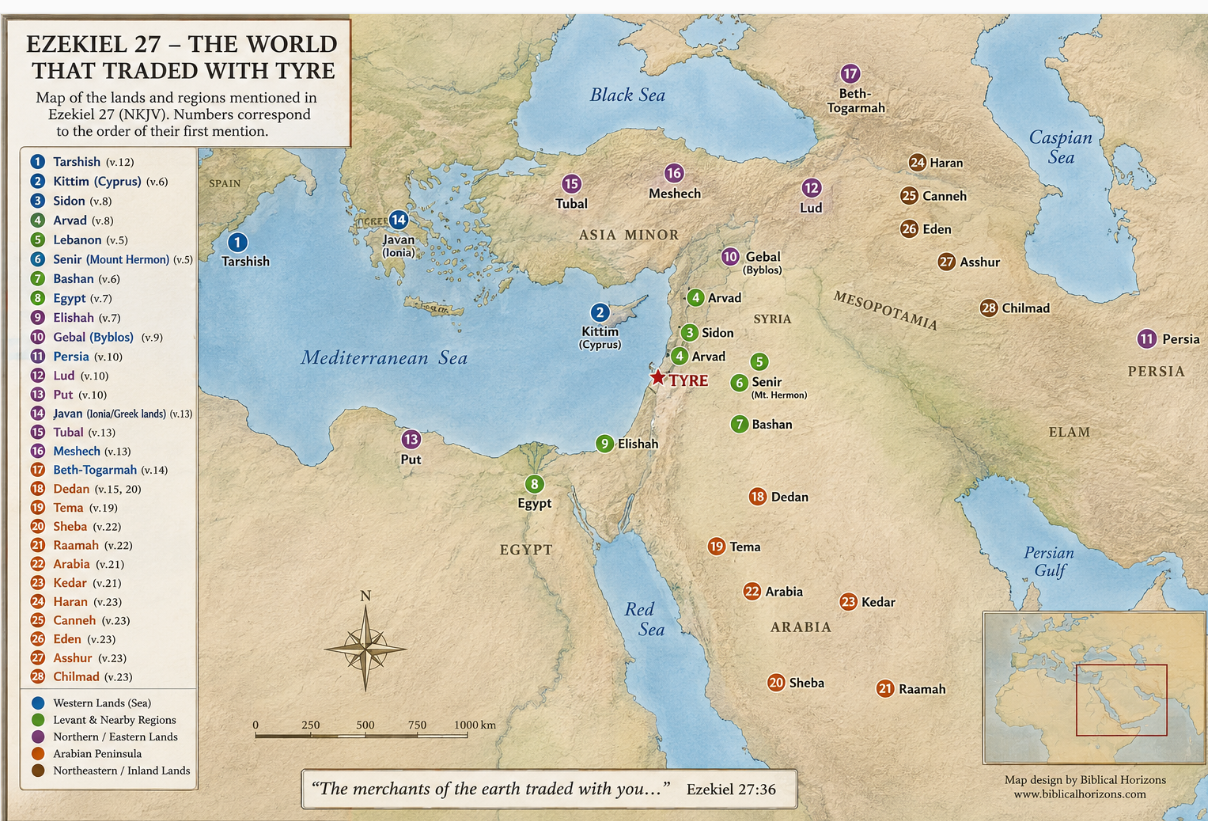
📍What the Locations Reveal About Tyre's Greatness
Taken together, the locations form a map stretching:
- West into the Mediterranean
- North into Anatolia and Armenia
- South into Arabia and Africa
- East into Mesopotamia
- Across sea routes and caravan routes
Tyre appears to be the economic center of the known world. The chapter repeatedly emphasizes, "They traded with you..." Tyre's greatness came from being the meeting place of nations.
She created a counterfeit unity of mankind through commerce.
💥 What the Locations Reveal About Her Fall
The same nations that enriched Tyre become witnesses to her destruction. Notice the repeated refrain:
Ezekiel 27:36 - "The merchants among the peoples hiss at you."
The nations do not save Tyre. They mourn her because they profited from her. Their grief is economic, not covenantal.
Tyre discovered too late that a network of interests is not the same thing as a community of love.
👁️ A Deeper Biblical Pattern
Ezekiel's portrait of Tyre resembles several earlier biblical cities:
- Babel gathered nations through human ambition.
- Nineveh gathered nations through military power.
- Tyre gathered nations through commerce.
- Jerusalem was intended to gather nations through the presence of God.
The contrast is profound. Tyre united peoples through trade. Jerusalem was called to unite peoples through worship.
✨ Tyre's ship was assembled from the wealth of every land, but when the storm came, every plank, sail, oar, sailor, merchant, and trading partner proved unable to keep her afloat. ✨
The lament of Ezekiel 27 is therefore not merely about a city. It is a warning against any greatness built entirely on wealth, influence, and inter-connectedness. The larger the ship becomes, the more catastrophic the wreck if its foundation is not God.
✨ A Contrast of Nations
The nations come to Solomon because of his God-given wisdom:
1 Kings 10:1 - "When the Queen of Sheba heard of the fame of Solomon concerning the name of the LORD..."
Notice that Solomon's fame is linked not merely to himself, but to the Name of the LORD.
This stands in sharp contrast to Babel:
- Babel: "Let us make a name for ourselves."
- Solomon: The nations come because of God's name reflected through him.
Jesus later references this event:
Matthew 12:42 - "The Queen of the South will rise up at the judgment with this generation and condemn it, for she came from the ends of the earth to hear the wisdom of Solomon, and behold, something greater than Solomon is here."
Thus the Queen of Sheba becomes a picture of the nations bringing their treasures in response to God's wisdom and glory.
II. 🏗️ Babel and 🚢 Tyre: Two Expressions of the Same Pride
One of the most striking observations when comparing Ezekiel 27 with Genesis 11 is that Tyre appears to be a later, more sophisticated version of Babel, who said:
Genesis 11:4 - "Come, let us build ourselves a city and a tower with its top in the heavens, and let us make a name for ourselves..."
Tyre never says these exact words, but Ezekiel reveals the same heart.
🏗️ Babel Built a Tower
At Babel, humanity sought greatness through:
- Human ingenuity
- Human cooperation
- Human achievement
- Human reputation
The concern was not architecture. The problem was self-exaltation. The goal was, "Let us make a name for ourselves."
In Scripture, a "name" represents:
- Reputation
- Glory
- Identity
- Legacy
Babel wanted glory apart from God. This is a continuation of Adam and Eve wanting knowledge apart from God.
🚢 Tyre Built a Trading Empire
Tyre's version of Babel is not a tower. It is a commercial network. Instead of bricks, Tyre assembles:
- Cedars from Lebanon
- Oaks from Bashan
- Linen from Egypt
- Gold from Sheba
- Craftsmen from Gebal
- Sailors from Sidon
- Soldiers from Persia
The nations themselves become the building materials.
Tyre creates something Babel only dreamed of: A truly international system. The entire world contributes to her greatness.
👑 Tyre's "Name"
Notice God's accusation:
Ezekiel 28:2, 17 - "Your heart was lifted up. Your heart is proud because of your beauty."
Tyre never says, "Let us make a name for ourselves." She doesn't have to. The name already exists. The nations know it. The merchants admire it. The kings envy it. Tyre has become a name.
The very thing Babel sought has been achieved.
🌍 Babel Gathered Humanity
At Babel: "The whole earth had one language."
Humanity united around a shared project. The unity itself was not the problem. God's ultimate purpose is a united humanity. The problem was the basis of the unity.
It was built around human self-glorification.
🌊 Tyre Gathered Nations
Tyre also gathers nations. Ezekiel 27 repeatedly says:
"They traded with you..."
"The merchants of the earth..."
"Many coastlands..."
The world becomes interconnected through Tyre. But again the center is not God, the center is profit; the nations are united around wealth. There is a lesson coming in the form of a storm.
Revelation 3:17 - "You say, ‘I am rich; I have acquired wealth and do not need a thing.’ But you do not realize that you are wretched, pitiful, poor, blind and naked."
Though these words are spoken to a church, which should definitely know better, they still apply to Tyre.
🔥 Both Seek Security Through Human Achievement
Babel feared, "Lest we be scattered." Tyre feared vulnerability. Her wealth became her fortress. Both attempt to solve human insecurity without dependence upon God.
- Babel says: "We will build high enough."
- Tyre says: "We will become rich enough."
The language changes, the heart remains the same.
👁️ The Great Irony
At Babel, humanity sought a name. God scattered them. At Tyre, humanity gave her a name. God sank her. Both stories reveal the same truth:
✨ A name gained apart from God cannot endure. ✨
Proverbs 18:12 - "Before destruction the heart of man is haughty."
🕊️ The Kingdom Alternative
Babel says:
"Let us make a name for ourselves."
God says to Abram:
Genesis 12:2 - "I will make your name great."
The contrast is deliberate. Immediately after Babel's self-exaltation comes God's call of Abraham. Babel grasps for greatness. Abraham receives greatness as a gift. Tyre accumulates glory. Israel is called to reflect glory.
Babel ascends. Tyre expands. The Kingdom receives.
✨ The Ultimate Reversal
The deepest contrast appears in Jesus. Babel sought a name. Tyre sought a name.
Philippians 2:7 - "[Jesus] Made Himself nothing..."
Babel climbed upward. Tyre enlarged herself outward. Christ descended. And because He humbled Himself:
Philippians 2:9 - "Therefore God highly exalted Him and gave Him the name that is above every name."
The Scriptures consistently present two paths:
- 🏗️ "Let us make a name for ourselves."
- ✝️ James 4:10 - "Humble yourselves before the Lord, and He will exalt you."
Babel and Tyre are monuments to the first path, seeking glory by grasping. Jesus is the fulfillment of the second, receiving glory through love, trust, and obedience.
In that sense, Ezekiel 27 is not merely a lament over a Phoenician city—it is the funeral song of every Babel ever built.
III. 🏗️ Babel, 🚢 Tyre, and 🪨 the Only Name That Stands
A common assumption is that Babel failed to make a name for itself. In one sense, that is not true. Thousands of years later, we still speak of Babel. Likewise, Tyre succeeded spectacularly. Its name became synonymous with wealth, commerce, influence, and beauty.
The tragedy is not that they failed to make a name. The tragedy is that the names they made could not save them. Scripture never suggests that human beings are incapable of becoming famous, powerful, influential, or celebrated.
Rather, it repeatedly asks: What happens when the storm comes?
🏗️ Babel's Name Endured-But Not as Intended
The builders said:
Genesis 11:4 - "Let us make a name for ourselves."
And they did. The name Babel became legendary. But it became a monument to confusion rather than glory. Their achievement remained.
Their security did not.
✨ The tower of Babel stood as testimony that a famous name is not the same thing as a safe foundation. ✨
🚢 Tyre's Name Filled the Earth
Ezekiel 27 portrays Tyre as perhaps the most successful commercial city in the ancient world. The nations knew her. Kings traded with her. Merchants depended on her. Entire economies revolved around her. Her name was great. Her influence was real. Her wealth was staggering.
Yet God asks a devastating question through the lament.
What happens when the sea rises and the winds obey the LORD's commands?
Psalm 135:6-7 - The Lord does whatever pleases Him, in the heavens and on the earth, in the seas and all their depths. He makes clouds rise from the ends of the earth; He sends lightning with the rain and brings out the wind from His storehouses.
Jeremiah 10:13, 51:16 - When He thunders, the waters in the heavens roar; He makes clouds rise from the ends of the earth. He sends lightning with the rain and brings out the wind from his storehouses.
The repetition suggests an emphasis difficult to ignore.
🌊 The Storm of Ezekiel 27
The turning point:
Ezekiel 27:26 - "Your rowers have brought you out into the high seas. The east wind has wrecked you in the heart of the seas."
The very sailors who made Tyre successful bring her into waters she cannot survive. The very systems that produced greatness expose weakness. The very machinery of success becomes the setting of judgment.
Then the lament concludes:
Ezekiel 27:36 - "The merchants among the peoples hiss at you; you have become a horror, and shall be no more forever."
The nations that admired Tyre do not save her. The world that celebrated her greatness becomes an audience to her collapse.
🪨 Jesus' Parable of the Storm
Jesus contrasts two houses. Both are built. Both appear successful. Both occupy valuable land. Both survive ordinary weather.
The difference is invisible until the storm arrives.
Matthew 7:24-27 - "Everyone who hears these words of Mine (the Sermon on the Mount) and puts them into practice is like a wise man who built his house on the rock.
The rain came down, the streams rose, and the winds blew and beat against that house; yet it did not fall, because it had its foundation on the rock.
But everyone who hears these words of mine and does not put them into practice is like a foolish man who built his house on sand.
The rain came down, the streams rose, and the winds blew and beat against that house, and it fell with a great crash."
The language is strikingly similar to Ezekiel's storm imagery. Nothing that crumbles is impressive.
🌬️ The East Wind and the Flood
In Ezekiel: 🚢 The east wind strikes Tyre.
In Matthew: 🏠 The winds strike the house.
The issue is not the storm. The storm comes for everyone. The issue is foundation.
Tyre trusted:
- Wealth
- Trade
- Influence
- Reputation
- International connections
The foolish builder trusted:
- Appearance
- Convenience
- Immediate results
Both seemed secure until tested.
🏰 The Strong City Illusion
Proverbs observes:
Proverbs 18:11 - "A rich man's wealth is his strong city, and like a high wall in his imagination."
Notice the phrase: "in his imagination." Tyre looked invincible. Babel looked unstoppable. The rich fool of Luke 12 looked secure. Yet all were trusting walls that existed largely in perception.
✨ The storm reveals reality. ✨
✨ The Name That Is a Refuge
Against all these false refuges stands another word of wisdom:
Proverbs 18:10 - "The name of the LORD is a strong tower; the righteous run into it and are safe."
Notice the irony. Babel built a tower. The righteous run into a tower. But the towers are not the same.
- Babel's tower - Humanity says, "We will build upward."
- God's tower - God says, "Run to Me."
One is constructed by human effort. The other exists because of God's character. One reaches toward heaven. The other comes from heaven.
One collapses. The other endures.
👁️ The Great Biblical Contrast
Scripture repeatedly presents two ways of seeking security:
The Name We Build
- 🏗️ Babel
- 🚢 Tyre
- 🏰 Wealth
- 👑 Reputation
- ⚔️ Power
- 📈 Influence
These things may become very large. They may even last generations. But they are still sand.
The Name We Enter
- 🪨 The LORD
- ✝️ Christ
- 🕊️ The Kingdom
- ❤️ Covenant relationship
This refuge often appears unimpressive to the world. Yet when the rain falls, floods rise, and winds strike, it remains.
🌊 A Final Connection
Ezekiel 27:26 and Matthew 7:24-27 ask essentially the same question. Not:
- "How large is the ship?"
- "How famous is the city?"
- "How impressive is the house?"
But:
- "What is underneath it?"
Tyre's ship was assembled from the wealth of nations, yet the east wind shattered it. The foolish man's house may have looked beautiful, yet the flood exposed its foundation. Babel's tower reached upward, yet it could not reach safety.
The only structure in Scripture that survives every storm is the one resting upon the character, word, and Name of God.
For this reason, the Bible's answer to "Let us make a name for ourselves" is never merely "Don't," its "There is already a Name given as a refuge."
Everything else, no matter how magnificent, is ultimately a house built upon sand.
🪨 Conclusion: The Name That Endures
The builders of Babel made a name for themselves. Tyre made a name for herself. For a time, both appeared successful. Their works were admired, remembered, and influential.
✨ The judgment of Scripture is not measured by visibility, fame, or longevity, but by endurance in the presence of God's truth. ✨
Babel's tower could not prevent scattering. Tyre's wealth could not prevent shipwreck. The merchants who enriched her became witnesses to her ruin. The same winds that filled her sails ultimately drove her into destruction. Like the house built upon sand, her greatness collapsed because it rested upon foundations unable to bear the storm.
Against this backdrop stands the quiet promise of God's kingdom. The righteous do not build a tower to reach heaven; they run into the Name of the LORD. They do not manufacture a reputation that will endure; they receive an inheritance that cannot perish. They do not trust in the strength of their ship, the height of their tower, or the applause of the nations, but in the One who remains when every storm has passed.
✨ Ezekiel 27 and Matthew 7 converge into a single warning and a single invitation. ✨
Every human-made name, however glorious, is ultimately sand. Every kingdom built on self-exaltation eventually encounters the east wind. But those who hear God's words and build upon them discover a foundation deeper than the seas, and strong enough to endure every inevitable storm.