🌱🌿🍇🌾 Abiding in the Presence of God: Trusting His Work in His Time [3 parts]
Introduction
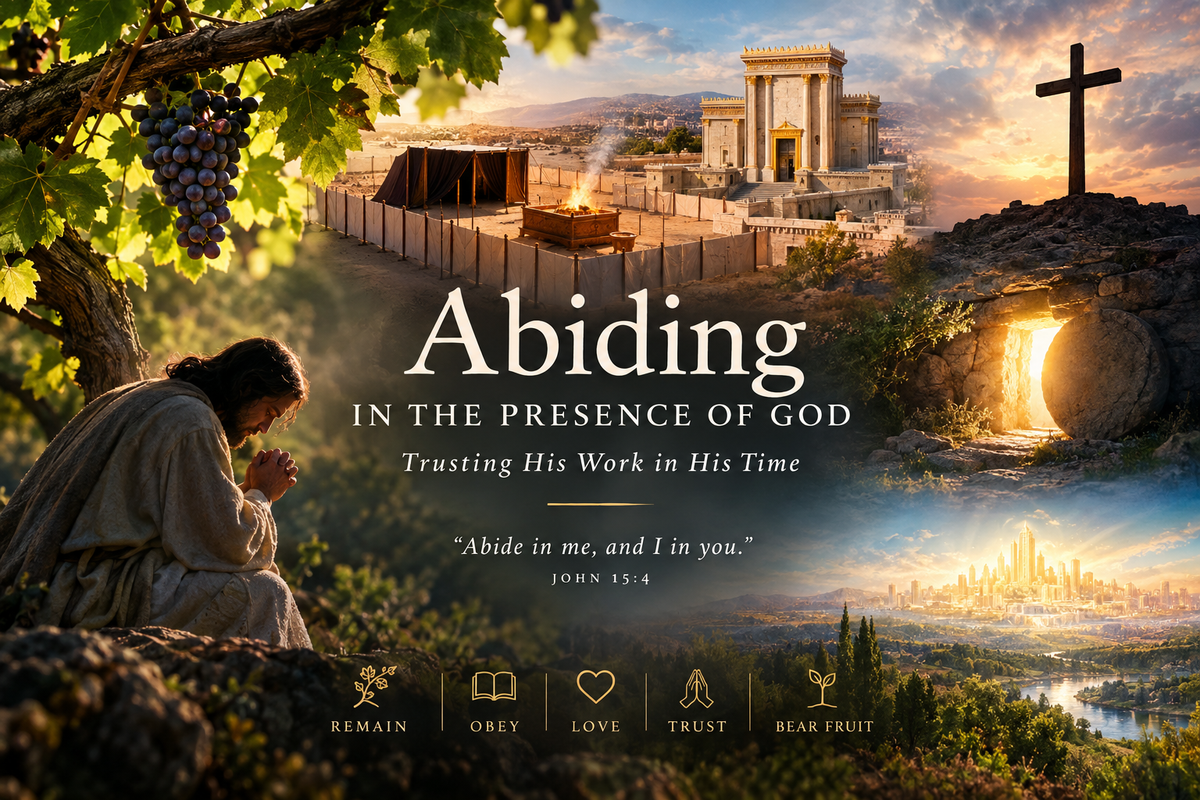
From the garden of Eden to the tabernacle and temple, from the incarnation of the Word to the promise of a renewed creation, Scripture reveals God's desire to dwell among His people. This dwelling theme provides a rich context for understanding Jesus' invitation to abide in Him.
Abiding is not an isolated spiritual discipline or a feeling we must learn to reproduce; it is a life of ongoing fellowship with God, expressed through trust, obedience, love, and faithful dependence upon Him.
Jesus not only teaches His disciples to abide but demonstrates what such a life looks like through His own unwavering allegiance to the Father.
Yet abiding presents a challenge that is easy to overlook: much of it looks and feels like nothing is happening. We naturally want visible evidence of growth, meaningful experiences, and tangible results that assure us our efforts are accomplishing something.
When those signs are absent, we may become impatient and attempt to manufacture the progress we desire. But Scripture repeatedly calls the righteous to live by faith rather than sight, trusting God's wisdom, goodness, and sovereignty over the times and seasons of growth.
Like branches connected to a vine or seeds developing beneath the soil, we are called to remain faithful without demanding that every stage of God's work become visible to us.
This study explores abiding as both a life lived in God's presence and a posture of trust that enables us to obey faithfully, resist anxious control, and leave the growth and its timing in His hands.
I.✨ The example Jesus uses
1a. A branch and a tree
John 15:1-12 - “I am the True Vine, and My Father is T he Vinedresser (Gardener).”
Every branch in Me that does not bear fruit He takes away, and every branch that does bear fruit He prunes, that it may bear more fruit. Already you are clean because of the word that I have spoken to you.
Abide in Me, and I in you. As the branch cannot bear fruit by itself, unless it abides in the vine, neither can you, unless you abide in Me. I am the vine; you are the branches. Whoever abides in Me and I in him, he it is that bears much fruit, for apart from Me you can do nothing.
If anyone does not abide in Me, he is thrown away like a branch and withers; and the branches are gathered, thrown into the fire, and burned. If you abide in Me, and My words abide in you, ask whatever you wish, and it will be done for you.
By this My Father is glorified, that you bear much fruit and so prove to be My disciples. As the Father has loved Me, so have I loved you. Abide in My love. If you keep My commandments, you will abide in My love, just as I have kept My Father's commandments and abide in His love. These things I have spoken to you, that my joy may be in you, and that your joy may be full.
“This is My commandment, that you love one another as I have loved you.”
1 Corinthians 13:2-3 - “If I have prophetic powers, and understand all mysteries and all knowledge, and if I have all faith, so as to remove mountains, but have not love, I am nothing. If I give away all I have, and if I deliver up my body to be burned, but have not love, I gain nothing.”
A branch doesn't produce fruit by trying harder to be a branch. It produces fruit because it remains connected to the vine, receiving what it needs to live.
If you cut a branch off the vine, it might look alive for a little while. It might even retain its leaves for a time. But it has been separated from the source that sustains it. Eventually, it withers.
Jesus uses that picture to teach us something important: the Christian life isn't about trying to produce godly behavior independently of God. It's about staying connected to Jesus, receiving life from Him, and allowing that life to shape how we live. Abiding doesn't mean we do nothing. A living branch bears fruit. But the fruit grows out of its connection to the vine.
At it's root, pun intended, abiding is learning to live with God, depend on Him, and remain faithful to Him in the ordinary moments of life—not just turning to Him when something goes wrong.
1b. Listening is not wisdom, doing is
Matthew 7:24-27 - “Everyone then who hears these words of Mine and does them will be like a wise man who built his house on the rock. And the rain fell, and the floods came, and the winds blew and beat on that house, but it did not fall, because it had been founded on the rock.
And everyone who hears these words of Mine and does not do them will be like a foolish man who built his house on the sand. And the rain fell, and the floods came, and the winds blew and beat against that house, and it fell, and great was the fall of it.”
Matthew 7:21-23 - “Not everyone who says to Me, ‘Lord, Lord,’ will enter the kingdom of heaven, but the one who does the will of My Father who is in heaven. On that day many will say to Me, ‘Lord, Lord, did we not prophesy in Your Name, and cast out demons in Your Name, and do many mighty works in Your Name?’
And then will I declare to them, ‘I never knew you; depart from Me, you workers of lawlessness.’
1 John 2:15-17 - Do not love the world or the things in the world. If anyone loves the world, the love of the Father is not in him. For all that is in the world—the desires of the flesh and the desires of the eyes and pride of life—is not from the Father but is from the world. The world is passing away along with its desires, but whoever does the will of God abides forever.
1 John 2:19 - They went out from us, but they were not of us; for if they had been of us, they would have continued with us. But they went out, that it might become plain that they all are not of us.
2. An example of one who abandoned abiding
King Uzziah offers a sobering historical example of the distinction between being enabled by God and continuing to walk humbly before Him.
2 Chronicles 26:5 - “[Uzziah] set himself to seek God in the days of Zechariah, who instructed him in the fear of God, and as long as he sought the LORD, God made him prosper.”
His success was not self-generated: God helped him against the Philistines, strengthened his defenses, equipped his army, and enabled him to become exceedingly powerful (2 Chronicles 26:6–15). Yet the narrative turns on a devastating contrast:
2 Chronicles 26:16 - “When he was strong, he grew proud, to his destruction.”
Uzziah entered the temple to burn incense on the altar, assuming a priestly function that God had not assigned to him, and responded with anger when the priests confronted him.
The very king who had experienced God’s help refused to heed God’s appointed correction; he treated the strength he had received as though it authorized him to act independently of the One who gave it. The result was judgment:
2 Chronicles 26:19-21- Then Uzziah was angry. When he became angry with the priests, leprosy broke out on his forehead in the presence of the priests in the house of the Lord...because the Lord had struck him.
And King Uzziah was a leper to the day of his death, and being a leper he was excluded from the house of the Lord.
Uzziah’s story illuminates Jesus’ warning that impressive accomplishments cannot substitute for faithful relationship: God’s enabling is not permission for self-rule, and past faithfulness is not a substitute for present humility.
Uzziah had sought God, and God had helped him; but when success fostered the illusion of self-sufficiency, he crossed a boundary God had established. His life therefore warns us not to confuse the evidence of God’s past work through us with proof that we are presently walking in submission to Him.
The question is not only whether God has empowered us to accomplish something, but whether we continue to honor His authority, receive correction, and remain faithful when the very blessings He has given make us strong.
3. What abiding looks like in everyday life
Abiding can sound like an abstract religious word, so I would translate it into ordinary experiences.
- Trusting Him: When you're afraid, you bring that fear to God rather than deciding you must face everything alone.
- Listening to Him: You take His words seriously enough to let them challenge your assumptions and choices.
- Remaining with Him: When life gets painful, confusing, or disappointing, you don't treat God as someone you only need when things are going well.
- Responding to Him: When you recognize that you've done wrong, you return to Him, receive His correction, and choose a different path.
- Learning His way of love: You begin treating people with the patience, honesty, mercy, and faithfulness that you see in Jesus.
✨ Abiding is not a single religious activity. Prayer and reading Scripture can help us abide, but abiding is the larger reality those practices nurture: a life lived in continuing relationship with God. ✨
You can pray and still resist what God is teaching you. You can read the Bible and refuse to put its words into practice. Abiding involves letting our relationship with God reach our actual decisions, relationships, and habits.
4. The connection between abiding and God's presence
The Bible's story begins with God present with humanity in the garden.
Leviticus 26:11–12 - “I will make My dwelling among you, and I will walk among you and I will be your God, and you shall be My people.”
1 Kings 8:10–11 - “And when the priests came out of the Holy Place, a cloud filled the house of the LORD, so that the priests could not stand to minister because of the cloud, for the glory of the LORD filled the house of the LORD.”
John 1:1, 14 - In the beginning was the Word, and the Word was with God, and the Word was God. And the Word became flesh and dwelt among us.
John 14:23 - Jesus answered him, “If anyone loves Me, he will keep My word, and My Father will love Him, and We will come to him and make Our home with him.
Revelation 21:3 - “Behold, the dwelling place of God is with man. He will dwell with them, and they will be his people, and God Himself will be with them as their God."
This is the great culmination of the biblical story: God will dwell with humanity.
These passages help us see that God's purpose isn't simply to give people instructions from a distance. He desires a people who live in His presence, receive His life, and reflect His character.
That is the larger story surrounding abiding. God draws near to humanity, makes His presence known in Jesus, and calls people into a life of fellowship with Him.
We should be careful not to suggest that God is physically confined to a place or that we earn His presence through good behavior. The point is relational: we are invited to live in fellowship with Him and to respond faithfully to the One who has drawn near.
5. A common misunderstanding
One of the most important things to clarify is that abiding is not about being perfect or maintaining a constant religious feeling. Some believers may think abiding means:
- Never struggling with doubt.
- Always feeling close to God.
- Praying constantly without distraction.
- Never sinning or making mistakes.
- Doing enough good things to keep God from leaving.
Those are not the right measures. Abiding is about the direction and continuity of a relationship, not the absence of every struggle.
Consider a child learning to walk with a parent. The child may stumble, become frightened, resist instruction, or need correction. The relationship is not defined by never stumbling. What matters is learning to trust the parent, receive guidance, and keep walking together.
That analogy has limits, but it can help people understand why failure should lead us toward honest repentance and renewed trust rather than hiding from God. Jesus' image of the vine also prevents us from reducing abiding to moral effort. The branch needs the vine. We need Christ.
6. Why abiding matters: love becomes the fruit
In John 15, Jesus connects abiding with bearing fruit, keeping His commands, and loving one another.
That gives us a practical way to understand the purpose of abiding. The goal isn't to become someone who knows more religious vocabulary. It isn't to accumulate Bible facts while remaining unchanged in how we treat people.
✨ As we remain in Christ, His teaching reshapes our understanding of what is good. ✨
We learn to tell the truth when lying would be easier, forgive instead of retaliate, serve instead of exploit, and love people when doing so costs us something. This doesn't mean every believer matures at the same pace or that every good action proves someone is abiding.
✨ Growth takes time, and we still need grace, correction, and community. ✨
But the connection Jesus makes is clear: abiding in Him and bearing the fruit of His character belong together. We don't love people to purchase a relationship with Jesus, we learn to love because we are living in relationship with Him.
Three questions to help people apply it
Rather than ending with a definition alone, I would invite people to consider three questions:
- Connection: Am I bringing my actual life to Jesus, or do I mostly think about Him when I attend church or face a crisis?
- Dependence: Where am I trying to produce good fruit through my own effort while resisting His guidance?
- Fruit: What is one relationship or decision in which remaining faithful to Jesus would change how I respond?
These questions move the conversation from knowing what abiding means to considering what abiding looks like.
The central message: Abiding is not a religious performance we offer God from a distance. It is a life of ongoing dependence, trust, and faithful response to Jesus—so that His life and teaching shape the way we live and love.
II.✨ Embrace the Mundane: Abiding When Nothing Seems to Be Happening
1. Most of abiding looks remarkably ordinary
We often imagine spiritual growth as a sequence of meaningful moments: a powerful prayer, a profound insight, a breakthrough, a changed habit, or a renewed sense of God's presence. Those moments can be genuine gifts. But they are not the whole of the Christian life.
Much of abiding looks like getting up, going to work, preparing a meal, keeping a promise, speaking truthfully, caring for someone, resisting temptation, praying when prayer feels unremarkable, and choosing faithfulness again tomorrow.
Nothing dramatic may happen. We may feel no particular closeness to God. We may finish the day without an insight to write down or an experience we can point to as evidence that we have grown.
But the absence of a remarkable experience is not evidence of the absence of God's work.
Consider the branch in John 15. Jesus does not describe the branch as repeatedly manufacturing a spiritual experience to prove that it remains connected to the vine. The branch abides. It receives life. In due season, it bears fruit.
The branch's responsibility is not to make the vine work faster. It is to remain connected to the vine. And for us, abiding/ remaining connected to Jesus includes the ordinary, repeated obedience through which trust becomes a way of life.
Abiding is not only remaining connected to Christ, it is learning to trust Him when that connection produces no visible evidence of progress, when growth is imperceptible, and when we are tempted to take control of what belongs to God.
That shifts the emphasis from How do I make myself grow? to How do I remain faithful while trusting God to accomplish His work in His time?
2. God established times and seasons for growth
Scripture repeatedly reminds us that human beings are not sovereign over the timing of God's purposes.
Genesis 8:22 - "While the earth remains, seedtime and harvest, cold and heat, summer and winter, day and night, shall not cease.”
Ecclesiastes 3:1 - "For everything there is a season, and a time for every matter under heaven."
Jesus uses agricultural imagery in Mark 4:26–29 to describe the kingdom of God:
Mark 4:27–28 - He sleeps and rises night and day, and the seed sprouts and grows; he knows not how. The earth produces by itself, first the blade, then the ear, then the full grain in the ear.
The farmer plants. He continues living through the ordinary rhythms of day and night. The seed grows, but he cannot command each stage of its development into existence.
The parable does not commend laziness. The farmer has planted the seed, and there will be a time to harvest. But Jesus draws attention to something the farmer cannot accomplish through effort: the life and growth of the seed are not under the farmer's sovereign control.
This is an important corrective to our impatience with spiritual formation.
We can cultivate habits that place us in a posture of receptivity to God's word. We can obey what we understand, repent when corrected, seek wise counsel, and serve the people entrusted to us.
But we cannot dictate the timetable of transformation, force maturity into existence, or determine every hidden thing God may be accomplishing through a season of waiting. There is a difference between faithfully tending what God has entrusted to us and attempting to exercise control over what belongs to Him.
3. Much of what grows is hidden beneath the ground

Before a plant becomes visible above the soil, much of its development is hidden from view. Roots establish themselves. The seed begins to germinate. Structures develop that the observer cannot yet see.
The image is useful because we often evaluate spiritual growth by looking for what is visible: improved behavior, greater confidence, clearer understanding, increased ministry effectiveness, or a stronger sense of purpose.
Yet God may be developing something less visible: patience under pressure, humility after disappointment, faithfulness without recognition, a deeper willingness to repent, or the capacity to love someone who cannot repay us.
We may be asking God to make us more effective while He is teaching us to become more trustworthy. We may be asking for a new assignment while He is deepening our faithfulness in the one we already have. We may be asking for immediate clarity while learning to obey what He has already made clear.
We should not assume that every delay is a season of hidden growth, or that every painful circumstance is a lesson God has specifically arranged. Scripture does not give us permission to claim certainty about every hidden purpose. But it does give us reason to trust God's wisdom without requiring us to see all that He is doing.
Faith learns to distinguish between what God has commanded us to do and what God has not yet made ours to understand. That distinction is especially important when we cannot see the roots.
4. The temptation is to make something happen so we can see that something is happening
This is where abiding becomes a test of allegiance. When growth is invisible, we become uncomfortable; we want evidence, we want momentum, we want a measurable result that reassures us our effort is working.
And so we may begin to manufacture progress. We take on more responsibilities because being busy feels like being fruitful. We force conversations that are not yet ready to happen.
We attempt to manage another person's spiritual development. We repeatedly change strategies because the current one has not produced visible results. We reach for control because waiting feels too much like doing nothing.
Sometimes action really is required. Faithfulness is not passivity, and waiting is not an excuse to neglect a clear responsibility. But sometimes our activity is driven less by obedience than by our inability to tolerate uncertainty.
✨ We want to see growth so badly that we interfere with the conditions in which growth might occur. ✨
This is why the distinction between faithful cultivation and anxious control matters. The question is not whether we are doing enough to produce visible results. The question is whether we are being faithful to God in the work that is actually ours to do.
5. The righteous live by faith, not by sight
Habakkuk gives this principle particular weight.
Habakkuk looks at injustice and impending judgment and struggles to understand what God is doing. The answer does not give him a comprehensive explanation of every detail or an immediate resolution of every difficulty.
He is called to live faithfully while awaiting God's appointed time. Habakkuk 2:3–4 connects the vision with its appointed time and declares:
Habakkuk 2:4 - The righteous shall live by his faith.
The Hebrew term emunah carries the sense of faithfulness, steadfastness, and reliability. In context, this is not simply agreeing that God exists or trying to feel optimistic about the future. It is continuing in faithful allegiance to God while the promised outcome remains unseen.
The New Testament takes up this declaration in Romans 1:17, Galatians 3:11, and Hebrews 10:38. Hebrews 11 then develops the life of faith through people who act on God's word without possessing immediate, visible confirmation of everything they have been promised.
Faith does not mean we close our eyes to reality. Habakkuk sees the injustice. The people described in Hebrews 11 experience real suffering, loss, and uncertainty. Rather, faith refuses to make visible circumstances the final authority over whether God is trustworthy or whether obedience is worthwhile.
That is precisely what abiding requires when nothing seems to be happening.
- We continue to speak truthfully when dishonesty appears more rewarding.
- We continue to love when love produces no immediate change in another person.
- We continue to pray when prayer feels ordinary.
- We continue to obey when obedience has not yet produced the outcome we hoped for.
We do not need to invent visible progress to justify continued faithfulness.
Acts 5:38 - "If this plan or this undertaking is of man, it will fail."
6. Trusting God's sovereignty means resisting the urge to do His work for Him
There is a subtle danger in religious activity: we can begin with a genuine desire to serve God and gradually assume responsibility for outcomes that belong to Him.
Abraham and Sarah provide a sobering example. God had promised Abraham offspring, yet the fulfillment seemed delayed. Genesis 16 records the attempt to secure the promised offspring through Hagar.
The narrative illustrates the danger of responding to a difficult wait with a humanly devised solution, although we should not flatten all its historical and personal complexities into a single lesson.
The broader principle is important: a promise from God does not authorize us to violate His character or seize control of His timetable in order to fulfill it. The same danger appears in our relationships, service, and spiritual formation.
We can teach, but we cannot make another person receptive. We can speak truth, but we cannot compel someone to embrace it. We can plant and water, but Paul reminds the Corinthians:
1 Corinthians 3:6–7 - "I planted, Apollos watered, but God gave the growth. So neither he who plants nor he who waters is anything, but only God who gives the growth."
That does not relieve us of responsibility. Paul still plants. Apollos still waters. Both have meaningful work to do. But neither is the source of the life they seek to nurture.
This is the boundary abiding teaches us to respect: faithfulness is our calling; sovereignty belongs to God. We should not confuse surrendering control with abandoning responsibility. Nor should we confuse taking responsibility with assuming control over the results.
We do the good that is ours to do, in the manner consistent with God's character, and entrust the growth to Him because:
John 15:1 - I am the True Vine, and My Father is the Vinedresser. Every branch that bears fruit He prunes, that it may bear more fruit.
7. Abiding is fidelity in the interval between planting and harvest
The interval between God's promise and its fulfillment, between our obedience and its visible fruit, or between the beginning of transformation and its maturity is not wasted time, it is a time in which faithfulness is practiced without the reassurance of immediate results.
✨ The time between planting and harvest is not an interruption of the agricultural process, it is part of it. ✨
John 15:4–5 calls us to abide in Christ because apart from Him we can do nothing. The passage does not invite us to obsess over the visibility of our fruit. It calls us to remain in Him, because fruitfulness arises from that relationship.
And Jesus makes the character of that relationship unmistakable; abiding in His love is connected to keeping His commands:
John 15:9–10 - As the Father has loved Me, so have I loved you. Abide in My love. If you keep My commandments, you will abide in My love, just as I have kept My Father's commandments and abide in His love.
So abiding is not passive waiting for a feeling, sign, or breakthrough. It is active fidelity without the demand for immediate evidence of success. Some days, abiding will look like a profound realization.
Other days, it will look like doing the dishes, keeping your word, caring for someone, resisting a familiar temptation, or going to bed without an answer to a question you have carried all day.
✨ The outward appearance may be unremarkable. The faithfulness is not. ✨
A simple way to understand abiding:
Abiding means remaining faithful to Jesus even when you cannot see that anything is happening.
We tend to want visible proof that we are growing. We want to feel closer to God, see immediate changes in ourselves, and observe the results of our efforts. When we cannot see those things, we may become impatient and try to force growth.
But Jesus describes us as branches connected to a vine, and He describes God's kingdom through the image of seed growing in the ground. The farmer can plant and tend the field, but he cannot command the seed to grow on his schedule. Much of its development happens beyond his sight and outside his control.
Our responsibility is to remain connected to Jesus, obey what He has taught us, love the people He has placed before us, and faithfully do the work He has entrusted to us. God's responsibility is not ours to seize. We cannot manufacture spiritual maturity, force another person's transformation, or make God's purposes happen through our own anxiety.
This is what it means to live by faith rather than by sight. We do not deny what we cannot see; we refuse to make what we can see the measure of God's faithfulness.
Sometimes the most faithful thing you can do is keep tending what God has given you, resist the urge to force an outcome, and trust Him with the growth you cannot see.
Questions for reflection
- Where in my life am I measuring God's faithfulness by how quickly I can see results?
- What responsibility has God actually entrusted to me, and what outcome am I trying to control?
- Am I remaining faithful in ordinary things, or am I waiting for a dramatic experience to reassure me that I am growing?
- Can I trust God's wisdom and goodness when I cannot explain the season I am in?
- What would faithful obedience look like today if I stopped trying to force tomorrow's harvest?
The heart of abiding: We plant when it is time to plant, tend what has been entrusted to us, and harvest when the time comes. We do not tear open the soil to check whether the seed is growing. We trust the One who gives life, remain faithful in the work that is ours, and refuse to confuse our inability to see growth with God's inability to bring it forth.
III.✨ Jesus Abiding in the Father: The Life We Are Called to Emulate
If we want to understand abiding, we should look beyond Jesus' teaching about the vine and branches and examine the life He actually lived.
Jesus does not present abiding as an abstract spiritual discipline. He demonstrates what a human life looks like when it is wholly oriented toward the Father: trusting His wisdom, obeying His will, refusing to seize control, and remaining faithful when the outcome is hidden, delayed, or painful.
✨ One of the most important things to notice is that Jesus did not measure faithfulness by visible success, immediate results, or the approval of people. ✨
He lived in continual fidelity to His Father, even when His actions appeared ineffective, His timing frustrated others, His obedience led to suffering, or His faithfulness was misunderstood. We should be precise here:
Jesus is the unique, one of a kind, Son who perfectly reveals the Father, not simply a religious example who achieved closeness to God through techniques we can reproduce. Yet He also lived a genuinely human life of prayer, obedience, dependence, and trust, and He explicitly calls His disciples to follow Him.
The goal is not to imitate the external details of every situation in Jesus' life. It is to learn His posture of allegiance to the Father. An incredibly powerful example of Jesus abiding is His prayer life, which includes the times for praying even when He is on the cross!
Jesus prays on the cross during times for prayer.
Roman Time Divisions
The day was split into 12 daylight hours starting at sunrise (approx. 6:00 AM) and ending at sunset. Fixed prayer times aligned with the rhythm of the day and Roman commercial/civic markers:
- 3rd Hour: Around 9:00 AM (morning break / third hour of daylight)
- 6th Hour: Around 12:00 PM (noon / midday meal)
- 9th Hour: Around 3:00 PM (afternoon break / evening sacrifice time)
3rd Hour: Around 9:00 AM
Mark 15:25 - It was the third hour when they crucified Him.
Luke 23:33-34 - When they came to the place called the Skull, they crucified Him there, along with the criminals—one on His right, the other on His left. Jesus said, “Father, forgive them, for they do not know what they are doing.”
6th Hour: Around 12:00 PM
Acts 10:9 - Peter went up on the housetop about the sixth hour to pray.
Luke 23:44-45 - It was now about the sixth hour, and there was darkness over the whole land until the ninth hour, while the sun's light failed.
We don't have an explicit example of Jesus praying at the 6th hour while crucified but absence of evidence in the text is not evidence of absence on the cross.
The arrival of the supernatural darkness at noon would have been the ultimate catalyst for prayer. In Jewish thought, sudden midday darkness carried heavy prophetic and judgment undertones:
Amos 8:9 - Declares the Lord God, I will make the sun go down at noon and darken the earth in broad daylight."
Facing the literal and spiritual darkness of that hour, it is highly probable that Jesus was actively praying.
9th Hour: Around 3:00 PM
Acts 3:1 - One day Peter and John were going up to the temple at the time of prayer—at three in the afternoon (the ninth hour).
Acts 10:1-3 - At Caesarea there was a man named Cornelius, a centurion in what was known as the Italian Regiment. He and all his family were devout and God-fearing; he gave generously to those in need and prayed to God regularly. One day at about three in the afternoon (the ninth hour) he had a vision.
Acts 10:30-31 - Cornelius said, 'I was praying in my house at the ninth hour. A man in shining clothes stood before me and said, ‘Cornelius, God has heard your prayer.'
Matthew 27:46 - About three in the afternoon Jesus cried out in a loud voice, “Eli, Eli, lema sabachthani?” (which means “My God, my God, why have you forsaken me?”).
Luke 23:44,46 - It was now about the sixth hour, and there was darkness over the whole land until the ninth hour. Jesus, calling out with a loud voice, said, “Father, into your hands I commit My spirit!”
Early Christian Documents:
- The Didache (written near the end of the first century) instructs believers to pray the Lord’s Prayer three times a day.
- Later second- and third-century writers like Tertullian, Clement of Alexandria, and the Apostolic Tradition (attributed to Hippolytus) explicitly document and formalize these inherited 3rd, 6th, and 9th-hour prayer patterns, linking them to events in Christ's life and Passion.
1. Jesus spent most of His earthly life outside the public eye

Luke 2:51–52 tells us that after the temple episode, Jesus returned to Nazareth with Mary and Joseph, submitted to them, and grew in wisdom, stature, and favor with God and people.
Then Scripture becomes quiet about His life for many years. This is reminiscent of David being anoited as a youth but going back to shepherding for a long time, continuing his preparation for the work that he was set aside for.
We are not given a record of daily miracles, public teaching, or dramatic demonstrations of divine power during many years. The Gospels move from Jesus as a boy to the beginning of His public ministry as an adult.
We should not pretend to know all the details of those unrecorded years. But the details Luke does provide are significant: Jesus returned home, lived under parental authority, and grew. This too is abiding:
Exodus 20:12 - Honor your father and your mother, that your days may be long in the land that the Lord your God is giving you.
The Son through whom all things were made did not bypass the ordinary rhythms of human development. His life included the hidden years of growing up, working, participating in community, and living within the responsibilities of an ordinary household.
This challenges our assumption that a life devoted to God must always look conspicuously spiritual or produce visible results. Jesus did not need to make every season publicly significant for that season to belong to the Father.
For us, abiding may mean faithfully inhabiting a season in which nobody is watching, nothing remarkable is happening, and there is no immediate platform for our gifts.
We can become impatient with obscurity because we associate significance with visibility. Jesus' hidden years remind us that obscurity and faithfulness are entirely compatible.
2. Jesus did not turn stones into bread to satisfy the immediate demand
Matthew 4:1–4 describes Jesus being tested in the wilderness after fasting for forty days and nights. The tester challenges Him to turn stones into bread.
The issue is not that eating bread is wrong. Jesus will eat again. Nor is it that He refuses to use power for any practical purpose. The temptation presses Him to act independently of the Father's will, using His identity and power to resolve His immediate need on the tester's terms. Jesus answers with Deuteronomy 8:3:
Matthew 4:4 - “Man shall not live by bread alone, but by every word that comes from the mouth of God.”
This response draws on Israel's wilderness experience. In Deuteronomy 8, God allowed Israel to experience hunger and then fed them with manna to teach them that life depends on His provision and word.
Jesus embodies faithful Israel. Where Israel repeatedly struggled to trust God in the wilderness, Jesus remains faithful under testing. Jesus experiences a real physical need, but the presence of that need does not authorize Him to abandon trust in the Father.
He does not demand that the Father prove His goodness by immediately removing the discomfort. He does not manufacture a solution simply because a solution is within His power.
For us, the application is not that meeting our needs is wrong or that we should refuse ordinary means of provision. It is that an urgent need does not give us permission to abandon faithful allegiance to God.
Sometimes the temptation to force growth is similar. We feel spiritually hungry for progress, clarity, recognition, or relief, and we begin manufacturing outcomes to satisfy that hunger. We may be able to make something happen, but the fact that we can do it does not mean it is ours to do.
Jesus shows us that dependence on the Father is not weakness. It is faithfulness under pressure.
3. Jesus did only what He saw the Father doing
John gives us one of the clearest descriptions of Jesus' abiding posture.
John 5:19 - “The Son can do nothing of His own accord, but only what He sees the Father doing.”
John 5:30 - “I can do nothing on My own. As I hear, I judge, and My judgment is just, because I seek not My own will but the will of Him who sent Me.”
These statements are not admissions of moral weakness or an inability to act. They describe the Son's perfect unity of purpose with the Father. Jesus does not pursue an independent agenda alongside God's purposes. His actions express His Father's will. This is crucial for understanding abiding.
Jesus does not begin with the question, What can I accomplish? His life is governed by the question, What is the Father doing, and how am I to respond faithfully? That gives us a way to distinguish faithful action from anxious activity.
We can be capable of doing something good and still need discernment about whether it is the right thing to do, at the right time, in the right way.
We can have a genuine desire to help and still act out of impatience, fear, or the need to control an outcome. Jesus does not teach us to suppress initiative. He teaches us to surrender independent self-direction to the Father.
For disciples, abiding means learning to bring our intentions, opportunities, gifts, and plans under God's revealed character and will.
We act decisively when obedience calls for action. We refrain when our proposed action would violate faithfulness. We do not assume that every opportunity is an assignment or that every delay must be overcome.
The question is not simply whether we can do something for God, but whether we are being faithful to God in doing it.
4. Jesus refused to let other people dictate God's timing
John 7 gives us a particularly useful example.
Jesus' brothers urge Him to go to Judea and display His works publicly. Their reasoning is essentially that if He wants to be known, He should make Himself known. Jesus responds that His time has not yet come.
The chapter unfolds with a contrast between their proposed timing and Jesus' own course of action. He eventually goes to the feast, but not in the manner or at the moment His brothers prescribe.
The point is not that Jesus always avoided publicity. He would teach openly and perform signs before crowds. The point is that He would not let other people's expectations determine the timing of His obedience.
This is especially relevant when we want to see growth.
Other people may pressure us to demonstrate progress, produce results, make a decision, take on a role, or prove that our faith is accomplishing something. Sometimes their counsel is wise. Sometimes it reflects their own expectations. Either way, their urgency does not automatically establish God's timetable.
We also apply this pressure to ourselves. We decide that by a certain age, after a certain number of months, or following a particular spiritual experience, we ought to have reached a certain stage. Then we begin to treat the absence of that result as a problem that we must solve.
Jesus' example calls us to discernment rather than reflexive reaction. There is a difference between responding promptly to what God has made clear and being hurried by the fear that we are falling behind, which is idolatry where we are governed not by God but by fear.
5. Jesus withdrew to pray even when the crowds wanted more
Luke 5:15–16 describes Jesus' growing public reputation. Crowds gathered to hear Him and to be healed. Yet Luke immediately tells us that Jesus would withdraw to desolate places and pray.
This is a remarkable juxtaposition. There was genuine need. People were coming to Him. His ministry was bearing visible fruit. Yet He did not allow the demands surrounding Him to consume every moment.
Jesus' withdrawal was not indifference toward suffering. He continued to heal, teach, and serve. But He also maintained His orientation toward the Father rather than allowing the pressure of demand to become the sole determinant of His activity.
We often assume that if we can do something beneficial, we must do it immediately. We may equate availability with love, busyness with fruitfulness, or constant activity with devotion.
Jesus demonstrates that faithful service and withdrawal are not opposites. There are times to give ourselves to the needs before us, and there are times to step away and pray.
For those who feel responsible for making things happen, this is an important lesson: not every need is a command to act, and not every interruption is a divine assignment.
Abiding includes making room to listen, to be still, and to recognize that we are not the savior of every situation.
We can rest without believing that everything will fall apart if we stop working. We can pray without demanding an immediate answer. We can leave some needs unmet by us because we are finite creatures, not God.
6. Jesus did not manufacture a kingdom on the crowd's terms
In John 6, Jesus feeds a large crowd. The sign generates an enthusiastic response, and the people intend to take Him by force to make Him king. Jesus withdraws again to the mountain by Himself.
The crowd's response appears to offer extraordinary success: recognition, influence, and an opportunity for public leadership. But their enthusiasm does not define the kingdom Jesus has come to establish.
They have seen something real, but they do not yet understand what it means. They want a king on terms that reflect their expectations. Jesus will not allow their excitement to redirect His mission.
This is a particularly important example because visible results can be more dangerous than visible failure. When something appears to be working, we may interpret success as confirmation that we should keep going.
A crowd gathers, a project grows, a person praises our efforts, or a ministry gains influence, and we assume that the results validate our course. But popularity is not the same as faithfulness. Neither is immediate effectiveness.
Jesus does not despise the crowd or the good that has occurred. He refuses to let a successful moment become the authority over His mission. We must learn the same distinction. Visible fruit can be encouraging, but it cannot replace discernment about what God has actually called us to do.
Sometimes we try to make something happen because we fear nothing is happening. At other times, we try to preserve something because it appears to be succeeding. In both cases, we can become governed by results instead of remaining faithful to God.
7. Jesus wept at Lazarus' tomb and still trusted the Father
John 11 offers a more complex example of abiding through delay. Jesus receives word that Lazarus is ill. John explicitly says that Jesus loved Martha, Mary, and Lazarus, and then tells us that Jesus (intentionally) remained where He was for two more days before going to Judea. By the time Jesus arrives, Lazarus has died.
We should not reduce the passage to a formula that God always delays because He is preparing a greater miracle. Jesus' raising of Lazarus is a unique sign within John's Gospel, and we should not promise that every painful delay will end in the visible outcome we desire.
But the passage does show that Jesus' love is not measured by His immediate intervention. His delay is not evidence that He does not love this family. When He arrives, He enters their grief. Jesus weeps.
This matters because we sometimes assume that trusting God means feeling peaceful about everything, or that a delayed answer must mean we have failed to pray correctly.
Jesus shows us that faithfulness can coexist with grief. Love does not require pretending that death is harmless or that suffering does not hurt. Abiding does not mean we stop longing for relief, asking for help, or grieving what has been lost. It means our sorrow does not have to become a verdict against God's goodness.
In this story, Jesus ultimately raises Lazarus, but that sign points beyond itself to Jesus' identity as the resurrection and the life. It does not turn every period of waiting into a guarantee of immediate restoration.
For us, the lesson is to remain faithful in the interval without inventing explanations for everything we cannot understand. We can trust the Father's goodness without claiming to know the Father's entire purpose.
8. Jesus surrendered His will in Gethsemane

In Gethsemane, Jesus' obedience reaches its most painful expression before the crucifixion. His prayer is recorded:
Matthew 26:39 - “My Father, if it be possible, let this cup pass from Me; nevertheless, not as I will, but as you will.”
Jesus does not pretend that suffering is desirable. He does not conceal His anguish behind a religious performance. He expresses His desire honestly and entrusts Himself to the Father's will.
This is not passive resignation to an impersonal fate. It is the costly obedience of the Son who knows the Father and remains faithful even when the path ahead involves suffering.
Gethsemane exposes one of the deepest temptations in our desire to control outcomes: we may assume that if God is good, He must arrange the path so that we can always see why it is good, feel comfortable walking it, and receive visible confirmation along the way.
Jesus' example does not permit that assumption.
✨ Faithfulness can be costly. Obedience can involve anguish. Trust does not require us to enjoy the circumstances or understand every reason for them. ✨
Yet Gethsemane must be read in light of the whole story. Jesus' surrender is not a declaration that suffering is always God's will for us, nor is it a command to remain in abusive or harmful situations. His particular vocation is unique.
We discern our own responsibilities through Jesus' teaching, the character of God, wisdom, and the counsel of mature believers.
The central lesson is the posture Jesus embodies: He speaks honestly to the Father, expresses His desire, and remains obedient rather than taking the outcome into His own hands.
This is abiding when the cost is real and the outcome cannot be controlled.
9. Jesus remained faithful when the cross looked like failure
At the crucifixion, the visible signs of success seem to disappear. Jesus is rejected by leaders, abandoned by many followers, mocked by onlookers, and put to death by Roman authority.
If we judged His mission by immediate appearances, the cross would look like defeat.
Yet Jesus' death is not a departure from His mission. It is central to it. John presents Jesus as laying down His life in obedience and love, and the resurrection vindicates Him.
John 10:17–18 presents Jesus' laying down of His life as a deliberate act in accordance with the authority He has received from the Father. John 19:30 records His declaration, “It is finished.”
Jesus does not abandon the Father's purpose when obedience leads somewhere that looks like failure. He remains faithful through death itself.
This does not mean that every apparent failure in our lives secretly guarantees a dramatic reversal. We should not turn the cross into a simplistic promise that every disappointment will become worldly success.
Instead, the cross reveals that faithfulness must be measured by obedience to God, not by the appearance of success at a particular moment.
Some acts of love will not be reciprocated. Some truthful words will be rejected. Some good work will go unrecognized. Some seasons will end without the result we hoped for.
The Christian hope is not that we can always make our efforts visibly successful. It is that God remains faithful, and that our labor in the Lord is not in vain (1 Corinthians 15:58).
The resurrection grounds that hope. We do not need to manufacture our own vindication or force every story to resolve on our preferred timetable.
10. Jesus teaches us to abide by remaining in His love and keeping His commands
All these examples lead back to John 15.
Jesus says:
John 15:9–10 - “As the Father has loved me, so have I loved you. Abide in my love. If you keep my commandments, you will abide in my love, just as I have kept my Father's commandments and abide in his love.”
Notice the pattern. Jesus describes His own abiding in the Father's love as connected to His faithful obedience. He then calls His disciples to abide in His love through keeping His commands.
This gives us a practical definition of abiding that holds together everything we have explored:
- It is relational, because we remain in His love.
- It is obedient, because His commands shape our actions.
- It is enduring, because we continue rather than abandoning faithfulness when it becomes difficult.
- It is dependent, because the branch receives life from the vine.
- It is fruitful, because the life we receive from Christ becomes visible in the way we love.
And importantly, abiding is not a technique for controlling the results of our lives. We cannot obey Jesus as a way of compelling God to give us a particular outcome. We obey because He is worthy of our allegiance, because His way is good, and because we trust the One to whom we belong.
Jesus does not say, “Abide in Me so that you can control when the fruit appears.” He calls us to remain in Him.
The fruit matters. But the branch does not become sovereign over the vine.
What we can learn from Jesus' example
- When life feels ordinary: Remember Jesus' hidden years in Nazareth. Be faithful in the life you have today, even when it feels insignificant.
Luke 2:51–52 - [Jesus] went down with them and came to Nazareth and was submissive to them. And His mother treasured up all these things in her heart. And Jesus increased in wisdom and in stature and in favor with God and man.
- When you feel an urgent need to make something happen: Remember Jesus in the wilderness. Do not allow discomfort or urgency to become permission to abandon faithful dependence.
Matthew 4:1–4 - Jesus was led up by the Spirit into the wilderness to be tested by the devil. And after fasting forty days and forty nights, He was hungry. And the tester came and said to Him, “If you are the Son of God, command these stones to become loaves of bread.” But He answered, “It is written, “‘Man shall not live by bread alone, but by every word that comes from the mouth of God.’” (Deuteronomy 8:3)
- When you have many opportunities and demands: Remember Jesus' withdrawal to pray. Do not confuse every need with an assignment or constant activity with fruitfulness.
Luke 5:15–16 - Great crowds gathered to hear Him and to be healed of their infirmities. But He would withdraw to desolate places and pray.
- When other people pressure you to produce results: Remember Jesus' response to His brothers. Let God's will, not other people's urgency, govern your decisions.
John 7:3–10 - [Jesus'] brothers said to Him, “Leave here and go to Judea, that your disciples also may see the works you are doing. For no one works in secret if He seeks to be known openly. If you do these things, show yourself to the world.” For not even his brothers believed in Him.
Jesus said to them, “My time has not yet come, but your time is always here. The world cannot hate you, but it hates Me because I testify about it that its works are evil. You go up to the feast. I am not going up to this feast, for My time has not yet fully come.” After saying this, He remained in Galilee.
But after his brothers had gone up to the feast, then he also went up, not publicly but in private.
- When waiting hurts: Remember Jesus at Lazarus' tomb and in Gethsemane. Bring your grief honestly to God without assuming that pain means He has abandoned you.
John 11:32–36 - When Mary came to where Jesus was and saw Him, she fell at His feet, saying to Him, “Lord, if you had been here, my brother would not have died.”
When Jesus saw her weeping, and the Jews who had come with her also weeping, He was deeply moved in His spirit and greatly troubled. And He said, “Where have you laid him?” They said to him, “Lord, come and see.” Jesus wept. So the Jews said, “See how he loved him!”
Matthew 26:36–39 - Jesus went with them to a place called Gethsemane, and He said to His disciples, “Sit here, while I go over there and pray.”
And taking with him Peter and the two sons of Zebedee, He began to be sorrowful and troubled. Then He said to them, “My soul is very sorrowful, even to death; remain here, and watch with Me.”
And going a little farther He fell on His face and prayed, saying, “My Father, if it be possible, let this cup pass from Me; nevertheless, not as I will, but as you will.”
- When faithfulness appears to have failed: Remember the cross. Do not use visible success as the final measure of obedience or attempt to manufacture your own vindication.
John 19:28–30 - Jesus, knowing that all was now finished, said (to fulfill the Scripture), “I thirst.” A jar full of sour wine stood there, so they put a sponge full of the sour wine on a hyssop branch and held it to His mouth. When Jesus had received the sour wine, He said, “It is finished,” and He bowed His head and gave up His spirit.
1 Corinthians 15:58 - Be steadfast, immovable, always abounding in the work of the Lord, knowing that in the Lord your labor is not in vain.
The deeper lesson: Jesus trusted the Father with what He could not control
Jesus was not passive. He taught, healed, confronted hypocrisy, served, prayed, and obeyed. He took decisive action when the Father's purposes required it.
But He did not confuse action with sovereignty.
He could act without demanding that every result appear immediately. He could withdraw without fearing that He was wasting an opportunity. He could endure rejection without redefining His mission. He could surrender His will without doubting the Father's goodness. That is the posture we are invited to learn.
✨ We are responsible for our obedience, not for exercising control over every consequence of our obedience. ✨
We are responsible for loving our neighbors, not for guaranteeing their response. We are responsible for planting and watering, not for making ourselves the source of life. And we are responsible for remaining faithful in the season we have been given, not for forcing that season to become another one.
Abiding means trusting the Father enough to obey Him without requiring Him to show us the outcome in advance. That trust does not eliminate action, it purifies our motives for action.
We stop acting to soothe our anxiety, prove our progress, or seize control of the future. We begin acting because faithfulness is what love requires of us today.
- 🌱 We can plant without seeing the harvest.
- 🌿 We can tend without controlling the growth.
- 🕊️ We can wait without abandoning obedience.
- ❤️ We can love without compelling a response.
And we can remain faithful because the life sustaining us does not originate in us. Jesus is our example: live faithfully before the Father, do the work that is yours to do, and trust Him with the work that belongs to Him.
Conclusion ✨
Abiding brings us back to the fundamental distinction between our responsibility and God's sovereignty. We are called to remain in Christ, receive His words, obey His commands, love one another, and faithfully tend what He has entrusted to us.
We are not called to manufacture spiritual maturity, compel another person's transformation, or force God's purposes to unfold according to our preferred timetable. Jesus embodies this distinction perfectly.
Whether in the obscurity of Nazareth, the pressures of public ministry, the sorrow at Lazarus' tomb, the anguish of Gethsemane, or the apparent defeat of the cross, He remains faithful to the Father without allowing immediate circumstances or visible outcomes to determine His allegiance.
The God who established His dwelling among Israel has made His presence known in the Son, invites His people into abiding fellowship, and promises to dwell with humanity in the fullness of the new creation.
This is the larger story in which our ordinary acts of faithfulness take their place. We may not recognize what is growing beneath the surface. We may not see the fruit of today's obedience tomorrow, or understand why a particular season has lasted as long as it has.
Nevertheless, the absence of visible progress does not require us to abandon faithfulness, just as the presence of apparent success does not authorize us to take control. We plant and water; God gives the growth. We obey what He has made clear and trust Him with what remains hidden.
Abiding, then, is not the anxious effort to make something happen so that we can reassure ourselves that we are growing. It is the steady practice of trusting the One who gives life.
We learn to be faithful in the ordinary, patient in the hidden, obedient in the uncertain, and steadfast when the harvest has not yet come. We do not tear open the soil to inspect the seed, nor do we seize the work of the Gardener.
We remain in Christ, confident that the Father knows the times and seasons, and that the life sustaining us does not originate in ourselves. Our calling is faithfulness; the growth belongs to God.