👑🐂📜⚖️🔥 An Altar of Our Own Making: The Cost of Redefining Worship [3 parts]
Introduction ✨
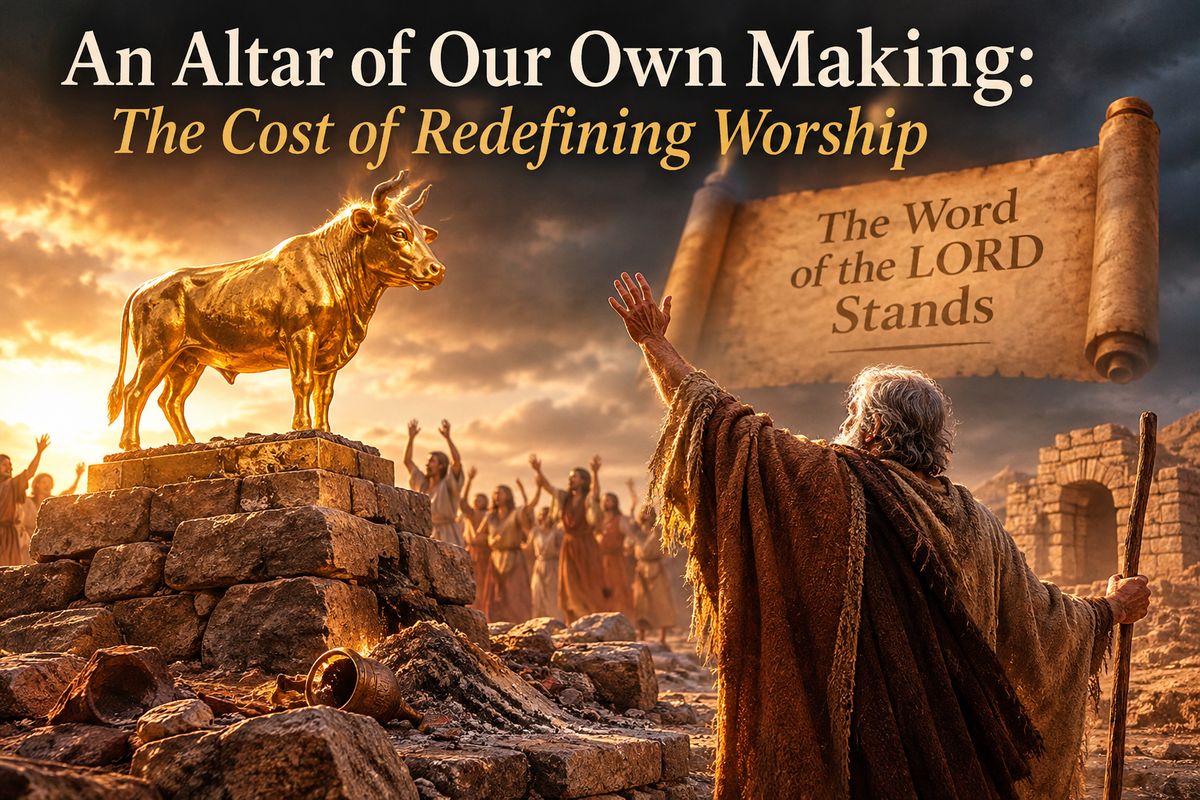
The division of the united monarchy under Rehoboam did more than fracture Israel politically. It created an opportunity for Jeroboam to establish an entirely new religious infrastructure designed to secure the allegiance of the northern tribes.
What began as a political solution to a potential national crisis became one of the most consequential acts of religious apostasy in Israel's history. In 1 Kings 12–13, the biblical narrative moves from the establishment of Jeroboam's alternative worship system to a dramatic confrontation at Bethel.
The golden calves, the self-appointed priesthood, and the king's self-devised festival are not presented as isolated administrative decisions. They represent an attempt to redefine Israel's relationship with its God on terms determined by its king.
Yet the narrative does not leave Jeroboam's innovations unanswered. A man of God arrives from Judah, confronts the altar itself, and announces a judgment that will not be fulfilled for approximately three centuries. What follows is an equally unsettling account of prophetic deception, disobedience, and divine judgment.
Together, these chapters raise important questions about the relationship between worship and political allegiance, the dangers of reshaping God's instructions to accommodate human preferences, the authority of His word, and the certainty that what He declares will ultimately come to pass.
I. ✨ The Golden Calves: The Reinvention of Israel's Worship
Jeroboam's Political and Religious Strategy
Following the division of the united monarchy, Jeroboam faced a significant political problem. Jerusalem remained the religious center of the former united kingdom, and the Temple continued to provide a powerful reason for the northern tribes to travel south into Rehoboam's territory.
Jeroboam feared that continued participation in Jerusalem's worship would eventually restore the people's allegiance to the Davidic monarchy. His solution was to establish alternative worship centers within the northern kingdom.
1 Kings 12:26–30 - Jeroboam thought to himself, “The kingdom will now likely revert to the house of David. If these people go up to offer sacrifices at the temple of the Lord in Jerusalem, they will again give their allegiance to their lord, Rehoboam king of Judah. They will kill me and return to King Rehoboam.”
After seeking advice, the king made two golden calves. He said to the people, “It is too much for you to go up to Jerusalem. Here are your gods, Israel, who brought you up out of Egypt.”
One he set up in Bethel, and the other in Dan. And this thing became a sin; the people came to worship the one at Bethel and went as far as Dan to worship the other.
These locations were strategically selected to serve the religious and political needs of his new kingdom. Bethel was situated near the southern border with Judah, directly along the principal route to Jerusalem.
Dan occupied the northernmost extremity of Israel's territory. Together, they provided geographically accessible alternatives to Jerusalem. The two locations also carried historical and religious associations:
- Bethel: Associated with Jacob's encounter with God, where he established a pillar and declared the place to be the house of God (Genesis 28:11–22).
- Dan: Associated with a pre-existing Levitical priesthood descended from the family of Moses (Judges 18:30).
Jeroboam effectively appropriated Israel's ancestral religious history to legitimize a new national worship system.
By invoking the familiar declaration, "Here are your gods, O Israel, who brought you up out of the land of Egypt" (1 Kings 12:28), he presented his innovations as though they were an authentic continuation of Israel's deliverance tradition.
The result was a religious system that redirected Israel's allegiance away from Jerusalem and toward the political centers of the northern monarchy.
The Literary Connection to Aaron's Golden Calf
The writer of 1 Kings establishes an unmistakable literary connection between Jeroboam's actions and Aaron's apostasy at Sinai. The dedication formula the people proclaim in Exodus, Jeroboam repeats in 1 Kings:
Exodus 32:4 - "These are your gods, O Israel, who brought you up out of the land of Egypt."
1 Kings 12:28 - "Behold your gods, O Israel, who brought you up out of the land of Egypt."
The verbal correspondence is significant. Jeroboam's religious innovation is presented against the backdrop of Israel's foundational act of rebellion. Several additional parallels reinforce this connection.
The Names of the Sons
- Aaron's sons included Nadab and Abihu (Exodus 6:23).
- Jeroboam's sons included Nadab and Abijah (1 Kings 14:1; 15:25).
The shared name Nadab creates an additional literary association between the two priestly and royal households. Aaron's sons Nadab and Abihu were struck down after offering unauthorized fire before the LORD (Leviticus 10:1–2), while Jeroboam's dynasty eventually experienced divine judgment and destruction.
The Self-Devised Festival
Exodus 32:3-5 - All the people took off their earrings and brought them to Aaron. He took what they handed him and made it into an idol cast in the shape of a calf, fashioning it with a tool. Then they said, “These are your gods, Israel, who brought you up out of Egypt.”
When Aaron saw this, he built an altar in front of the calf and announced, “Tomorrow there will be a festival to the LORD.”
1 Kings 12:31–33 - Jeroboam built shrines on high places and appointed priests from all sorts of people, even though they were not Levites.
He instituted a festival on the fifteenth day of the eighth month, like the festival held in Judah, and offered sacrifices on the altar. This he did in Bethel, sacrificing to the calves he had made. And at Bethel he also installed priests at the high places he had made.
On the fifteenth day of the eighth month, a month of his own choosing, he offered sacrifices on the altar he had built at Bethel. So he instituted the festival for the Israelites and went up to the altar to make offerings.
The parallel is particularly important: both Aaron and Jeroboam retain the language of worshiping the LORD while introducing religious practices of their own making.
The issue is not simply whether Israel continued using the name of its God. The issue is whether Israel would worship Him according to His instructions or according to human invention.
The Golden Calf: A Representation of Yahweh or a Replacement for Him?
The account in Exodus 32 raises an important interpretive question: Did Aaron intend to replace Yahweh with another deity, or was the calf intended to serve as a physical throne or pedestal for the invisible God of Israel?
Ancient Near Eastern iconography provides a useful context for considering this question. In the ancient Levant and Mesopotamia, bovine imagery was frequently associated with divine strength and kingship. Storm gods such as Baal and Hadad were commonly represented standing upon bulls or calves.
In this iconographic arrangement, the animal could function as the throne or pedestal of a deity rather than as a literal representation of the deity itself. This raises the possibility that the calf was intended to function as a physical platform for Yahweh's invisible presence.
The southern tradition provides an interesting comparison:
Exodus 25:18–22 - Make two cherubim out of hammered gold at the ends of the cover. Make one cherub on one end and the second cherub on the other; make the cherubim of one piece with the cover, at the two ends.
The cherubim are to have their wings spread upward, overshadowing the cover with them. The cherubim are to face each other, looking toward the cover. Place the cover on top of the ark and put in the ark the tablets of the covenant law that I will give you.
There, above the cover between the two cherubim that are over the ark of the covenant law, I will meet with you and give you all My commands for the Israelites.
The northern calf imagery may have attempted to accomplish something structurally similar: provide a visible throne or localized representation of the invisible divine presence.
Several textual observations support the possibility that Aaron did not initially intend to introduce an entirely different deity. First, the Hebrew word elohim can function as either a plural designation for gods or a singular designation for God.
In Exodus 32:4, the expression is associated with a single calf. The proclamation can therefore be understood as referring to Israel's God rather than necessarily introducing multiple competing deities.
Second, Aaron's subsequent declaration is explicit:
Exodus 32:5 - "Tomorrow shall be a feast to the LORD."
Aaron invokes the covenant name of Israel's God. This suggests that he may have intended to maintain the identity of Yahweh while introducing an unauthorized physical representation of His presence.
However, identifying the intended function of the calf does not resolve the theological problem.
The Actual Sin of the Calf Cult
Exodus 20:4 - “You shall not make for yourself an image in the form of anything in heaven above or on the earth beneath or in the waters below.
Even if the calf was intended as a pedestal for an invisible God, the image still represented an attempt to establish a physical, humanly manufactured point of access to the Creator.
The distinction between representing the invisible God and replacing Him with a visible object is dangerously thin.
Exodus 32:5-6 - Aaron built an altar in front of the calf and announced, “Tomorrow there will be a festival to the Lord.”
So the next day the people rose early and sacrificed burnt offerings and presented fellowship offerings. Afterward they sat down to eat and drink and got up to indulge in revelry.
This demonstrates how quickly the distinction collapses. The people begin offering sacrifices and engaging in revelry around the image. The object intended to facilitate worship becomes the center of worship.
By the time Jeroboam introduces his calves, he is repeating this same compromise on a national scale. The familiar image becomes a means of directing religious devotion toward the king's political centers.
The Scribal Polemic: Was Exodus 32 Shaped Against Jeroboam?
An important scholarly proposal concerns the literary relationship between Exodus 32 and 1 Kings 12. Some modern scholars argue that the golden calf narrative, in its present literary form, was shaped or emphasized by southern Judean scribes as a polemic against the northern kingdom's religious practices.
Under this interpretation, the relationship may not be limited to 1 Kings deliberately echoing an older Exodus tradition. The Exodus account itself may also have been shaped or emphasized to condemn Jeroboam's innovations.
The argument rests on several observations.
Aaron, the foundational southern priestly figure, is portrayed as participating in an act of religious compromise. He creates a golden calf, appeases a restless population, and presides over an unauthorized festival.
These details closely parallel Jeroboam's actions.
This creates an interesting literary tension: even the ancestral priestly figure associated with the southern tradition is portrayed as capable of committing the very kind of apostasy that would later characterize the northern kingdom.
The resulting narrative provides a powerful condemnation of northern worship. A Judean reader encountering Jeroboam's dedication formula would recognize that the same words had already appeared in the account of Israel's rebellion at Sinai.
The northern religious system is consequently presented not as a legitimate innovation, but as a repetition of Israel's foundational failure. This remains a scholarly reconstruction of the literary history, rather than an established fact about the composition of Exodus.
The Iconic Divide: Cherubim versus Calves
The competing religious centers of Jerusalem and the northern kingdom also represented two different approaches to depicting the divine throne.
The Southern Model: Cherubim
In Solomon's Temple, the Ark of the Covenant was associated with the invisible presence of Yahweh enthroned above the cherubim (Exodus 25:18–22).
Ancient Near Eastern iconography frequently depicted cherubim-like creatures as winged guardians, sphinxes, or other composite royal creatures. Such imagery communicated kingship, majesty, and heavenly guardianship.
The Northern Model: Calves
Jeroboam's calves drew upon bovine symbolism familiar throughout the ancient Near East. The bull represented strength, fertility, agricultural prosperity, and royal power. These associations made it an especially recognizable symbol within the northern kingdom.
The resulting contrast can be represented as follows:
The Invisible Presence of YHWH
- Southern Iconography — Jerusalem
- Cherubim
- Winged, composite heavenly creatures
- Royal throne imagery
- Northern Iconography — Bethel and Dan
- Calves
- Bovine imagery
- Strength, fertility, and agricultural power
Both traditions could be understood as attempting to depict a throne for an invisible deity. However, from the perspective of the biblical narrative, the northern choice represents an unacceptable theological compromise.
The calf was not simply an alternative artistic preference. Its presence was inseparable from the larger system of unauthorized worship, political manipulation, and disobedience.
The first movement of the narrative therefore establishes the fundamental problem: Jeroboam has attempted to make Israel's worship serve the interests of his kingdom rather than allowing the kingdom to remain accountable to the God who delivered Israel from Egypt.
II.✨ The Man of God: The Authority of the Word of the LORD
1 Kings 13 begins with an extraordinary confrontation. Jeroboam is standing beside the altar at Bethel, preparing to burn incense during the festival he has devised. A man of God arrives from Judah with a message directed not initially toward the king, but toward the altar itself.
1 Kings 13:2 - "O altar, altar, thus says the LORD: Behold, a son shall be born to the house of David, Josiah by name, and he shall sacrifice on you the priests of the high places who make offerings on you, and human bones shall be burned on you."
The prophecy is remarkable for its specificity. The prophet identifies a future king by name, identifies his Davidic lineage, and describes the precise judgment that will eventually be carried out against the altar.
Josiah would not appear on the historical scene for approximately three centuries.
The immediate response to the prophecy provides an additional demonstration of divine authority. The man of God announces a sign: the altar will be split apart, and its ashes will be poured out.
Jeroboam responds by extending his hand and commanding that the prophet be seized. However, the king's hand immediately withers and becomes immobile. The man who possesses political authority over the northern kingdom cannot even control his own hand.
Jeroboam then asks the man of God to intercede with the LORD. The prophet prays, and the king's hand is restored. The sequence is striking:
- The king commands the prophet to be seized.
- The king's hand withers.
- The king requests the prophet's intercession.
- The prophet prays.
- The king's hand is restored.
The altar is also split apart, and its ashes spill out, fulfilling the announced sign. Jeroboam then invites the prophet home and offers him a reward. The prophet refuses. His instructions from God were explicit: he must neither eat bread nor drink water nor return by the way he came.
He departs Bethel by another route.
The Deception of the Old Prophet
The narrative then shifts from the public confrontation at Bethel to a private test of obedience.
An old prophet living in Bethel hears what happened through his sons. He saddles his donkey, finds the Judean man of God resting beneath an oak tree, and invites him to return to his home to eat.
The Judean prophet repeats the command he received from God. He is not to eat or drink in the northern kingdom. The old prophet responds:
1 Kings 13:18 - "I also am a prophet as you are, and an angel spoke to me by the word of the LORD, saying, 'Bring him back with you into your house that he may eat bread and drink water.'"
(But he was lying to him.)
1 Kings 13:18-19 - So the man of God returned with him and ate and drank in his house.
This creates the central theological tension of the chapter. The Judean prophet had received a direct command from God. He now encounters someone claiming to possess a subsequent revelation that contradicts that original command.
He accepts the secondhand claim and abandons the instructions he had received.
Judgment at the Table
While the two prophets are sitting at the table, the word of the LORD comes to the old prophet. The very man who fabricated an angelic message is now compelled to deliver a genuine prophetic judgment.
The message is devastating: because the Judean man of God disobeyed the command given to him, his body will not be buried in the tomb of his fathers.
The irony is difficult to miss. The old prophet had lied about receiving a message from God. Yet God uses him to pronounce the actual judgment against the man he deceived.
The narrative does not allow prophetic identity, religious experience, or another person's claimed spiritual authority to supersede the word God has already given.
The Judean prophet is subsequently killed by a lion while traveling home. However, the circumstances of his death are unusual. The lion does not consume the corpse. It does not attack the donkey. Instead, the lion and donkey remain beside the body as two witnesses.
The unnatural behavior of the animals emphasizes that this was not an ordinary encounter with a wild animal. The scene functions as a supernatural sign confirming the announced judgment.
The Theological Significance of the Prophet's Disobedience
Why does the narrative devote so much attention to the death of a prophet who had just performed a miraculous sign and delivered an accurate prophecy? The account serves several purposes.
The Certainty of God's Word
The Judean prophet demonstrates that even a person commissioned by God is accountable to the instructions he has received. His prophetic authority does not exempt him from obedience.
If a prophet who has just demonstrated God's power through miraculous signs is held accountable for abandoning a direct command, the judgment announced against Jeroboam's deliberate, state-sponsored apostasy should be taken even more seriously.
The Danger of Religious Deception
The old prophet invokes an angelic message and appeals to his own prophetic identity. His claim sounds religiously credible. Yet the claim contradicts the direct instruction already given to the Judean prophet.
The account exposes the danger of allowing another person's supposed spiritual authority to override what God has actually commanded.
The Word Remains Authoritative
The Judean prophet's failure does not invalidate the prophecy he originally delivered against Bethel.
- The altar will still be judged.
- Josiah will still come.
- The word of the LORD remains certain even when the messenger fails.
Why the Old Prophet Wanted His Bones Buried Beside the Judean Prophet
Following the Judean prophet's death, the old prophet retrieves his body, mourns over him, and buries him in his own family tomb. He then gives his sons an unusual instruction:
1 Kings 13:31 - "When I die, bury me in the grave where the man of God is buried; lay my bones beside his bones."
This request anticipates the coming judgment against Bethel. The old prophet recognizes that the Judean prophet's announcement will come to pass. He wants his own remains associated with the tomb of the man whose prophecy will eventually be fulfilled. This becomes particularly important when the narrative reaches Josiah in 2 Kings 23.
The second movement therefore demonstrates two related realities: the word of God cannot be overturned by religious deception, and even the prophet who deceives another man ultimately recognizes the certainty of the judgment he helped announce.
III.✨ The Fulfillment: The Word of the LORD Does Not Fall to the Ground
Josiah and the Destruction of Bethel's Altar
Approximately three centuries after the man of God announced judgment against Bethel, King Josiah of Judah arrives to carry out a sweeping religious reform.
The account in 2 Kings 23 describes his actions in language that directly recalls the prophecy of 1 Kings 13. Josiah does not simply condemn the northern sanctuary. He systematically destroys its religious infrastructure.
2 Kings 23:15 - Even the altar at Bethel, the high place made by Jeroboam son of Nebat, who had caused Israel to sin—even that altar and high place he demolished. He burned the high place and ground it to powder, and burned the Asherah pole also.
He then turns his attention to the priests. The prophecy had specifically declared that a son of David would sacrifice the priests of the high places upon the altar.
2 Kings 23:20 - Josiah slaughtered all the priests of those high places on the altars and burned human bones on them.
The final detail is especially significant. Josiah orders human bones to be taken from the surrounding tombs and burned upon the altar, accomplishing the predicted defilement (2 Kings 23:16).
In the ancient Near Eastern context, the deliberate use of human remains to pollute a sacred site represented a profound act of desecration. The prophecy is fulfilled in its specific details:
- A son of David arrives.
- He destroys the altar at Bethel.
- He executes the priests of the high places.
- He burns human bones upon the altar.
The word spoken centuries earlier has not been forgotten.
The Preserved Tomb
During the destruction, Josiah notices a monument and asks about it. The people identify it as the tomb of the man of God who had come from Judah and prophesied these things. Josiah responds by ordering that the tomb remain undisturbed.
2 Kings 23:18 - "Let him rest; let no one move his bones."
This detail brings the reader back to the unusual conclusion of 1 Kings 13. The Judean prophet had been buried in the tomb of the old prophet at Bethel. The old prophet had specifically requested that his own bones be placed beside those of the Judean prophet.
Now, when Josiah arrives to fulfill the prophecy, both men's remains are preserved. The tomb becomes a physical testimony to the prophetic word. There is a remarkable narrative continuity here:
- The man of God announces judgment against the altar.
- The old prophet recognizes the certainty of that judgment.
- The old prophet requests burial beside the Judean prophet.
- Josiah arrives centuries later.
The altar is destroyed, the priests are judged, and the tomb containing the two prophets is spared. The very place where the old prophet had deceived the Judean prophet becomes the location where his own remains are preserved alongside the man whose word he had once contradicted.
Reconsidering the Old Prophet of Bethel
The old prophet remains one of the most enigmatic figures in the narrative.
Why did he seek out the Judean prophet? Why did he lie about receiving an angelic message? And why did he later insist on being buried beside the man he had deceived? Several interpretive possibilities help illuminate his behavior.
The Political and Religious Sympathizer
The old prophet lived in a kingdom whose religious system was being reorganized under Jeroboam. The king had established alternative worship centers and appointed priests who were not drawn from the traditional Levitical priesthood.
Deuteronomy 18:1 - The Levitical priests—indeed, the whole tribe of Levi—are to have no allotment or inheritance with Israel. They shall live on the food offerings presented to the LORD, for that is their inheritance.
Numbers 3:5-10 - The Lord said to Moses, “Bring the tribe of Levi and present them to Aaron the priest to assist him. They are to perform duties for him and for the whole community at the tent of meeting by doing the work of the tabernacle. They are to take care of all the furnishings of the tent of meeting, fulfilling the obligations of the Israelites by doing the work of the tabernacle.
Give the Levites to Aaron and his sons; they are the Israelites who are to be given wholly to him. Appoint Aaron and his sons to serve as priests; anyone else who approaches the sanctuary is to be put to death.”
1 Kings 12:31 - Jeroboam built shrines on high places and appointed priests from all sorts of people, even though they were not Levites.
The old prophet may have represented an older prophetic tradition struggling to maintain its place within this new religious environment. When he heard that a Judean prophet had publicly confronted Jeroboam and demonstrated extraordinary divine authority, he may have wanted to associate himself with that authority.
His invitation to the Judean prophet could therefore reflect a desire for religious solidarity or recognition. This interpretation remains speculative; the text does not explicitly identify his political motives.
The Testing of a Prophet
Another possibility concerns the challenge of prophetic discernment. The old prophet's claim was designed to test whether the Judean prophet would remain faithful to the direct command he had received.
Would he hold to the word given to him by Yahweh, or would he accept a secondhand revelation from another prophet? The Judean prophet fails to maintain that distinction.
The narrative thereby demonstrates that religious credentials, claims of angelic communication, and appeals to another person's prophetic status cannot automatically establish the authority of a message.
The Quest for Solidarity in Death
The old prophet's final request suggests that he eventually recognizes the certainty of the Judean prophet's announcement. His insistence on being buried beside the Judean prophet indicate that he wants his own remains associated with the righteous man's tomb.
One possible interpretation is that he anticipates Josiah's future actions and believes the tomb will be spared when the surrounding graves are desecrated. In this reading, the old prophet effectively seeks protection through association with the very man whose obedience he undermined.
The text does not explicitly state that this was his calculation, but the sequence of events makes the possibility noteworthy. His final request also creates a striking literary reversal: the man who had misrepresented God's word ultimately seeks the company of the man whose word proved true.
Jeroboam's Final Refusal to Turn
The narrative also returns our attention to Jeroboam.
After the events at Bethel, the king has witnessed an extraordinary sequence of divine interventions:
- His altar is split apart.
- His hand withers.
- His hand is restored through the prophet's intercession.
- The Judean prophet's death is accompanied by an unmistakable supernatural sign.
Yet the narrative records the tragic conclusion:
1 Kings 13:33 - "After this thing Jeroboam did not turn from his evil way."
The king has received warning after warning, but he does not abandon his religious innovations. His refusal is particularly significant because the narrative has already demonstrated that the God of Israel is not confined to Jerusalem, Bethel, or Dan.
✨ Yahweh remains sovereign over the king, the altar, the prophets, the animals, and the future.✨
Jeroboam's political arrangements cannot insulate his kingdom from divine accountability. His religious system may have secured the allegiance of the northern tribes for a time, but it could not secure the favor of the God whose name he had appropriated.
Conclusion
The narrative of 1 Kings 12–13 and its eventual fulfillment in 2 Kings 23 presents a sustained examination of what happens when human authority attempts to redefine the worship of God.
Jeroboam's golden calves were not simply religious objects. They represented an entire political and theological strategy: establish alternative centers of worship, redirect national allegiance, appropriate ancestral traditions, and construct a religious system that would serve the interests of the monarchy.
The literary connection to Aaron's golden calf makes the seriousness of this compromise unmistakable. Israel had already experienced the consequences of attempting to represent the invisible God through unauthorized imagery. Yet the northern kingdom repeated the same foundational failure on a national scale.
The arrival of the Judean man of God demonstrates that the LORD has not surrendered His authority to Jeroboam. The king may control the northern kingdom, but he cannot control the word of God. The altar itself becomes the object of prophetic judgment.
The account of the two prophets adds another dimension. The man of God is not exempt from obedience simply because he has received a divine commission, performed a sign, or spoken an accurate prophecy. Nor does another person's religious standing or claim of angelic revelation supersede a direct command from God.
The old prophet's deception exposes the danger of substituting religious credibility for actual faithfulness. The Judean prophet's failure demonstrates the seriousness of abandoning what God has instructed.
Finally, Josiah's actions establish that the prophetic word is not dependent upon the lifetime, reputation, or continued presence of its messenger. Three centuries pass, kings rise and fall, and the northern kingdom disappears. Yet the word spoken against Bethel remains certain.
There is a final irony in the preservation of the two prophets' tomb. The old prophet who deceived the Judean man eventually seeks burial beside him, and both are spared when Josiah carries out the announced judgment.
✨ Invoking God's Name is not the same as honoring His authority, and claiming to represent His word is not the same as remaining faithful to it. ✨
The altar that Jeroboam established to secure his kingdom is destroyed. The religious system he created does not endure. The king's political calculations do not prevent the judgment of God. But the word of the LORD stands.