(C) 👰♀️🫣💔🏜️✝️🌄 Our Pattern of Distancing Ourselves From God: The Fearful Bride Misreading Presence as Danger [3 parts]
Introduction
Across Scripture, a consistent emotional pattern emerges around divine and covenantal presence: what is meant to be nearness is often perceived as threat.
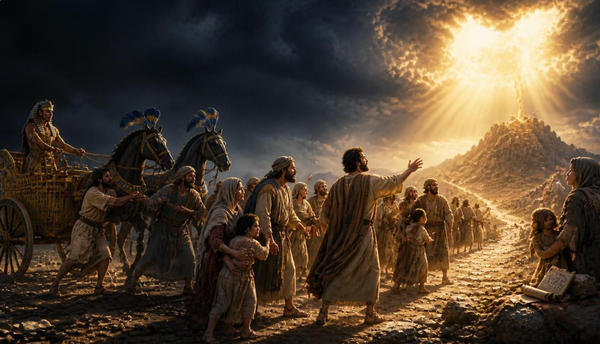
At Sinai, Israel recoils from the thunder and fire, interpreting holiness as danger and choosing distance over intimacy. In the narrative of David and the woman of Tekoa, this dynamic is refracted through royal justice and fractured family reconciliation—where banishment persists not because restoration is impossible, but because it is not fully pursued.
In both scenes, presence is misread as something to avoid rather than something to enter. This is the tension of the fearful bride: proximity to authority, glory, or love is experienced first through the lens of exposure, vulnerability, and potential judgment, rather than communion.Introduction
I. Sinai: The Fearful Bride
Immediately after the giving of the Ten Commandments:
Exodus 20:18-19 - Now when all the people saw the thunder and the flashes of lightning and the sound of the trumpet and the mountain smoking, the people were afraid and trembled, and they stood far off and said to Moses, “You speak to us, and we will listen; but do not let God speak to us, lest we die.”
Notice the language of perception again:
- They saw.
- They trembled.
- They withdrew.
Their response to God's presence is distance. Then Moses says something seemingly paradoxical:
Exodus 20:20 - Moses said to the people, “Do not fear, for God has come to test you, that the fear of Him may be before you, that you may not sin.”
The people stood far off, while Moses drew near to the thick darkness where God was.
"Do not be afraid...so that you may fear." Two different kinds of fear are being distinguished.
Both “fear” words come from the same Hebrew root:
1. (yareʼ) - “to fear” : Terror
This is the root behind both expressions. It carries a wide semantic range:
- fear / being afraid
- terror (emotional distress response)
- reverence / awe
- recognition of overwhelming authority
✨ Hebrew does not separate “fear” and “reverence” as cleanly as English does. Context determines direction. ✨
The people are terrified. This fear causes withdrawal. It says: 'hide, 'stay away,' 'keep your distance.' This is the fear Adam exhibits after Eden.
Genesis 3:10 - "I was afraid because I was naked; so I hid."
2. “Do not fear” - (al-tirā’ū) : Reverence
This is qal imperfect plural of yareʼ.
Here it clearly means:
- terror
- panic
- the instinct to withdraw or flee
Moses is essentially saying, 'Do not be terrified in the presence of God.' This is fear as distance-producing emotion.
Moses wants them to possess another kind of fear, a holy awe. A reverent awareness of God's greatness. This fear does not drive one away. It draws one into obedience.
The distinction is crucial. The Bible never seeks to eliminate reverence, it seeks to eliminate terror.
The Problem Introduced in Eden
Before Genesis 3, humanity walked openly with God. After sin: shame appears, hiding happens, and fear dictates action.
Fear is one of the earliest symptoms of the Fall. The tragedy is not merely that humanity sinned but that humanity became afraid of the One who loved them.
Throughout Scripture, God repeatedly says, "Do not fear," because fear keeps creating distance.
✨ The divine project is not merely forgiveness, its restored fellowship. ✨
1 John 4:18 and "Perfect Love"
1 John 4:18 - There is no fear in love, but perfect love casts out fear. For fear has to do with punishment, and whoever fears has not been perfected in love.
The Greek word translated "perfect" is: τέλειος (teleios).
This word is enormously important. It does not primarily mean: flawless, errorless, without defect. Rather it means: complete, mature, fully developed, brought to its intended goal.
The same word family appears throughout the New Testament.
Matthew 5:48 - "Be perfect (teleioi), as your heavenly Father is perfect."
Jesus is not commanding instant moral flawlessness. He is calling His disciples toward mature, complete love. Likewise James says:
James 1:4 - "Let endurance have its perfect result, so that you may be perfect and complete."
Again, maturity. Wholeness. Completion. John is describing a process. A journey. A sanctification.
✨ 1 John 4:18 could be paraphrased:"Mature love drives out fear" or "love brought to its intended goal expels terror." ✨
Fear as an Indicator of Incomplete Formation
Notice what John specifically says, "fear involves punishment." The Greek idea carries the sense of expectation of judgment.
The fearful person is still relating to God primarily as: Judge, Threat, Punisher. John is not denying God's justice; he is describing a relationship transformed by love.
As love matures, the believer increasingly understands:
- God's character,
- God's intentions,
- God's faithfulness.
The result is not arrogance, but confidence. The child no longer hides when the Father enters the room. This calls to mind the first time Peter met Jesus and saw the miraculous catch of fish:
Luke 5:8 - When Simon Peter saw it, he fell down at Jesus' knees, saying, “Depart from me, for I am a sinful man, O Lord.”
This is our natural response after Eden, fear of God in His holiness.
Sinai and 1 John Together
Viewed together, Sinai becomes the beginning of a journey.
At Sinai:⚡ God descends, 😨 The people retreat, 🙈 They remain at a distance.
In 1 John: ❤️ Love matures, 🔥 Fear is expelled, 🤝 Fellowship grows.
The movement is from terror toward communion.
The Goal Revealed in Revelation 22
The Bible's final chapters complete the story. Notice the contrast with Sinai. At Sinai: thunder, smoke, distance, and trembling.
In Revelation 22, "The throne of God and of the Lamb will be in it." Not distant. Present. Then, "They will see His face." The very thing humanity feared becomes humanity's joy.
This would have been astonishing to an Israelite reader. Throughout the Old Testament:
- Moses cannot fully see God's glory.
- The high priest enters only once a year.
- The people remain outside.
- Cherubim guard access.
Then, "There will no longer be any curse." The barriers introduced in Eden are gone.
✨ Fear is gone. Shame is gone. Distance is gone. Night is gone. ✨
Sanctification as Preparation for Presence
This raises a beautiful possibility.Perhaps sanctification is not merely moral improvement, perhaps it is preparation for presence. From Genesis onward, God seems to be forming a people capable of dwelling openly with Him.
Consider the progression:
- Eden -🚶 God walks with humanity.
- Fall - 🙈 Humanity hides.
- Sinai - ⛰️ Humanity fears.
- Tabernacle - ⛺ God dwells nearby.
- Temple - 🏛️ Presence localized.
- Jesus - 👑 God with us.
- Pentecost - 🔥 God within us.
- New Jerusalem - 🌅 God among us with no barriers.
The entire story is movement toward unhindered communion.
The Great Reversal
Seen this way, Exodus 20:20 and 1 John 4:18 are not opposites. They are stages of the same journey. At Sinai, God teaches reverence. Through sanctification, He removes terror. What remains is holy love.
The fear that says, "Run away" is cast out. The awe that says, "Holy, holy, holy" remains forever. The culmination is Revelation 22.
✨ Humanity finally becomes what it was always meant to be: a people who can stand before God without hiding, without shame, without terror, and without any desire to flee. ✨
The story begins with Adam saying, "I was afraid." The story ends with God's servants looking directly upon His face.
That may be one of the deepest descriptions of salvation in all of Scripture—not merely being forgiven by God, but becoming the kind of people who are no longer afraid to live in His presence.
II. 1. The contrast being drawn: David vs. God
2 Samuel 14:13–14 is one of the most theologically charged moments in the David narratives because it exposes both David’s instinct toward restoration and his limits as a human judge.
This is a carefully crafted argument aimed at David regarding Absalom. But embedded in it is a theological claim about God’s character. The woman of Tekoa says to David:
2 Samuel 14:13–14 - “Why then have you planned such a thing against the people of God? For in giving this decision the king convicts himself, in that the king does not bring his banished one home again.
We must all die; we are like water spilled on the ground… yet God does not take away life, but plans ways so that the banished one will not remain an outcast.”
Essentially, she points out the contrast in David's static justice and God’s dynamic and restorative justice.
- David keeps Absalom exiled.
- But God does not treat the banished as permanently excluded.
- God “devises means” (ḥašab maḥašābôt) so that the outcast may return.
That phrase is key: “devises plans” / “finds ways” / “plans means.” Hebrew idea: God is not passive about restoration—He is strategically inventive in mercy.
2. David’s limitation: justice without reconciliation
David is not portrayed as cruel here. His problem is more subtle, he can forgive privately, but he struggles to publicly restore the relationship.
Absalom is not executed. But neither is he embraced. So Absalom lives in an in-between state:
- alive, but not reconciled
- royal, but excluded
- near, but not received
This is important: David’s system creates liminal exile rather than restoration. And that liminal space becomes unstable—eventually producing rebellion.
3. God’s character as described in the text
The woman’s theological claim is bold, “God does not take away life; instead, He devises ways so the banished one does not remain estranged.” This is not denying judgment in Scripture generally. It is emphasizing a pattern:
God is not satisfied with exile as a final state, He actively works toward reintegration. This aligns strongly with the broader biblical arc:
- Adam → sought out after hiding (Genesis 3:9)
- Cain → marked for protection even after judgment (Genesis 4:15)
- Israel → repeatedly brought back after exile
- Prophets → constant call to return (shuv)
- Jesus → eats with sinners and tax collectors
The trajectory is consistent: judgment is real, but not final in intent.
4. Peter makes the principle explicit
2 Peter 3:9 - “The Lord is not slow about His promise… but is patient toward you, not wishing for any to perish but for all to come to repentance.”
The Greek behind “wishing” (boulomenos) carries the sense of deliberate intention or desire.
And “repentance” (metanoia) is not mere regret—it is a transformation of mind and direction. So Peter frames God as:
- patient in timing,
- intentional in mercy,
- oriented toward repentance rather than destruction.
This matches the spirit of 2 Samuel 14:14, but clarifies it:
✨ God is not indifferent to justice—but His justice is ordered toward restoration where possible. ✨
5. The key difference between David and God
David’s limitation is not a lack of compassion—it is a lack of capacity. He is:
- a finite judge
- constrained by political stability
- bound by the consequences of sin within his kingdom
So he ends up in a tension: Justice demands separation while love desires reconciliation He cannot fully resolve both.
God, by contrast:
- does not abandon justice
- but also does not abandon the sinner
- and is able to “devise means” that hold both together
In biblical theology, those “means” ultimately converge in Christ:
- justice satisfied (cross)
- reconciliation accomplished (resurrection)
- banished brought near (Ephesians 2:13)
6. The irony of Absalom’s story
The narrative quietly demonstrates the danger of incomplete restoration: Absalom is eventually “brought back” externally, but not truly reconciled inwardly with David, leading to political rupture and attempted overthrow
So 2 Samuel 14 is not endorsing cheap restoration. It is exposing a gap: partial reconciliation without healed relationship is unstable
✨ God’s restoration is never merely administrative—it is transformative. ✨
7. The deeper theological thread: “the banished one”
That phrase is crucial: “so that the banished one will not remain an outcast.” This anticipates a major biblical motif:
- Eden: banishment
- Israel: exile
- Humanity: alienation
- Christ: “cast out” - outside the camp (Hebrews 13:12)
And then reversal:
- return
- adoption
- nearness
- dwelling with God
Completion:
Revelation 22:4 - “They will see His face.”
8. Synthesis
Putting it together:
- David shows the tension of justice and mercy without full reconciliation power
- The woman of Tekoa articulates a theology of divine restoration
- 2 Peter 3:9 clarifies the divine intent behind that restoration
- The broader canon shows the mechanism: God Himself provides the “way” back
So the contrast is not: David = harsh judge / God = soft judge
It is more precise: David = limited judge who cannot fully restore what he loves / God = sovereign judge who both judges rightly and creates the means of return.
And that “means” ultimately becomes personal in Christ.
9. Insight
The deepest contrast in 2 Samuel 14 is not about emotion—it is about capacity: David can desire restoration, God can accomplish it.
That is why Scripture consistently moves from: “Do not remain an outcast” (promise in principle) to “Christ Jesus… brought near those who were far off” (Ephesians 2:13)
The biblical story is not simply about God refusing to abandon people. It is about God refusing to let exile be the final word—and then constructing the very path by which the banished return.
III. 1. The “fearful bride” pattern: presence misread as danger
From Eden onward, humanity’s first reflex toward God after rupture is not attraction but withdrawal:
- Adam hides among trees (Genesis 3:8–10)
- Israel trembles at Sinai and asks for distance (Exodus 20:18–19)
- Isaiah cries “Woe is me” when he sees glory (Isaiah 6:5)
The presence of God is interpreted through a distorted lens: not as home, but as threat.
This is the emotional core of the “fearful bride” motif: the beloved mistakes the voice of the Bridegroom for judgment rather than invitation.
2. 2 Samuel 14: God “devises means” to end exile
The woman of Tekoa’s claim becomes a theological hinge:
2 Samuel 14:14 - “God does not take away life, but devises ways so that the banished one will not remain an outcast.”
The key idea is not sentiment—it is strategy.
God is portrayed as actively constructing pathways back from exile. Not waiting, not merely permitting return, but designing return into reality.
✨ This is not passive mercy. It is engineered reconciliation. ✨
And once you read the canon forward, those “devised ways” begin to accumulate:
- Covenant
- Tabernacle
- Sacrifice
- Priesthood
- Prophets
- Exile itself as discipline rather than abandonment
- And ultimately, incarnation
Each is a structure meant to answer one question: “How do I bring the banished home without destroying them?”
3. The inner desire behind the pursuit
Peter pulls the veil back on divine intention:
2 Peter 3:9 - “The Lord… is patient… not wishing that any should perish, but that all should come to repentance.”
The word behind “wishing” (boulomenos) is not casual preference. It carries the sense of deliberate will, settled intent. So the divine posture isn't indifference to sin, or selective exclusion, its restrained urgency.
✨ God delays, not because He is absent, but because He is pursuing outcomes that require time for mercy to land without destroying the object of mercy. ✨
✨ This re-frames delay as pursuit, not distance.✨
4. The cost hidden inside “bringing the banished home”
It is one thing to say, “God brings people back,” it is another to ask, “at what cost does He do so?”
In 2 Samuel 14, David cannot fully restore Absalom without destabilizing justice and kingship. He is trapped by limitation. But Scripture gradually reveals something startling:
God does not solve the exile problem from a distance, He enters it.
Rom. 5:8 - “While we were still sinners, Christ died for us.”
2 Corinthians 5:19 - “God was in Christ reconciling the world to Himself.”
Notice the direction: Not humanity ascending, rather God descending. The “means” God devises is not merely a plan, it is Himself.
5. The Bridegroom who refuses to accept permanent separation
If we hold the bridal imagery consistently, the story becomes emotionally coherent. The Bride is fearful, ashamed after failure, hiding after exposure, distant after guilt.
The Bridegroom responds not with replacement, but pursuit. Hosea makes this explicit in covenant form: a betrayed marriage becomes the stage for relentless love.
Luke 15 gives it narrative form:
- the shepherd goes after the lost sheep
- the woman searches for the coin
- the father runs toward his prodigal son
Each parable dismantles the assumption that distance means disinterest. Distance becomes the very reason for pursuit.
6. The climax: the King absorbs the cost of return
The deepest reversal is this: In human systems the king preserves himself and the banished bear the cost of return.
✨ In the gospel, the King bears the cost so the banished can return. ✨
This is why the cross is not only atonement but revelation. It reveals something about God that was always true but not yet fully visible: God does not remain untouched by human exile, He enters it.
7. Fear transformed: from “stay away” to “come near”
This is where the fearful bride motif resolves. Fear is not simply removed—it is re-educated.
- At Sinai: fear = “do not approach”
- In Christ: fear = transformed into reverent awe that no longer requires distance
John summarizes the end state:
1 John 4:18 - “Perfect love casts out fear.”
Not because God becomes less holy but because love proves He is not hostile.
The Bride learns: presence is no longer danger, glory is no longer threat, and holiness is no longer rejection.
8. Revelation 22 - exile permanently undone
The story does not end with forgiveness only, but with proximity restored beyond rupture:
Revelation 22:4–5 - “They will see His face, and His Name will be on their foreheads… and there will no longer be any curse.”
This is not merely legal reconciliation. It is spatial, relational, and perceptual restoration:
- No hiding
- No exile
- No mediated distance
- No fear-driven separation
The Bride finally lives where she was always meant to be: in direct presence without terror.
9. Synthesis: the relentless King
Across the canon, one line holds steady:
- God does not abandon the banished
- God does not normalize exile
- God does not accept distance as final
Instead:
- He devises means (2 Samuel 14:14)
- He delays judgment for repentance (2 Peter 3:9)
- He enters exile Himself (cross)
- He restores presence permanently (Revelation 22)
And the cost is never theoretical, its personal.
So the love is not proven by sentiment, but by descent. Not by declaration, but by wounds. Not by permission for return, but by God making return possible at His own expense.
Conclusion
If Eden begins with a fearful bride hiding from God among trees, Scripture ends with a healed bride standing in open light without shame. And the bridge between those two moments is not human courage, it is divine pursuit.
A King who refuses to let exile have the final word—and therefore steps into exile Himself until nothing remains that can separate His people from His presence again. Paul appears to have really internalized this truth:
Romans 8:38-39 - I am convinced that neither death nor life, neither angels nor demons, neither the present nor the future, nor any powers, neither height nor depth, nor anything else in all creation, will be able to separate us from the love of God that is in Christ Jesus our Lord.