🕊️ 🗣️🐍📜🦁 🫏 The Boundaries of Obedience: When Beasts Know Better [3 parts]
Introduction ✨
Throughout Scripture, humanity is distinguished from the rest of creation by its unique relationship with the Creator.
Made in God's image, humanity is entrusted with dominion over the earth, given the capacity to hear and understand divine instruction, and called to exercise its responsibilities under the authority of the One who created it.
Yet this elevated position carries an equally significant responsibility: humanity must remain faithful to the voice of its Creator. The biblical narrative repeatedly exposes the tragedy of people who possess God's instruction but allow competing voices, personal desires, fear, or self-interest to become more influential than what God has spoken.
The garden of Eden provides an early illustration of this conflict, as Adam and Eve encounter a voice that challenges their understanding of God's instruction and intentions.
Generations later, the unnamed man of God in 1 Kings 13 encounters a similar challenge when an old prophet claims to have received a different instruction from YHWH.
King Saul presents another expression of this failure, having experienced the Spirit of God and received explicit commands, yet repeatedly allowing his circumstances, fear of the people, and desire for personal preservation to influence his obedience.
These accounts reveal that familiarity with God, spiritual experiences, recognized authority, and even an accurate knowledge of His commands do not automatically produce continuing faithfulness.
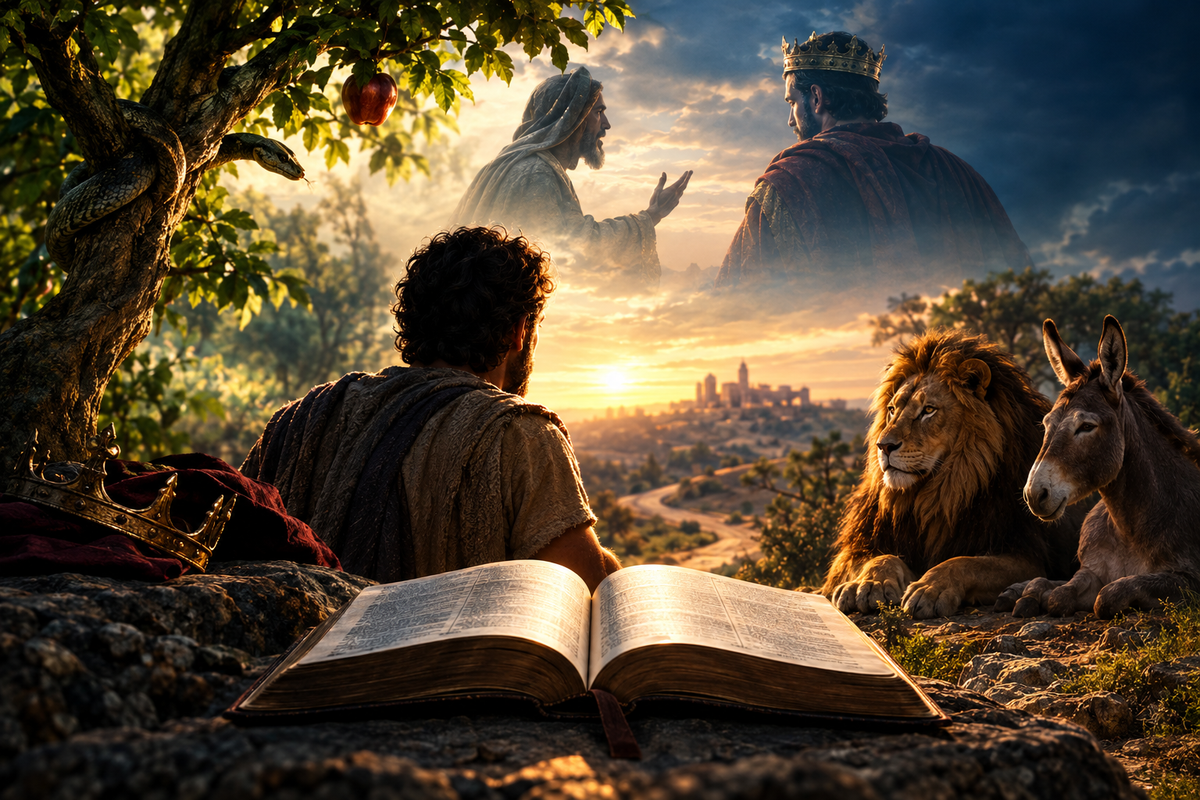
The account in 1 Kings 13 introduces an especially striking detail: after the man of God disobeys and is killed, a lion and a donkey stand beside his body without consuming it or attacking one another.
Their unusual behavior becomes a visible witness to the events, as the lion fulfills its appointed role without exceeding it, while the man entrusted with God's word has failed to remain within the boundaries of his commission.
This scene invites us to consider the broader biblical testimony concerning creation, including the ox and donkey that recognize their master in Isaiah 1:3, Balaam's donkey that perceives what its master cannot, and the recurring imagery of animals responding to an order that humanity sometimes fails to recognize.
Taken together, these accounts raise questions that extend beyond isolated acts of disobedience. What does it mean to hear God's voice faithfully? Can spiritual authority or previous experiences with God become substitutes for present obedience? What happens when humanity, entrusted with greater understanding and responsibility, demonstrates less fidelity than the creatures over which it was given dominion?
Ultimately, these narratives examine the relationship between hearing, allegiance, discernment, and obedience, inviting us to consider whether our lives reflect the order established by the Creator or the competing voices that continually seek to displace His authority.
I. ✨ The Voice That Contradicts the Word
I. The Original Instruction: Knowing What God Has Said
Genesis 2:16–17 - "And the LORD God commanded the man, saying, 'You may surely eat of every tree of the garden, but of the tree of the knowledge of good and evil you shall not eat, for in the day that you eat of it you shall surely die.'"
Adam's situation begins with an unmistakable instruction. God establishes the boundaries of human freedom within the garden, providing abundant permission alongside one specific prohibition.
Adam does not need to discover God's will through speculation, competing opinions, or the interpretation of another person; he has received the instruction directly from God.
This is important because the temptation in Genesis 3 does not begin with Adam lacking information. It begins with another voice introducing a competing account of reality. The serpent does not initially offer Adam a different garden or a different God; he offers a different interpretation of the garden and God's intentions. We encounter a similar situation in 1 Kings 13.
1 Kings 13:8–9 - "But the man of God said to the king, 'If you give me half your house, I will not go in with you. And I will not eat bread or drink water in this place, for so was it commanded me by the word of the LORD, saying, "You shall neither eat bread nor drink water nor return by the way that you came."'"
The man of God has received a specific instruction from YHWH. He is to deliver his prophetic message against Jeroboam's altar, refuse hospitality, refrain from eating and drinking, and return by a different route. His assignment is accompanied by clearly defined boundaries.
Notice the similarity: Adam is told what he may and may not eat, while the man of God is told what he may and may not eat or drink. In both accounts, the instruction involves something seemingly ordinary: food.
Yet the issue is much larger than the food itself. The issue is whether the individual will remain faithful to the word that established the boundary. The boundary is not the test of God's generosity; it is the place where trust in God's word becomes visible.
II. The Introduction of Another Voice: "Did God Really Say?"
Genesis 3:1 - "He said to the woman, 'Did God actually say, "You shall not eat of any tree in the garden"?'"
The serpent introduces doubt by questioning the content of God's instruction. His opening question subtly distorts what God actually said, shifting attention away from the abundance of permitted trees toward the one prohibited tree. He then advances the deception by directly contradicting God's warning.
Genesis 3:4–5 - "But the serpent said to the woman, 'You will not surely die. For God knows that when you eat of it your eyes will be opened, and you will be like God, knowing good and evil.'"
The serpent presents an alternative explanation of God's intentions. Rather than trusting the Creator's explanation of what will happen, Eve is invited to accept the creature's explanation of what God supposedly knows and why He established the boundary. Now consider the account in 1 Kings 13.
An old prophet hears about the man of God's actions and goes looking for him. He finds him resting under an oak tree and invites him to return home to eat bread.
1 Kings 13:15–18 - "And he said to him, 'Come home with me and eat bread.' And he said, 'I may not return with you, or go in with you, neither will I eat bread nor drink water with you in this place, for it was said to me by the word of the LORD, "You shall neither eat bread nor drink water there, nor return by the way that you came."'
And he said to him, 'I also am a prophet as you are, and an angel spoke to me by the word of the LORD, saying, "Bring him back with you into your house that he may eat bread and drink water."' But he lied to him."
The parallel is particularly revealing. The man of God initially responds correctly. He remembers his instruction, repeats it, and refuses the invitation. He knows precisely what he has been told.
However, the old prophet introduces a competing authority. He does not simply suggest that the man of God reconsider his decision; he claims to possess a subsequent revelation from God, delivered through an angel.
This makes the temptation particularly dangerous. The old prophet uses the language of divine authority to undermine an instruction that genuinely came from divine authority. There is an important distinction between the two accounts:
- In Eden, the serpent directly contradicts God's word and offers an alternative interpretation of God's intentions.
- In 1 Kings 13, the old prophet claims that God has provided a subsequent instruction that supersedes the original one.
Both voices attempt to displace the authority of what God has already spoken.
And there is an especially sobering detail: the old prophet's claim is a lie. The narrator tells us so explicitly. The man of God is not dealing with a legitimate new revelation that he simply misunderstands; he is deceived by someone falsely claiming divine authorization.
The danger is not confined to voices that openly reject God. Sometimes the more difficult deception comes from a voice that invokes God while contradicting His actual instruction.
III. The Failure of Discernment: When Another Voice Becomes More Persuasive Than God's Word
Genesis 3:6 - "So when the woman saw that the tree was good for food, and that it was a delight to the eyes, and that the tree was to be desired to make one wise, she took of its fruit and ate, and she also gave some to her husband who was with her, and he ate."
Something changes between hearing the serpent's words and taking the fruit. Eve begins to evaluate the tree through the alternative understanding the serpent has introduced. What God identified as forbidden is now perceived as desirable, beneficial, and capable of providing something she lacks.
The serpent has effectively invited humanity to become its own authority concerning what is good and what is harmful. Instead of allowing God's word to determine how the tree should be understood, Eve begins to evaluate God's word through what she sees and desires. The same progression occurs in 1 Kings 13.
1 Kings 13:19 - "So he went back with him and ate bread in his house and drank water."
The man of God has already articulated the original instruction. He has even resisted the invitation once. Yet when another individual claims to possess a more recent word from God, he changes his course and accepts the invitation.
The tragedy is that the man of God does not need additional information to fulfill his assignment. He needs to remain faithful to the information he has already received.
There is an important lesson here about discernment: A new claim of divine authority does not invalidate an established word of divine authority.
This becomes especially significant when we consider the identity of the person introducing the alternative message. The old prophet is not an obvious outsider to the prophetic community.
He identifies himself as a prophet, speaks the appropriate religious language, and claims an encounter with an angel. His apparent credentials become part of the deception.
Deuteronomy 13:1–3 - "If a prophet or a dreamer of dreams arises among you and gives you a sign or a wonder, and the sign or wonder that he tells you comes to pass, and if he says, 'Let us go after other gods,' which you have not known, 'and let us serve them,' you shall not listen to the words of that prophet or that dreamer of dreams."
The principle is significant: even a supernatural sign does not give someone permission to lead God's people away from what God has already commanded. The authority of the message must be evaluated against the authority of God's established revelation.
The same principle applies to the man of God. His responsibility was not to accept the old prophet's claim because it sounded spiritually credible. His responsibility was to remain faithful to the word he had received.
This also exposes an important distinction between hearing and obeying. A person can hear God's word, accurately repeat God's word, and initially act in accordance with God's word, yet subsequently surrender that obedience to a competing voice.
Knowing what God has said and continuing to live according to what God has said are two different responsibilities.
IV. The Consequences: The Garden, the Lion, and the Loss of Life
The consequences of these two accounts are remarkably similar in their theological significance.
Genesis 3:17–19 - "Because you have listened to the voice of your wife and have eaten of the tree of which I commanded you, 'You shall not eat of it,' cursed is the ground because of you; in pain you shall eat of it all the days of your life."
Notice how God describes Adam's failure: "Because you have listened to the voice of your wife." The issue is not that Adam should never listen to his wife. Scripture provides no such principle. The issue is that Adam allowed another voice to lead him into violating an instruction that God had already given him.
The language is especially important because Adam's disobedience is described in terms of whose voice he listened to. His failure was not simply an isolated act of eating fruit; it was a failure of allegiance expressed through obedience to the wrong voice.
This is particularly striking when placed alongside the judgment pronounced against the man of God.
1 Kings 13:21–22 - "And he cried to the man of God who came from Judah, 'Thus says the LORD, "Because you have disobeyed the word of the LORD and have not kept the command that the LORD your God commanded you, but have come back and have eaten bread and drunk water in the place of which he said to you, 'Eat no bread and drink no water,' your body shall not come to the tomb of your fathers."'"
The old prophet, who had deceived the man of God, now delivers the genuine word of YHWH concerning his disobedience. The man of God will not return home alive.
1 Kings 13:24 - "And as he went away a lion met him on the road and killed him. And his body was thrown in the road, and the donkey stood beside it; the lion also stood beside the body."
The man of God dies on the very journey on which he was supposed to be demonstrating obedience to God's instruction. The lion does not consume his body, nor does it attack the donkey. The scene is extraordinary: the lion and donkey stand together beside the body, a supernatural sign accompanying the judgment.
There is an additional connection worth considering. In Genesis, humanity's disobedience results in death and expulsion from the garden. In 1 Kings, the man of God experiences death outside the place where he was supposed to have remained faithful to his commission.
Both accounts demonstrate that the consequences of disobedience extend beyond the immediate action. What appears to be a small decision concerning food becomes an expression of whether someone will trust God's word enough to remain within its boundaries.
There is also an important difference between the two men. First Timothy 2:14 distinguishes Adam's transgression from Eve's deception, saying Adam was not deceived. The man of God, however, is explicitly deceived by the old prophet's lie. Their circumstances are not identical, but both accounts expose the consequences of allowing another voice to take precedence over God's instruction.
The Mouth of YHWH
1 Kings 13:21 - "Because you have disobeyed the word of the LORD..."
The Hebrew expression translated "disobeyed the word of the LORD" is (lo shama'ta lefi YHWH), literally conveying, "you did not listen to the mouth of YHWH."
The verb shama (שמע) means to hear, listen, heed, or obey, while peh (פה), meaning "mouth," identifies the source of the instruction. This is particularly striking when compared with Genesis 3:17, where God tells Adam, "Because you have listened to the voice of your wife" (ki shama'ta leqol ishtékha).
Both passages use the same verb, shama, to describe whose voice was heeded, but they contrast the source of the authority: Adam listened to the qol (קוֹל), the voice of his wife, rather than remaining faithful to God's instruction, while the man of God failed to listen to the peh, the mouth of YHWH, after accepting the old prophet's competing claim.
The irony is that both men had received God's instruction, yet another voice became more influential than the One who had spoken.
This also illuminates Saul's confession in 1 Samuel 15:24 — "I feared the people and obeyed their voice" — where he uses the same shama vocabulary to acknowledge that he listened to the people's voice rather than God's command.
Across all three accounts, the issue is fundamentally one of allegiance expressed through hearing: to whom do we lend our ears when the voice of another conflicts with the word that has already come from God?
V. The Larger Biblical Principle: Whose Voice Will Determine What Is True?
The connection between these accounts becomes even more significant when we consider the biblical emphasis on hearing.
The Hebrew verb shama carries the sense of hearing, listening, and responding. It is not simply the reception of sound; in its covenantal context, hearing is closely associated with heeding and obeying.
This is why the central confession of Israel begins with an invitation to hear:
Deuteronomy 6:4–5 - "Hear, O Israel: The LORD is our God, the LORD alone. You shall love the LORD your God with all your heart and with all your soul and with all your might."
✨ The Shema establishes a relationship between hearing God and loving God. ✨
Israel's allegiance is demonstrated through listening to His instruction and ordering life accordingly. This principle also appears in the ministry of Jesus.
John 10:27 - "My sheep hear My voice, and I know them, and they follow Me."
Jesus does not describe His sheep as those who simply recognize religious language or are impressed by spiritual claims. They recognize His voice and follow Him. That distinction is essential.
The man of God in 1 Kings 13 heard someone claiming to speak the word of YHWH, but he failed to distinguish the false claim from the instruction he had genuinely received. Jesus describes a different relationship between the shepherd and His sheep: His people recognize His voice and follow Him.
Galatians 1:8 - "Even if we or an angel from heaven should preach to you a gospel contrary to the one we preached to you, let him be accursed."
The reference to an angel is particularly relevant to 1 Kings 13. The old prophet claimed that an angel had delivered a new instruction. Paul establishes that even an angelic messenger cannot authorize a message that contradicts the gospel already delivered.
The principle is consistent throughout Scripture: spiritual authority is not established by the confidence, credentials, supernatural claims, or religious vocabulary of the messenger. The message must remain faithful to what God has revealed.
This does not mean God cannot give additional instruction, correction, or direction. It means that claims of subsequent revelation must never be accepted uncritically, especially when they contradict something God has already made clear.
The question is not whether someone sounds spiritual, whether they occupy a position of authority, or whether they claim to have received a special revelation. The question is whether what they are saying is faithful to God.
The First Responsibility Is to Remain Faithful to the Voice You Have Already Heard
The accounts of Adam and the man of God reveal a recurring vulnerability in humanity: we can receive God's instruction, understand its boundaries, and even begin walking in obedience, yet become vulnerable when another voice offers an alternative. The serpent did not need to remove Adam and Eve from the garden before introducing disobedience; he needed only to persuade them to reconsider what God had said. Likewise, the old prophet did not need to convince the man of God that his original instruction was false; he simply needed to convince him that a different instruction had subsequently been given.
There is something particularly sobering about the man of God because he had already demonstrated that he knew how to refuse the invitation. His initial response was correct, his understanding of the command was accurate, and his assignment had been faithfully completed. Yet he became vulnerable after the apparent authority of another person's revelation caused him to reconsider what he already knew. His failure reminds us that yesterday's obedience does not guarantee today's faithfulness. We must continue to discern whose voice we are following.
This brings us back to the garden. The serpent's question, "Did God actually say?" remains a pattern of temptation throughout Scripture. Sometimes the competing voice is openly hostile to God; sometimes it comes through someone who appears religious, knowledgeable, experienced, or spiritually authoritative. Sometimes it appeals to our desires, and sometimes it appeals to our desire to be accommodating or trusting. Regardless of its presentation, the essential danger remains the same: allowing another voice to become the authority by which we evaluate God's voice.
Ultimately, faithfulness requires more than knowing what God has said. It requires maintaining our allegiance when another voice offers a more attractive, convenient, or seemingly authoritative alternative. We must learn to recognize that not every invitation deserves acceptance, not every spiritual claim deserves agreement, and not every new interpretation deserves our trust.
The question is not simply whether we have heard God's voice, but whether we will remain faithful to it when another voice tells us something different.
A final connection worth emphasizing
There is a fascinating contrast between Genesis 3 and John 10:
- Genesis 3: Another voice introduces doubt about what God has said, and humanity follows it into death.
- John 10: The sheep recognize the Shepherd's voice, follow Him, and receive life.
The movement from Eden to the Good Shepherd is significant. The problem introduced in the garden is not simply a failure to observe a prohibition; it is a breakdown in humanity's relationship with the voice of its Creator.
Jesus presents Himself as the Shepherd whose voice His sheep recognize, whose care they trust, and whose leadership they follow.
John 10:10 - "I came that they may have life and have it abundantly."
The contrast is profound: the serpent offers a supposed pathway to greater life through distrust of God's word, while Jesus gives life through restored relationship with the Father. The garden presents the tragedy of humanity listening to the wrong voice.
The Good Shepherd presents the invitation to learn again whose voice leads to life.
II.✨ The Office Without Obedience
The old prophet introduces a question that is easy to overlook: What do we make of someone who occupies a recognized position of spiritual authority but whose conduct does not consistently reflect obedience to God?
When we place the old prophet alongside King Saul, we encounter two different expressions of the same danger: the separation of spiritual position, experience, or authority from continuing faithfulness to God's word.
There are also some important distinctions to make concerning the old prophet's age and the requirements of the Law.
I. The Old Prophet: Age, Authority, and the Question of Faithfulness
1 Kings 13:11 - "An old prophet lived in Bethel. And his sons came and told him all that the man of God had done that day in Bethel."
The description of the man as an old prophet is interesting. He is not introduced as a false prophet, an outsider, or someone entirely unfamiliar with YHWH. He is identified as a prophet living in Bethel, the very place where Jeroboam had established his alternative worship system.
If this man had been persistently functioning as a false prophet, why had he not been judged under the Law? Consider the requirements concerning false prophets:
Deuteronomy 18:20 - "But the prophet who presumes to speak a word in My Name that I have not commanded him to speak, or who speaks in the name of other gods, that same prophet shall die."
Deuteronomy 13:5 - "But that prophet or that dreamer of dreams shall be put to death, because he has taught rebellion against the LORD your God."
The Law established serious consequences for someone who falsely claimed divine authority or led Israel into rebellion against YHWH. Therefore, the old prophet's continued existence and recognized prophetic identity raise legitimate questions about his history.
His age does not establish that he had always been a faithful prophet, nor does it establish that Israel had consistently enforced the Law. We do not know whether his previous conduct had been questionable, whether his lie was known to the community, or whether he had an otherwise legitimate prophetic history.
There is another possibility worth considering: A person can genuinely occupy a prophetic office and still act unfaithfully within it. The narrative does not tell us that everything the old prophet had ever said was false. It tells us that on this particular occasion, he lied.
That distinction becomes especially interesting when we reach the end of the account.
1 Kings 13:29–30 - "And the prophet took up the body of the man of God and laid it on the donkey and brought it back to the city to mourn and to bury him. And he laid the body in his own grave."
The old prophet subsequently mourns the man of God, buries him in his own tomb, and asks that his own bones eventually be placed alongside those of the man of God. He also affirms that the prophetic word concerning the altar at Bethel.
1 Kings 13:32 - "For the saying that he called out by the word of the LORD against the altar in Bethel and against all the houses of the high places that are in the cities of Samaria shall surely come to pass."
This is fascinating. The man who lied to the man of God nevertheless recognizes the authenticity of the man's original commission and affirms the certainty of his prophecy. It is possible that the old prophet genuinely believed in YHWH and recognized the authority of His word while nevertheless acting deceptively.
His religious identity did not prevent him from becoming an instrument of deception. That makes him a particularly sobering character. Spiritual familiarity is not the same thing as spiritual faithfulness.
II. King Saul: When Spiritual Experience Becomes Separated from Obedience
The comparison with Saul is particularly valuable because Saul provides a more extensive account of someone who had experienced the Spirit of God and subsequently demonstrated an increasingly compromised relationship with God's instruction. Consider Saul's beginning.
1 Samuel 10:6 - "Then the Spirit of the LORD will rush upon you, and you will prophesy with them and be turned into another man."
1 Samuel 10:10 - "When they came to Gibeah, behold, a group of prophets met him, and the Spirit of God rushed upon him, and he prophesied among them."
Saul experienced the Spirit of God in a recognizable and public way. He was appointed king, empowered by the Spirit, and given an opportunity to lead Israel under God's direction.
This is important because Saul's subsequent failures cannot be explained by saying that he never experienced God's presence or received God's instruction. He had. Yet his relationship with obedience deteriorated.
A. Saul's first major failure: Substituting his judgment for God's instruction
1 Samuel 13:8–9 - "He waited seven days, the time appointed by Samuel. But Samuel did not come to Gilgal, and the people were scattering from him. So Saul said, 'Bring the burnt offering here to me, and the peace offerings.' And he offered the burnt offering."
Saul is under pressure. His army is scattering, the Philistines are gathering, and Samuel has not arrived when expected. Rather than remaining faithful to the instruction he received, Saul takes matters into his own hands.
1 Samuel 13:11–12 - "What have you done?" And Saul said, "When I saw that the people were scattering from me, and that you did not come within the days appointed, and that the Philistines had mustered at Michmash, I said, 'Now the Philistines will come down against me at Gilgal, and I have not sought the favor of the LORD.' So I forced myself, and offered the burnt offering."
Notice the progression:
- He sees a threatening circumstance.
- He becomes concerned about losing his people.
- He evaluates God's instruction through the pressure of the moment.
- He takes action that he believes will secure the desired outcome.
His explanation is revealing: "I forced myself."
Saul presents his disobedience as something circumstances practically compelled him to do. But pressure does not transfer authority from God to the person experiencing it.
This is closely related to the man of God in 1 Kings 13. Both men received instructions and subsequently allowed another consideration to alter their obedience.
The man of God was influenced by another prophet's claimed revelation. Saul was influenced by the circumstances surrounding his kingship and his concern about losing the people.
B. Saul's second major failure: Preserving what God commanded him to destroy
The account in 1 Samuel 15 takes the issue further.
1 Samuel 15:3 - "Now go and strike Amalek and devote to destruction all that they have. Do not spare them, but kill both man and woman, child and infant, ox and sheep, camel and donkey."
God's instruction is explicit. However, Saul spares Agag and preserves the best of the livestock. When Samuel confronts him, Saul initially presents himself as obedient.
1 Samuel 15:13 - "Samuel came to Saul, and Saul said to him, 'Blessed be you to the LORD. I have performed the commandment of the LORD.'"
This is an extraordinary statement considering what Saul has actually done. He has redefined obedience in a way that accommodates his own decisions. Samuel responds:
1 Samuel 15:22–23 - "Has the LORD as great delight in burnt offerings and sacrifices, as in obeying the voice of the LORD? Behold, to obey is better than sacrifice, and to listen than the fat of rams. For rebellion is as the sin of divination, and presumption is as iniquity and idolatry."
Here the language of hearing becomes especially important. Samuel places listening to God's voice above the religious activity Saul offers as justification for his behavior. Saul's response reveals the underlying motivation.
1 Samuel 15:24 - "I have sinned, for I have transgressed the commandment of the LORD and your words, because I feared the people and obeyed their voice."
This is perhaps the strongest connection to the man of God and Adam. Saul explicitly acknowledges that he listened to another voice instead of obeying God's instruction.
Compare:
Individual | Competing voice or influence | Result |
|---|---|---|
Adam | The serpent and Eve | Ate what God prohibited |
Man of God | The old prophet | Ate what God prohibited |
Saul | The people and his own interests | Preserved what God commanded him to destroy |
Each account involves a displacement of God's authority by another consideration. And Saul's explanation is particularly revealing: "I feared the people and obeyed their voice." The issue is allegiance. Saul's desire to retain the approval and support of the people became more influential than his responsibility to obey YHWH.
III. The Spirit, the Office, and the Character of the Person
There is another connection between Saul and the old prophet that deserves attention. Both demonstrate why spiritual position and spiritual experience cannot be treated as guarantees of continuing faithfulness. Consider what happens to Saul after his disobedience.
1 Samuel 16:14 - "Now the Spirit of the LORD departed from Saul, and a harmful spirit from the LORD tormented him."
This is a tragic reversal of 1 Samuel 10. The man upon whom the Spirit of God had rushed is now described as having the Spirit depart from him.
Saul retains his royal position for a time, but his relationship with God's authority has deteriorated. He increasingly operates through fear, jealousy, self-preservation, and hostility toward David.
The distinction between Saul's office and his character becomes increasingly visible. The old prophet offers a different picture. He retains his prophetic identity in the narrative, yet his actions reveal that he is capable of serious deception.
We should be careful not to equate their situations completely. Saul receives an explicit judgment concerning the loss of his kingship, while the old prophet receives no corresponding declaration that his prophetic office has been removed.
Nevertheless, both accounts warn against treating a person's spiritual history as sufficient evidence of present faithfulness. This connects with a principle Jesus later articulates:
Matthew 7:16 - "You will recognize them by their fruits."
A person's claims, titles, history, and religious vocabulary must be evaluated alongside the fruit of their conduct.
The old prophet says he received a word from an angel. Saul says he performed God's commandment. Both statements must be evaluated against what actually happened. Religious language cannot transform disobedience into obedience.
IV. The Common Thread: Whose Voice Do You Fear, Trust, and Obey?
There is a particularly interesting progression across these three accounts.
- Adam: God gives an instruction, another voice challenges it, and Adam participates in disobedience.
- The man of God: God gives an instruction, another religious authority claims to supersede it, and the man of God changes course.
- Saul: God gives an instruction, circumstances and human expectations create pressure, and Saul chooses what preserves his interests.
The underlying problem is not identical in each account, but the common issue is the displacement of God's word.
Saul's example adds something especially important: sometimes the competing voice does not even need to claim divine authority. It can simply be the voice of people whose approval we desire, circumstances we fear, or interests we want to preserve. This is why the following passage is so relevant:
Proverbs 29:25 - "The fear of man lays a snare, but whoever trusts in the LORD is safe."
Saul feared losing the people. The man of God accepted the old prophet's claimed authority. Adam and Eve entertained the serpent's alternative explanation of God's intentions. In each case, another consideration became more influential than trust in what God had said. There is also a connection to Jesus' own temptation.
Matthew 4:4 - "[Jesus] answered, 'It is written, "Man shall not live by bread alone, but by every word that comes from the mouth of God."'"
Jesus encounters the temptation to use His authority to satisfy an immediate desire. He responds by grounding His decision in what God has spoken.
Where Adam and the man of God fail in the context of food, Jesus remains faithful. Where Saul allows circumstances and human expectations to dictate his actions, Jesus refuses to allow immediate needs to determine His allegiance.
The contrast is not simply between three disobedient individuals and one obedient individual. It is between competing ways of determining what is good, necessary, and worth pursuing.
V. A Final Observation: The Danger of Relying on Yesterday's Faithfulness
Saul's initial experience with the Spirit did not exempt him from the necessity of continued obedience. The old prophet's apparent history and prophetic identity did not exempt him from the responsibility to speak truthfully.
The man of God's successful completion of his prophetic assignment did not exempt him from the responsibility to remain obedient on the journey home.
These accounts challenge the assumption that previous faithfulness, spiritual experiences, or recognized positions provide immunity against subsequent disobedience.
1 Corinthians 10:12 - "Therefore let anyone who thinks that he stands take heed lest he fall."
Paul's warning follows his discussion of Israel's wilderness failures. Israel had experienced God's deliverance, provision, and presence, yet many subsequently fell through disobedience.
The lesson is not to become suspicious of every voice, every person, or every spiritual experience. It is to cultivate a relationship with God in which His revealed character and word remain the standard by which everything else is evaluated.
The person who once heard correctly must continue listening faithfully. The person who once obeyed must continue obeying. And the person who has been entrusted with spiritual responsibility must never confuse that responsibility with immunity from accountability.
The connections in one view
Theme | Genesis 3 | 1 Kings 13 | 1 Samuel 13–15 |
|---|---|---|---|
Original instruction | Do not eat | Do not eat or drink there | Devote Amalek to destruction |
Competing influence | Serpent / Eve | Old prophet | Circumstances / people |
Distortion | God's warning questioned | New revelation falsely claimed | God's command reinterpreted |
Underlying issue | Distrust | Deception and disobedience | Fear and self-interest |
Consequence | Death and exile | Death | Rejection as king |
A unifying thought: The greatest danger is not always that we do not know what God has said. Sometimes it is that we know, but something else has become more important to us than obeying it.
III.✨ When Beasts Obey Boundaries
In 1 Kings 13 there is an overlook able irony: the animals behave in accordance with the divine order, while the man who has received and understood God's word fails to do so.
The lion and donkey become silent witnesses to the failure of the man of God. Their behavior exposes a contrast between the obedience of creation and the disobedience of the human being entrusted with God's instruction.
It also brings us back to Adam, whose original commission involved exercising dominion over the creatures of the earth. In both accounts, humanity's relationship to God's authority is called into question through the behavior of animals.
I. The Lion and the Donkey: Creation as a Witness to Obedience
1 Kings 13:24–25 - "And as he went away a lion met him on the road and killed him. And his body was thrown in the road, and the donkey stood beside it; the lion also stood beside the body."
The details of this scene are extraordinary. The lion has killed the man of God, but it does not consume his body. The donkey remains beside the body, and neither animal attacks the other. The narrator deliberately draws attention to their unusual behavior by describing both animals standing alongside the deceased man.
The scene is not simply an account of a man being killed by a wild animal. It is a divinely appointed sign. The lion fulfills its role in the judgment, but does not proceed beyond it. The donkey remains in place rather than fleeing, and the lion does not treat the donkey as prey.
The restraint is particularly striking when we consider the lion's natural appetite. A lion is a predator, and a human corpse would ordinarily present an opportunity for consumption. Yet the lion does not eat. Its behavior is governed by the limits of its assignment rather than by what it might naturally desire.
There is an important distinction here: the narrative does not tell us that the lion consciously understood God's command or exercised moral discernment. We should not attribute human reasoning or covenantal responsibility to the animal. Nevertheless, its behavior demonstrates that even the creatures of the earth remain subject to God's authority.
The lion does exactly what it is appointed to do, but does not exceed its assignment. The man of God, by contrast, receives an explicit instruction and exceeds the boundaries established for him.
II. The Beast and the Man: When the Unthinking Creature Outperforms the Human Being
There is a linguistic connection worth exploring here.
The Hebrew word ba'ar (בער) is associated with burning and, in particular contexts, with being brutish, stupid, or lacking understanding. The related adjective ba'ar can describe someone who behaves like an animal in the sense of lacking discernment.
Psalm 73:22 - "I was brutish and ignorant; I was like a beast toward You."
The Hebrew expression translated "brutish" is ba'ar. Asaph is describing his former lack of understanding in terms of animal-like ignorance.
Proverbs 30:2 - "Surely I am too stupid to be a man. I have not the understanding of a man."
Here the language similarly contrasts human identity with an absence of understanding.
There is also a connection to the Hebrew behemah (בהמה), the general term for a beast or animal. Although ba'ar and behemah are not interchangeable, both help illuminate the biblical contrast between human understanding and animal behavior.
The man of God has received a word from YHWH. He has demonstrated that he understands it. He can articulate it accurately. Yet he ultimately acts contrary to it.
The lion, by comparison, does not possess the man's understanding, prophetic commission, or access to divine instruction in the same manner. Nevertheless, its behavior remains within the limits of the divine appointment.
We find a similar irony in Isaiah:
Isaiah 1:3 - "The ox knows its owner, and the donkey its master's crib, but Israel does not know, my people do not understand."
The ox and donkey recognize the one to whom they belong, while God's own people fail to recognize their Creator.
The comparison is devastating. Animals that lack Israel's covenantal instruction demonstrate a kind of recognition that God's people, who have received His instruction, fail to demonstrate.
This is closely related to the scene in 1 Kings 13. The donkey and lion remain within their appointed roles, while the man of God fails to remain within the boundaries of his commission.
The tragedy is not that the animals possess greater knowledge than the man, but that the man possesses greater knowledge and demonstrates less faithfulness.
III. Adam: Humanity's Dominion and the Reversal of the Created Order
The connection to Adam makes this even more significant.
Genesis 1:26 - "Let us make man in our image, after our likeness. And let them have dominion over the fish of the sea and over the birds of the heavens and over the livestock and over all the earth and over every creeping thing that creeps on the earth."
Humanity is given a distinctive position within creation. Adam is created in God's image and entrusted with dominion over the creatures of the earth.
But dominion is not independent authority. Humanity is entrusted with responsibility under God's authority. Adam's authority is derived from the Creator, and his proper exercise of that authority depends upon remaining faithful to the Creator's instruction.
The serpent's appearance in Genesis 3 introduces a reversal. Rather than humanity exercising its God-given responsibility under God's direction, the human beings become responsive to the voice of a creature that challenges God's word.
The creature speaks, humanity listens, and humanity disobeys. The irony is profound: the one appointed to exercise dominion over creation becomes subject to the influence of another creature. Adam abandons the authority of the Creator as the determining voice in his life. Now place 1 Kings 13 alongside this.
The man of God is likewise given a commission and specific boundaries. He is supposed to carry out his assignment under the authority of YHWH. Yet another creature-like figure, the old prophet, persuades him to abandon the instruction he received.
The parallels are worth setting out:
Eden | 1 Kings 13 |
|---|---|
Adam receives God's instruction. | The man of God receives God's instruction. |
Another voice challenges the instruction. | Another prophet claims a different instruction. |
Adam listens to the competing voice. | The man of God listens to the competing voice. |
Adam eats what God prohibited. | The man of God eats what God prohibited. |
Humanity's relationship with creation is affected by disobedience. | Animals become witnesses to the man's disobedience. |
There is an additional reversal in 1 Kings 13: the animals are not the source of temptation. They become witnesses to the consequences of human failure.
In Eden, a creature introduces the competing voice. In Bethel, the creatures demonstrate restraint while the human being has failed to exercise it.
IV. Balaam's Donkey: Another Animal That Sees What the Human Being Cannot
There is another biblical account that strengthens this theme considerably.
Numbers 22:27–28 - "When the donkey saw the angel of the LORD, she lay down under Balaam. And Balaam's anger was kindled, and he struck the donkey with his staff. Then the LORD opened the mouth of the donkey, and she said to Balaam, 'What have I done to you, that you have struck me these three times?'"
Balaam is a man who claims spiritual knowledge, yet he cannot see the angel of YHWH standing in his path. His donkey sees what he cannot. The irony is unmistakable: the supposedly perceptive religious man is blind, while the animal demonstrates greater awareness of what is happening.
This is especially relevant because Balaam is another example of someone whose spiritual position and religious vocabulary do not guarantee that his desires are aligned with God's purposes. Peter later recalls this event:
2 Peter 2:16 - "But was rebuked for his own transgression; a speechless donkey spoke with human voice and restrained the prophet's madness."
The Greek word translated "madness" is paraphronia, conveying irrationality or being out of one's right mind.
The larger context concerns false teachers who have abandoned the right way in pursuit of unrighteous gain. Balaam becomes an example of someone whose desire for personal benefit compromises his relationship with divine instruction.
Now the connections become especially interesting:
- Adam listens to a creature and disobeys God.
- Balaam is restrained by a creature because he cannot perceive God's opposition.
- The man of God disobeys while a lion and donkey stand as witnesses to the limits of their own appointed behavior.
Across these accounts, animals become instruments through which the limitations and failures of human discernment are exposed.
V. The Broader Biblical Witness: When Creation Responds Better Than Humanity
This theme extends beyond these three accounts.
Jeremiah 8:7 - "Even the stork in the heavens knows her times, and the turtledove, swallow, and crane keep the time of their coming, but My people know not the rules of the LORD."
Jeremiah contrasts the instinctive responsiveness of migratory birds to their appointed seasons with Israel's failure to recognize the requirements of YHWH. The birds respond to the order established within creation, but God's people fail to respond to the One who established that order.
Job 12:7–8 - "Ask the beasts, and they will teach you; the birds of the heavens, and they will tell you; or the bushes of the earth, and they will teach you; and the fish of the sea will declare to you."
Creation itself becomes a witness to God's sovereignty.
This is not to suggest that animals are morally superior to human beings or that their instinctive behavior constitutes covenantal obedience. Rather, Scripture repeatedly uses the created order to expose humanity's failure to recognize and respond appropriately to its Creator.
The lion and donkey in 1 Kings 13 fit this pattern beautifully. Their behavior is a visible demonstration that the events surrounding the man of God's death remain under divine authority.
When the Beasts Know Their Boundaries but Humanity Abandons Its Own
The lion and donkey provide one of the most sobering details in the entire account of 1 Kings 13. The lion has the natural capacity and apparent opportunity to consume the man's body, but it does not.
The donkey, which might naturally flee from a predator, remains beside the body. Neither animal exceeds what the narrative presents as its appointed role. Meanwhile, the man who has received God's explicit instruction has abandoned the boundaries of his commission.
This brings us back to Adam. Humanity was created in God's image and entrusted with dominion over the earth, but dominion was never permission to operate independently of the Creator.
The human vocation was to represent God's rule within creation, exercising authority while remaining subject to His authority. Yet Adam allowed another voice to displace God's instruction, and the man of God in 1 Kings 13 repeated that fundamental failure.
There is a particular irony in the fact that the animals become witnesses to the judgment of the man. The lion does not need to understand the prophetic commission, and the donkey does not need to comprehend the word spoken to the man of God.
Yet their behavior remains within the boundaries established by the One who rules over creation. The human being, who possesses the capacity to hear, understand, deliberate, and obey, demonstrates less fidelity than the creatures that lack those capacities.
Isaiah's observation becomes an appropriate closing thought: the ox knows its owner, and the donkey knows its master's feeding place, but God's people can fail to recognize the One to whom they belong. The problem is not a lack of capacity to hear; it is a failure to respond faithfully to the One who has spoken.
Humanity's exalted position in creation carries an equally significant responsibility: those entrusted with greater understanding are accountable for how they respond to what they have been given.
And perhaps the sharpest lesson from the lion and donkey is this: The beasts remain within the boundaries of their Creator's authority, while the man who was given God's word steps outside his own.
Conclusion ✨
From the garden of Eden to the road outside Bethel, Scripture presents a recurring tragedy: humanity receives instruction from God but becomes susceptible to voices that offer an alternative.
Adam and Eve entertain a competing explanation of God's intentions, the man of God accepts a false claim of subsequent revelation, and Saul allows fear, circumstances, and personal interests to influence his response to explicit commands.
Their circumstances differ, but the underlying failure is remarkably consistent. Each demonstrates what happens when something other than the Creator's word becomes the determining authority in human conduct.
The account of Saul adds an important warning concerning spiritual experience and position. He was once empowered by the Spirit of God, appointed to lead Israel, and given clear instructions, yet his previous experiences did not protect him from subsequent disobedience.
Likewise, the old prophet's recognized prophetic identity did not prevent him from becoming a source of deception. These accounts challenge the assumption that yesterday's faithfulness, spiritual credentials, religious knowledge, or recognized authority guarantee present integrity.
✨ The responsibility to hear and obey does not end with a previous encounter with God; it remains an ongoing expression of allegiance. ✨
Perhaps the most unexpected witness to this truth is found in the lion and donkey. The creatures stand beside the body of the man of God, neither consuming nor disturbing what lies before them. The lion does not satisfy its natural appetite, and the donkey does not abandon its place.
We are not told that either animal understands the divine instruction given to the man, yet their behavior remains within the boundaries of the event God has appointed. The man, who possessed the ability to hear, understand, and repeat God's word, has failed to demonstrate the same restraint.
The irony recalls Isaiah's observation that the ox knows its owner and the donkey its master's feeding place, while God's own people can fail to recognize the One to whom they belong.
This brings us back to humanity's original vocation. Dominion over creation was never intended to mean independence from the Creator; it was a responsibility to represent His rule while remaining submitted to His authority.
Adam's failure introduced disorder into that relationship, and the man of God provides another illustration of the same reversal: the human being entrusted with divine instruction becomes less faithful than the creatures that surround him.
The problem is not that the animals have attained humanity's understanding, but that humanity has failed to live according to the understanding it has received. Jesus provides the essential contrast.
Where Adam yielded to another voice, where the man of God accepted a false prophetic claim, and where Saul allowed the voices of people and self-interest to displace God's instruction, Jesus remained faithful to the Father.
His declaration that His sheep hear His voice and follow Him presents the restoration of a relationship in which hearing leads to faithful response. The Good Shepherd does not lead humanity toward independence from God, but toward life in the presence and under the authority of the Father.
Ultimately, these narratives remind us that the measure of faithfulness is not how much Scripture we know, how much spiritual experience we have accumulated, what position we occupy, or how convincingly we can repeat God's instructions.
It is whether we continue to order our lives according to what He has spoken, even when another voice offers something more appealing, convenient, or seemingly authoritative. Creation remains under the sovereignty of its Creator; humanity's calling is to recognize that sovereignty willingly and faithfully.
The creatures remain within the boundaries of their Creator's authority, while the human beings entrusted with His word repeatedly step outside their own. The question, then, is not simply whether we have heard His voice, but whether our lives demonstrate that we recognize the One to whom we belong.