🌳🌳✨ ✝️ ✨🌳🌳 The Cross Between Two Gardens: John 1-20 as a Chiasm [3 parts]
I. 1: How John Fits the Chiastic Structure
John is one of the most structurally sophisticated writers in the New Testament, and many scholars argue his Gospel contains layered chiastic, concentric, and inclusio structures.
Whether the entire Gospel is one grand chiasm is debated, but we're going to explore the possibility that John 1:38 ↔ John 20:15 are the A) and A') parts of a large chiasm. The key question becomes:
Is John intentionally framing the Gospel around the movement from “What are you seeking?” to “Whom are you seeking?”
I think there is a compelling case that he is doing something chiastic or at least concentrically framed.
John frequently writes in mirrored structures. Examples:
Cana Temple Frame
John 2–4 has a movement often noticed as:
- Cana sign (water/wine)
- Temple cleansing
- Nicodemus
- Samaritan woman
- Cana healing
Beginning and ending at Cana.
Lazarus / Passion Mirroring
John 11 anticipates resurrection themes fulfilled in John 20.
Prologue / Epilogue Echoes
John 1 mirrors John 20–21 repeatedly:
| John 1 | John 20–21 |
|---|---|
| “In the beginning” | new creation week imagery |
| light overcoming darkness | resurrection morning |
| first disciples called | recommissioning disciples |
| “Come and see” | “Blessed are those who believe” |
| testimony of witness | testimony of beloved disciple |
John thinks in literary symmetry. So exploring 1:38 as A and 20:15 as A’ is methodologically sound.
Proposed Chiastic Frame
A - First Question - Jesus’ first words:
John 1:38 - “What are you seeking?”
Disciples begin the journey. Themes:
- searching
- discipleship
- identity
- abiding (menō)
- Messiah recognition
A’ - Final Resurrection Question - Jesus asks:
John 20:15 - “Whom are you seeking?”
Themes:
- searching fulfilled
- recognition
- resurrection
- restored relationship
- true identity revealed
This already looks intentional. Especially because John places enormous theological importance on first and last things.
- First sign: Water → wine
- Final sign: Death → life
- First words: - What are you seeking?
- Resurrection words: - Whom are you seeking?
John loves narrative completion.
The Linguistic Shift Matters
John 1:38 - What are you seeking?
- ti zēteite. τί = what. Object undefined. Human desire is immature or unclear.
John 20:15 - Whom are you seeking?
- tina zēteis. τίνα = whom. Now desire has become personal. This feels almost like discipleship maturation.
The Gospel begins with vague spiritual longing and ends with the discovery that what one seeks is actually Someone.
That is profoundly Johannine.
2: Does the Garden Strengthen the Chiasm?
Yes—substantially. John’s Gospel begins in a quasi-Edenic way:
John 1:1 - “In the beginning…”
That is not accidental. John wants Genesis in our ears. Then the resurrection happens in a garden (19:41). Only John tells us this. Then Mary thinks Jesus is the gardener (John 20:14-15). If John is writing concentrically, the ending returns us to the beginning of creation.
So the Gospel may function like this:
A - Seeking begins (1:38)
B - Signs reveal identity
C - Temple/new dwelling
D - Abiding and vine
X — Cross (“It is finished”)
D’ - New temple/tomb
C’ - New dwelling through Spirit
B’ - Resurrection signs
A’ - Seeking fulfilled (20:15)
Not exact, but the pattern works conceptually.
3: John 1 and John 20 Have Remarkable Echoes
Consider the parallels.
| John 1 | John 20 |
|---|---|
| “In the beginning” | new creation morning |
| darkness/light | dawn resurrection |
| disciples seek Jesus | Mary seeks Jesus |
| “What are you seeking?” | “Whom are you seeking?” |
| “Come and see” | “Go tell My brothers” |
| first witness: Andrew | first resurrection witness: Mary |
| recognition of Messiah | recognition of risen Lord |
The narrative feels circular rather than linear. John is ending where he began—but transformed. That is classic concentric storytelling.
4: Mary as the Reversal of the First Disciples
John 1 - Two disciples seek Jesus. Question: What are you seeking?
They ask: Where are You staying?
Jesus: Come and see.
Movement: Seeking → dwelling.
John 20 - Mary seeks Jesus. Question: Whom are you seeking?
She thinks: gardener. Jesus: “Mariam.”
Movement: Seeking → recognition.
The Gospel seems to answer its opening question.
- At first, seekers do not know what they seek.
- At the resurrection seekers discover Whom they truly sought.
5: Could John 21 Be an Epilogue?
John 20:30–31 - “These are written so that you may believe…”
This sounds like a conclusion. Many scholars agree. Chapter 21 acts like a pastoral commissioning appendix. This matters because it puts John 20:15 near the final theological note. If true, then John 1:38 looks more like A) and John 20:15 like A’) in the chiastic structure.
The Gospel proper would end with seeking fulfilled in the garden.
A Possible Theological Reading 🌿
If John intends this frame, the Gospel says:
- A - What are you seeking? (Human longing begins confused).
- Middle - Signs, bread, light, shepherd, vine, temple.
- A’ - Whom are you seeking?
Longing matures into encounter. The answer to every hunger in John is not ultimately: bread, theology, signs, or even the temple.
The answer is: the risen Christ Himself. And fittingly—He is found in a garden, spoken by name, where the exile from Eden quietly begins to reverse.
II. A - Seeking Begins
If John is writing concentrically, the challenge is identifying textual anchors rather than merely thematic parallels. Below is a plausible working model for the Gospel (excluding chapter 21 as epilogue), built around the proposed chiasm.
John 1:35–39 - Key passage:
John 1:38 - “What are you seeking?”
Themes:
- seeking
- discipleship begins
- recognition of Jesus
- abiding/dwelling begins
Important details: “Rabbi, where are you staying (meneis)?” “Come and you will see.” The verb μένω (menō, abide/remain) appears immediately. This is not just curiosity—it initiates John’s entire theology of dwelling.
Parallel:
A’ - Seeking Fulfilled
John 20:11–18
Key passage:
“Whom are you seeking?” (20:15)
Themes:
- seeking completed
- mistaken perception → revelation
- recognition through voice
- resurrection relationship
The first question of the Gospel is answered in the garden.
A / A’ pairing:
Seeking → Finding
Following → Witnessing
Curiosity → Recognition
B - Signs Reveal Identity
John 1:19–12:50 (or more narrowly: 2–12)
John explicitly structures much of the Gospel around signs. Key passages:
- John 2:11 - Water to wine: “This, the first of His signs…”
- John 4:54 - Healing official’s son.
- John 6 - Feeding multitudes → Bread discourse.
- John 9 - Healing blind man → Light of world.
- John 11 - Raising Lazarus → Resurrection and Life.
Signs reveal who Jesus is which culminates in:
- John 20:30–31 - “Jesus did many other signs…”
Parallel:
B’ - Resurrection Signs
John 20:19–29
Especially:
- wounds shown to disciples (20:20)
- breathing Spirit (20:22)
- Thomas seeing Jesus but not needing to touch wounds (20:27)
Then, “These are written so that you may believe…”
✨ The resurrection becomes the ultimate sign confirming all previous ones. ✨
B / B’
Early signs reveal identity progressively.
Final resurrection signs confirm identity climactically.
Water → wine culminates in death → life. Lazarus foreshadows Jesus.
C - Temple / New Dwelling
John 2:13–22
Temple cleansing.
Key passage: “Destroy this temple…” John clarifies: He spoke of the temple of His body. This becomes foundational. Jesus is the replacement Temple.
John 1:14
“The Word became flesh and tabernacled (eskēnōsen) among us”
Temple/presence language.
Parallel:
C’ — New Dwelling Through Spirit
John 20:19–23
Key passage:
“He breathed on them…”
“Receive the Holy Spirit.”
The Temple theme expands. Now God’s presence dwells, not merely in Jesus’ body, but in His people through the Spirit.
John 14:16–23
“We will make our dwelling with Him.”
The Greek: (monē) dwelling place. This is temple language transformed.
C / C’
Temple embodied in Christ → Temple extended through Spirit.
Presence moves from: Tabernacle → Temple → Jesus → Church.
D - Abiding and Vine
John 13–17
Especially John 15. Key passage: “Abide (menō) in Me.”
Themes:
- communion
- fruitfulness
- love
- union with Christ
Jesus: “I am the true vine. and the Father is the Gardener/vinedresser.” This is deeply Edenic and covenantal.
Parallel:
D’ — New Temple / Garden Tomb
John 19:38–20:18
Why here? Because John deliberately gives garden imagery (19:41) and "gardener" (kēpouros) (20:15).
Plus:
- tomb becomes Holy of Holies
- angels frame mercy-seat imagery
- linen garments left behind
This becomes the place of renewed communion. The abiding discourse promised union. The resurrection garden inaugurates it.
D / D’
Abide in Me → Relationship restored through resurrection.
Vine/gardener imagery → Actual garden + “gardener.”
X - The Center
John 19:16–30
The Cross. Central passage: “It is finished” (tetelestai).
This is the hinge. Everything moves toward this. Everything flows outward from this.
- Temple: fulfilled.
- Atonement: completed.
- Kingdom: enthroned paradoxically (death appears to be failure not triumph).
- Garden restoration: made possible.
John emphasizes sovereignty: Jesus is not overwhelmed. He completes mission.
John 10:18
“I lay it down of My own accord.”
The center of the Gospel is not tragedy. It is completion.
Visual Model
A — Seeking Begins
📍1:35–39
“What are you seeking?”
B — Signs Reveal Identity
📍2:1–12:50
Water, bread, sight, Lazarus
C — Temple / Divine Dwelling
📍1:14; 2:13–22
“Destroy this temple”
D — Abiding / Vine / Gardener
📍13–17, esp. 15
“Abide in Me”
X — CROSS / COMPLETION ✝️
📍19:16–30
“It is finished”
D’ — Garden / New Communion 🌿
📍19:41–20:18
Gardener, garden, resurrection
C’ — Spirit as New Dwelling 🕊️
📍20:19–23
“Receive the Holy Spirit”
B’ — Resurrection Signs
📍20:19–29
Thomas, wounds, appearances
A’ — Seeking Fulfilled
📍20:11–18
“Whom are you seeking?”
The real strength of the chiastic proposal is that John 1 and John 20 genuinely feel like intentional literary bookends, especially with the “seeking” language and garden restoration motif. 🌿
III. ✝️ The Center Is Not Death-It Is Fulfillment
If the proposed chiasm is sound, then the most important question is not whether every correspondence can be proven beyond doubt, but: What is John placing at the center?
In a chiasm, the center is the interpretive key to everything around it. The outer layers explain the center, and the center explains the outer layers.
Using the structure we explored:
| Section | Theme |
|---|---|
| A | Seeking begins |
| B | Signs reveal identity |
| C | Temple/new dwelling |
| D | Abiding in the Vine |
| X | The Cross: "It is finished" |
| D' | Garden/restored communion |
| C' | Spirit/new dwelling |
| B' | Resurrection signs |
| A' | Seeking fulfilled |
Then the center is not simply the crucifixion, but the completion of God's restorative work through Jesus. John's account differs noticeably from the Synoptics. Matthew, Mark, and Luke emphasize:
- suffering
- abandonment
- darkness
- anguish
John includes suffering but places greater emphasis on completion. His climactic declaration is, Tetelestai, "It is finished" (John 19:30).
Not, "I am finished," but "It is accomplished." The verb implies:
- completed
- brought to its intended goal
- fulfilled
- brought to perfection
The center of the Gospel is therefore:
✨ Jesus accomplishing everything the Scriptures, symbols, institutions, and story of Israel were moving toward. ✨
Everything Before the Center Moves Toward It
Consider the first half of the Gospel.
A → Seeking
The disciples seek.
But they do not yet understand what they seek.
B → Signs
The signs reveal pieces of Jesus' identity.
Water becomes wine.
Bread multiplies.
Blind eyes open.
Dead men rise.
But none of these are ends in themselves.
They point toward something.
C → Temple
Jesus says, "Destroy this temple."
The question remains: How will He become the new Temple?
D → Abide
Jesus says, "Abide in Me."
The question remains: How can sinful humanity actually abide in God?
X → All these questions move toward the center, the Cross addresses every one of them, and everything after the center flows from it
The second half shows the results.
D' → Garden Communion
Now the risen Christ meets Mary. Relationship is restored. The communion promised in John 15 becomes reality.
C' → New Dwelling
The Spirit is breathed upon the disciples. The Temple expands. God dwells among His people. This answers the questions the disciples asked Jesus early on, "where are you staying (dwelling/tabernacling)."
B' → Resurrection Signs
The signs culminate. The wounds authenticate everything.
Thomas confesses, "My Lord and my God." The signs have reached their goal.
And although Thomas is adamant:
John 20:25 - "Unless I see in His hands the mark of the nails, and place my finger into the mark of the nails, and place my hand into His side, I will never believe.”
Yet, this doesn't turn out to be true at all, once again we've lied to by a painting:
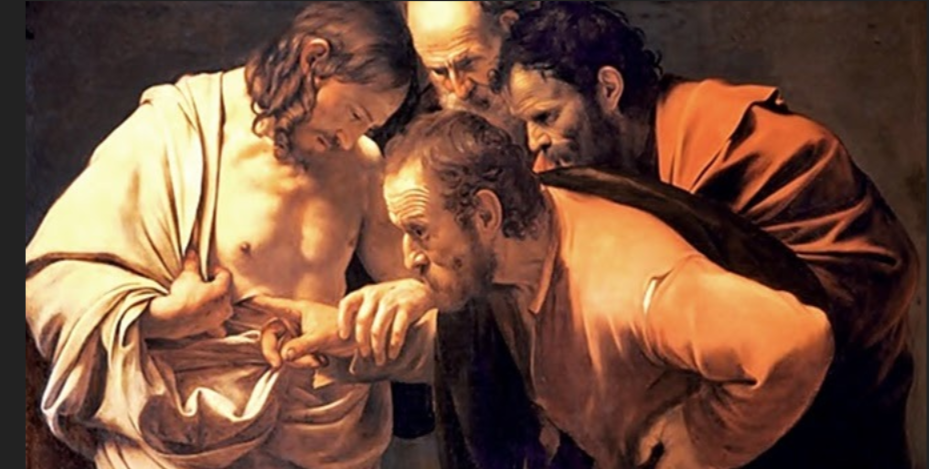
John 20:26-29 - "Eight days later, His disciples were inside again, and Thomas was with them. Although the doors were locked, Jesus came and stood among them and said, “Peace be with you.”
"Then He said to Thomas, “Put your finger here, and see My hands; and put out your hand, and place it in My side. Do not disbelieve, but believe.” Thomas answered Him, “My Lord and my God!” Jesus said to him, “Have you believed because you have seen Me?"
Thomas doesn't actually need to touch Jesus to believe, and he makes the declaration that all the seeking was moving towards: Jesus IS God!
A' → Seeking Fulfilled
The Gospel began: What are you seeking?
It ends: Whom are you seeking?
The seeker finds the One sought.
🌳 The Center as the Reversal of Eden
Viewed through John's garden imagery, the center becomes even richer.
Genesis begins with: God's presence, human fellowship, and a garden.
Then comes: sin, death, exile (yes, death comes BEFORE exile).
John presents the Cross as the turning point where exile begins to reverse. Notice the sequence:
- Eden - Garden → Sin → Death → Exile
- John - Cross → Resurrection → Garden → Restored Presence
✨ John's narrative is not merely historical. It is theological geography; The Cross becomes the hinge between exile and restoration. ✨
🏛️ The Center as the Fulfillment of Temple
Earlier we observed the converging of Exodus 25, Leviticus 16, and John 20. If that is intentional, then the center means:
- The Temple system reaches its intended goal.
- The sacrifices pointed here.
- The priesthood pointed here.
- The mercy seat pointed here.
- The Day of Atonement pointed here.
Not because they were merely predictions. But because they were patterns awaiting completion. The Cross is where symbol becomes reality. This is alluded to in:
Colossians 2:16-17 - "Let no one pass judgment on you in questions of food and drink, or with regard to a festival or a new moon or a Sabbath. These are a shadow of the things to come, the reality, however, is found in Christ."
Hebrews 10:1, 10 - The Law is only a shadow of the good things that are coming—not the realities themselves. We have been made holy through the sacrifice of the body of Jesus Christ once for all.
🕊️ The Center as the Revelation of God's Character
John repeatedly ties glory to the Cross. This is one of the most shocking things in the Gospel. In human terms, the Cross appears to be defeat. John calls it glory.
John 12:23 - "The hour has come for the Son of Man to be glorified."
✨ The center of the chiasm reveals something profound: The deepest revelation of God is not power displayed through domination. it is self-giving love. ✨
The One through whom all things were made (John 1:3) reveals His glory by laying down His life. Thus the center of the Gospel is simultaneously:
- the revelation of God,
- the fulfillment of Scripture,
- the accomplishment of atonement,
- the defeat of death,
- the restoration of creation.
🔥 Theological Thrust of the Center
If the proposed chiasm is valid, then John's central claim may be summarized this way:
✨ The center of John's Gospel is not merely that Jesus died. It is that through His death, Jesus completed the work necessary to restore humanity to the presence of God. ✨
That would explain why the narrative moves immediately from "It is finished" to:
- a garden,
- a tomb transformed into a holy place,
- linen left behind,
- the Shepherd calling His sheep by name,
- the Spirit breathed into humanity,
These are images that evoke not merely resurrection, but new creation.
In that reading, the center of the chiasm is the moment when the old creation story reaches its logical end and the new creation story begins. 🌿🕊️✝️📖