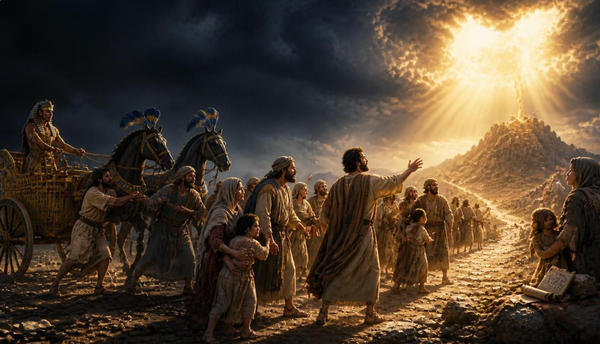
(A) 🌳⛺📜🍇🏛️✝️👑 The Story of God's Dwelling Presence: From Eden, through the Ark, to Abiding in Christ [3 parts]
![(A) 🌳⛺📜🍇🏛️✝️👑 The Story of God's Dwelling Presence: From Eden, through the Ark, to Abiding in Christ [3 parts]](https://storage.ghost.io/c/ab/d8/abd818ed-d1c7-4d9a-800d-8de8bae8d50c/content/images/size/w1200/2026/06/Screenshot-2026-06-01-8.01.16-PM.png)
Introduction:
From the Garden of Eden to the New Jerusalem, Scripture tells a single, unified story:
✨ God desires to dwell with humanity, and humanity is invited to dwell with Him. ✨
The Ark of the Covenant served as the earthly symbol of that reality, containing the covenant tablets, manna, and Aaron's rod—each ultimately fulfilled in Jesus Christ, the true Ark of the New Covenant.
In Him, God's Word, God's priesthood, God's provision, God's mercy seat, and God's presence are no longer contained within a sacred object but embodied in a living Person.
This is why John declares that the Word became flesh and "tabernacled" among us, and why Jesus repeatedly calls His disciples to "abide" in Him. The language of dwelling, remaining, clinging, walking, standing firm, and enduring is not a collection of disconnected metaphors but the unfolding of one covenant theme:
✨ life is found in continual communion with God. ✨
Psalm 91 stands as one of Scripture's clearest expressions of this truth. The psalm's promises are rooted not in a formula for protection but in a location—the secret place of the Most High.
The one who dwells, remains, lodges, and abides under God's shadow experiences the blessings of covenant fellowship. In this sense, Psalm 91 echoes Eden, anticipates the Tabernacle, points toward Christ, and foreshadows the final restoration of all things.
I. ✝️📜 Jesus as the Ark of the New Covenant
One of the most profound themes in Scripture is that the things God gave Israel were not merely religious objects but prophetic shadows pointing toward Christ. The Ark of the Covenant was the holiest object in Israel's worship because it represented God's throne among His people. Yet the New Testament presents Jesus as the reality toward which the Ark pointed.
The Ark was not merely a box containing sacred relics. It was the meeting place between God and humanity, the location of atonement, covenant, law, priesthood, and divine presence.
Jesus fulfills every one of those functions.
📦 What Was Inside the Ark?
The Ark contained:
- The stone tablets of the covenant - Exodus 25:16 - "Put in the ark the tablets of the covenant law, which I will give you."
- Aaron's rod that budded - Numbers 17:10 - "The Lord said to Moses, 'Put back Aaron’s staff in front of the ark of the covenant law, to be kept as a sign to the rebellious.' "
- A golden jar containing manna - Exodus 16:34 - "The Lord commanded Moses, Aaron put the manna with the tablets of the covenant law, so that it might be preserved."
But by the time of King Solomon:
1 Kings 8:9 - "There was nothing in the ark except the two stone tablets that Moses had placed in it at Horeb, where the Lord made a covenant with the Israelites after they came out of Egypt."
The book of Hebrews is the only place in Scripture that details all the Ark's contents in one location:
Hebrews 9:1-2 - "The first covenant had regulations for worship and also an earthly sanctuary. A tabernacle was set up. In its first room were the lampstand and the table with its consecrated bread; this was called the Holy Place.
Hebrews 9:3-4 - Behind the second curtain was a room called the Most Holy Place, which had the golden altar of incense and the gold-covered ark of the covenant, [containing] the gold jar of manna, Aaron’s staff that had budded, and the stone tablets of the covenant."
Each item testified to a different aspect of God's relationship with Israel. The remarkable thing is that all three are fulfilled in Christ.
📜 The Tablets of the Covenant → Jesus the Living Word
The stone tablets represented God's covenant and His revealed will. God wrote the commandments with His own finger:
Exodus 31:18 - "When the Lord finished speaking to Moses on Mount Sinai, He gave him the two tablets of the covenant law, the tablets of stone inscribed by the finger of God."
Inside the Ark, Israel possessed God's word, the Law, written on stone. John opens his Gospel by presenting Jesus as something greater:
John 1:1, 14 - "In the beginning was the Word, and the Word was with God, and the Word was God. The Word became flesh and made His dwelling among us."
The Ark contained God's word, Jesus is God's Word. The tablets revealed God's character, Jesus embodies God's character. The tablets told people what righteousness looked like, Jesus lived a perfectly righteous life. Jeremiah's New Covenant prophecy anticipated this:
Jeremiah 31:33 - "I will put My law within them, and I will write it on their hearts."
Ezekiel 36:26 - I will give you a new heart, (an undivided heart - 11:19) and put a new spirit in you; I will remove from you your heart of stone and give you a heart of flesh.
From hearts of stone to hearts of flesh. The Word of God on stone, the Word of God in flesh. God is nothing if not consistent.
🌿 Aaron's Budding Rod → Jesus the True High Priest
Numbers 17 records Israel's rebellion against Aaron's priesthood. God commanded each tribal leader to place a staff before Him. Only Aaron's rod miraculously came to life. It budded, blossomed, and produced almonds. A dead stick became living wood. The rod became proof of God's chosen priest.
Hebrews presents Jesus as the ultimate High Priest. Aaron's rod demonstrated divine appointment. Jesus' resurrection demonstrated divine appointment.
Aaron's staff:
- Was dead wood that lived.
- Produced miraculous fruit.
- Vindicated God's chosen priest.
Jesus:
- Was crucified on dead wood, then lived.
- Bears eternal fruit.
- Was publicly vindicated by resurrection.
The budding rod was a miniature resurrection. Jesus is the reality to that resurrection's shadow. The rod testified that Aaron was God's priest. The empty tomb testifies that Jesus is God's eternal High Priest.
🍞 The Jar of Manna → Jesus the Bread of Life
The manna represented God's supernatural provision in the wilderness. It reminded Israel that life comes from God. A portion was preserved in the Ark as a testimony.
In John 6 Jesus directly identifies Himself as the fulfillment of manna.
John 6:32, 35 - "It was not Moses who gave you the bread from heaven. I am the bread of life..."
John 6:49, 58 - "Your fathers ate the manna in the wilderness, and they died. Whoever feeds on this bread will live forever."
The manna sustained physical life (bios), Jesus gives eternal life (zoe). The manna came down from heaven, Jesus came down from heaven.
Psalm 78:18-25 - They willfully put God to the test by demanding the food they craved. They spoke against God; they said, “Can God really spread a table in the wilderness? Can He also give us bread?"
They did not believe in God or trust in His deliverance. Yet He gave a command to the skies above and opened the doors of the heavens; He rained down manna for the people to eat, He gave them the grain of heaven. Human beings ate the bread of angels.
☁️ The Presence Above the Ark → God Dwelling Among Us
The contents are important, but the most important thing about the Ark was what rested above it: The glory of God, the Shekinah presence. God's throne was symbolically located between the cherubim.
Exodus 25:22 - "There I will meet with you..."
The Ark was where heaven and earth met. John deliberately echoes this imagery:
John 1:14 - "The Word became flesh and dwelt [eskēnōsen] among us."
The Greek word eskēnōsen literally means "tabernacled." God's presence no longer dwells above a golden box, God's presence dwells bodily in Christ.
Colossians 2:9 - "In Him all the fullness of deity dwells bodily."
The Ark carried God's presence. Jesus is God's presence.
🩸 The Mercy Seat → The Cross
The lid of the Ark was called the Mercy Seat (Hebrew: kapporet). Once each year blood was sprinkled there on the Day of Atonement. The Mercy Seat was where judgment and mercy met.
Paul uses astonishing language:
Romans 3:25 - "God presented Christ as a propitiation [hilastērion]..."
The Greek term hilastērion is the same word used in the Septuagint (LXX) for the Mercy Seat. Paul is effectively saying: Jesus is the Mercy Seat.
✨ The place where atonement happened has become a Person. ✨
The blood that was sprinkled on the Ark now comes from Christ Himself.
🌎 The Ark and the New Creation
- The Ark accompanied Israel through the wilderness into the Promised Land. It led the people through the Jordan. It represented God's presence guiding His people into inheritance.
2 Samuel 6:2 - "The ark of God, which is called by the Name, the Name of the LORD Almighty."
The Ark of God is called by the Name of the LORD Almighty.
- The Angel of YHWH brought Israel out of Egypt.
Exodus 23:20-12 - “Behold, I send an Angel before you to guard you on the way and to bring you to the place that I have prepared. Pay careful attention to Him and obey His voice; do not rebel against Him, for He will not pardon your transgression, for My Name is in Him.
Numbers 20:16 - "When we cried to the LORD, He heard our voice and sent an Angel and brought us out of Egypt."
Judges 2:1 - The Angel of the LORD (YHWH)...said, 'I brought you up from Egypt and brought you into the land that I swore to give to your fathers.'
- YHWH brought Israel out of Egypt.
Exodus 20:2 - "I am the LORD your God, who brought you out of the land of Egypt, out of the house of slavery."
Deuteronomy 5:6 - "I am the LORD your God, who brought you out of the land of Egypt."
- Jesus brought Israel out of Egypt.
Jude 1:5 - "Jesus, who saved a people out of the land of Egypt..."
Jesus functions in the same way The Ark does, representing God and guiding His people into inheritance. The Ark entered Canaan. Jesus leads humanity into the Kingdom.
The Ark crossed the Jordan. Jesus is baptized in the Jordan and later passes through death and resurrection. In baptism, we signify our own passing through death to life, resurrected as a new creation.
👑 The Greater Reality
The Old Ark contained:
📜 The Word of God
🌿 The sign of the true priesthood
🍞 Bread from heaven
Jesus is:
📜 The Living Word
🌿 The Resurrected High Priest
🍞 The Bread of Life
The Ark was the meeting place between God and man, Jesus is the mediator between God and man. The Ark was sprinkled with sacrificial blood, Jesus sheds His own blood. The Ark carried the covenant, Jesus is the covenant.
As Jeremiah foresaw a day when people would no longer speak of the Ark because something greater had come (Jeremiah 3:16–17), the New Testament presents that greater reality: not a sacred object, but a living King.
The old Ark was a shadow of God's presence among His people. Jesus is Emmanuel—God tabernacled with us.
II. ⛺🌳🏠 Abide With Me: The Bible's Story of Dwelling in God's Presence
One of the great unifying themes of Scripture is not merely salvation, forgiveness, or even covenant, it is dwelling. From Genesis to Revelation, God is seeking a people who will remain with Him, and He is seeking to remain with them.
The vocabulary changes across the centuries:
- Tabernacle
- Dwell
- Walk
- Remain
- Stay
- Abide
- Continue
- Endure
- Stand firm
- Persevere
Yet they all orbit the same central reality: Will humanity remain in God's presence and covenant life?
The Bible begins with God dwelling with humanity in a garden and ends with God dwelling with humanity in a city-garden. Everything in between is the story of God's effort to restore that lost fellowship.
🌳 Genesis: Humanity Was Created to Dwell
The Garden of Eden was the first sanctuary.
God walked among Adam and Eve.
Genesis 3:8 - "They heard the sound of the LORD God walking in the garden..."
The issue in Genesis 3 is not merely disobedience, it is separation. Humanity ceases to dwell with God. Adam and Eve are expelled eastward from Eden. The tragedy is fundamentally relational.
The biblical story now becomes: How can humanity return to God's presence?
- Men we won't be asking: Nadab, Abihu, Uzzah. 🔥🔥 👀
⛺ The Tabernacle: God Dwells Among His People
After the Exodus, God commands Israel:
Exodus 25:8 - "Let them make Me a sanctuary, that I may dwell [shakan] among them."
The Hebrew verb is shakan. From it comes the concept later called the Shekinah, God's dwelling presence. God is not merely giving ritual instructions. He is recreating Eden.
The tabernacle is a portable Eden where heaven and earth overlap once more. The goal is not sacrifice. The goal is presence. Sacrifice serves presence.
🏛️ The Temple: A Permanent Dwelling
The tabernacle eventually becomes the Temple. When it is dedicated:
1 Kings 8:11 - "The glory of the LORD filled the house."
The Temple becomes the focal point of God's dwelling among His covenant people. Yet Israel repeatedly fails to remain faithful.
Notice the recurring pattern: God remains faithful, Israel does not.
The tension throughout the Old Testament is not whether God will abide. It is whether His people will.
🌿 The Language of "Remaining" in the Old Testament
Several Hebrew ideas converge here:
Yashab (to dwell, sit, remain)
Used of dwelling in the land and dwelling with God.
Amad (to stand)
Used of standing before God and remaining faithful.
Dabaq (to cling)
The same word used of marriage.
Deuteronomy 10:20 - "You shall cling to the LORD your God."
Romans 12:9 - Love must be sincere. Hate what is evil; cling to what is good.
Israel's covenant relationship is portrayed as steadfast attachment. Not mere agreement, not intellectual assent, attachment. Remaining. Abiding.
🍇 The Prophets: Israel's Failure to Remain
The prophets repeatedly describe Israel's problem as a refusal to continue in covenant faithfulness.
- Jeremiah
Jeremiah 2:32 - "You have forgotten Me days without number."
- Hosea
Israel is compared to an unfaithful spouse.
- Ezekiel
The glory departs from the Temple. The ultimate tragedy is not military defeat. It is the loss of God's dwelling presence.
The exile becomes a physical picture of humanity's original expulsion from Eden.
✨ Jesus: God Tabernacles Among Us
John deliberately reaches back to Exodus language.
John 1:14 - "The Word became flesh and dwelt among us."
The Greek verb is eskēnōsen. Literally: "He tabernacled among us."
Jesus is not merely teaching about God, He is the new dwelling place of God.
The Temple becomes a Person, the Presence becomes a Person, the Ark becomes a Person, the meeting place between heaven and earth becomes a Person.
✨ Everything the tabernacle anticipated is fulfilled in Christ. ✨
🍇 John 15: Abide in Me
Jesus takes the entire biblical theme and compresses it into one command:
John 15:4 - "Abide in Me, and I in you."
The Greek word is menō. It means:
- Remain
- Continue
- Stay
- Dwell
- Persist
This word appears repeatedly in John. Jesus is describing covenant permanence. Not occasional visitation, not sporadic devotion, a continuing union.
✨ The branch does not occasionally touch the vine, it remains connected; Life flows through continual attachment. ✨
🕊️ The Holy Spirit: God's Presence Within
The New Covenant intensifies the theme. In the Old Testament, God's presence dwelt among His people. In the New Testament, God's presence dwells within His people.
1 Corinthians 3:16 - "You are God's temple."
1 Corinthians 6:19 - "Your body is a temple of the Holy Spirit."
- These statements are not made to individuals, but to a group. "You" and "your body" are both corporate identifiers in light of who the letter is addressed to. Take note that the language is pregnant with plurality:
1 Corinthians 1:2 - "To the church of God in Corinth, to those sanctified in Christ Jesus and called to be His holy people, together with all those everywhere who call on the Name of our Lord Jesus Christ."
The goal of redemption is not merely legal acquittal, it is restored habitation. God once walked beside humanity in Eden. Now He dwells within redeemed humanity.
🛡️ Standing Firm and Enduring
The apostles extend Jesus' language of abiding into the language of perseverance.
1 Corinthians 16:13 - "Stand firm in the faith."
Colossians 1:23 - "Continue in the faith."
Hebrews 3:14 - "We have come to share in Christ, if indeed we hold our original confidence firm to the end."
James 1:12 - "Blessed is the man who remains steadfast under trial."
Revelation 2:10 - "Be faithful unto death."
These are not disconnected ideas. They are all describing covenant endurance. The language shifts: Abide, continue, hold fast, remain, endure, stand firm.
But the reality is the same: The call that echoes from Genesis to Revelation is remarkably consistent: Remain with God, because God desires to remain with you.
🌾 Revelation: The Dwelling of God Restored
The Bible ends where it began. Not with people escaping earth, but with God dwelling among humanity. We don't go to Him, because we never have, He comes to us, because that has ALWAYS been the way.
Revelation 21:3 - "Behold, the dwelling place of God is with man."
The Greek word here is related to skēnē—tabernacle. A literal rendering would be: "The tabernacle of God is with humanity." The story has come full circle.
- Genesis: God dwells with humanity.
- Exodus: God dwells among humanity.
- John: God dwells as humanity.
- The Church: God dwells within humanity.
- Revelation: God dwells forever with redeemed humanity.
🌳⛺🍇🕊️🏛️👑 The Unified Theme
Viewed together, tabernacling, dwelling, walking, remaining, abiding, continuing, persevering, and standing firm are not separate doctrines. They are different expressions of one covenant reality.
- 🌳 Adam was called to remain in God's presence. Eden lost.
- Israel was called to remain faithful to God's covenant.
- ⛺ The tabernacle embodied God's desire to remain among His people. Presence restored.
- 🍇 Jesus came as God's dwelling place among humanity. Believers are called to abide in Christ. Abide in Christ.
- 🕊️ The Spirit abides within believers. Spirit within.
- 🏛️ The saints endure because they remain attached to Him. Living temple.
- 👑 And the final hope of Scripture is not merely life after death but permanent communion, God with His people forever:
Revelation 22:4 - "They will see His face."
The Bible's story can be summarized in a single movement: God desires to dwell with humanity, and true life is found by returning to Him and then remaining in Him.
III. 🕊️⛺ Psalm 91: The Psalm of Abiding in God's Presence
When viewed through the lens of the biblical theme of dwelling, remaining, abiding, and persevering, Psalm 91 emerges as one of the clearest expressions of that theme in all of Scripture.
This is not primarily a psalm about protection, it is a psalm about where a person lives spiritually. Protection is the consequence, dwelling is the subject.
The entire psalm begins with a location:
Psalm 91:1 - "He who dwells in the secret place of the Most High shall abide under the shadow of the Almighty."
The first promise is not safety, its proximity.
⛺ "He Who Dwells"
The Hebrew verb is yashab. It means: to dwell, to sit, to remain, to stay, to inhabit. This is not a visitor. This is someone who has made God's presence their home. The imagery is covenantal.
✨ The person is not merely seeking God's help during a crisis, they have chosen God's presence as their place of residence. ✨
Psalm 91 begins where John 15 ends: "Abide in Me." The psalmist says: "Live there."
🌑 "The Secret Place"
The "secret place" (seter) refers to a hidden place of protection. Throughout Scripture this language often describes God's presence itself.
Compare:
Psalm 27:5 - "In the day of trouble He will conceal me in His shelter."
Psalm 31:20 - "You hide them in the secret place of Your presence."
The safest place in Scripture is not a physical fortress, it is God's presence. The psalm is not teaching magical immunity. It is teaching relational security.
🪽 "Abide Under the Shadow"
The second verb is different.
"...shall abide under the shadow of the Almighty."
The Hebrew is lun. It means: to lodge, to spend the night, to remain overnight. The believer not only dwells there permanently, they spend dangerous and terrifying nights there.
- When darkness comes, they remain.
- When uncertainty comes, they remain.
- When danger comes, they remain.
This anticipates Jesus' repeated call to continue, remain, and abide.
☁️ Shadow Language and the Tabernacle
The imagery of God's shadow likely echoes the Tabernacle. The cloud of God's presence overshadowed the sanctuary. Israel literally lived beneath the shadow of God's dwelling presence. The same concept appears elsewhere:
Psalm 105:39 - "He spread a cloud for a covering."
The shadow is not darkness, it is divine covering. Like the pillar of cloud in the wilderness, the shadow signifies God's nearness. Psalm 91 therefore contains strong tabernacle imagery.
The one who dwells near God's presence lives beneath His covering.
🏕️ A Wilderness Psalm?
I have wondered if Psalm 91 functions as a Midrash on Israel's wilderness experience as it repeatedly references dangers associated with the wilderness journey:
- Terror by night
- Arrows by day
- Pestilence
- Destruction
- Serpents
- Lions
- Angelic protection
Israel experienced every one of these themes.
Yet the decisive question throughout the wilderness was never: "Can God protect us?" The question was: "Will Israel remain with God?" Again and again they were tempted to abandon trust.
Psalm 91 describes the opposite response. The faithful one remains. The faithful one dwells. The faithful one abides.
🐍 The Serpent and the Reversal of Eden
One of the most fascinating verses states:
Psalm 91:13 - "You shall tread upon the lion and the cobra."
The serpent figure successfully drove humanity out of God's presence in Genesis 3. In Psalm 91, the faithful worshiper tramples the serpent. This is Eden language reversed. Rather than being expelled from God's presence, the righteous remain within it.
The serpent no longer drives them away. The serpent is beneath their feet. This is anticipated by:
Genesis 3:15 - "He will crush your head..."
Romans 16:20 - "The God of peace will soon crush Satan under your feet."
The one who abides becomes the one who overcomes the disruptor of peace.
✝️ Jesus and Psalm 91
Psalm 91 appears prominently in Jesus' desert testing. During the narrative, Satan quotes Psalm 91. He specifically cites:
Psalm 91:11 - "He will command His angels concerning you..."
This is profoundly significant. Jesus is being tested in the wilderness—the very setting Psalm 91 evokes. The temptation is essentially:
- "Will you continue trusting the Father?"
- "Will you remain?"
- "Will you abide?"
Jesus refuses to manipulate God's promises. He remains faithful. Where Israel failed to remain in trust, Jesus remains steadfast. Where Adam left obedience, Jesus continues in obedience.
Jesus becomes the ultimate Psalm 91 worshiper.
🍇 Psalm 91 and John 15
The parallels are remarkable.
- Psalm 91: He who dwells...
- John 15: Abide in Me.
- Psalm 91: Under His shadow.
- John 15: In Me.
- Psalm 91: He shall deliver you.
- John 15: Apart from Me you can do nothing.
- Psalm 91: Because he has set his love upon Me...
- John 15: Abide in My love.
- Psalm 91: With long life I will satisfy him.
- John 15: That you may have life.
Both passages revolve around a single reality: Life flows from remaining in covenant communion with God.
🔥 The Climax of the Psalm
The key to the entire psalm appears near the end.
God Himself begins speaking:
Psalm 91:14 - "Because he has set his love upon Me, therefore I will deliver him."
The Hebrew expression means something like: "Because he has attached himself to Me." This echoes the covenant word dabaq ("cling"), used throughout Deuteronomy.
The faithful person is not merely believing facts about God, they are attached to Him, they remain with Him, they dwell with Him. They abide.
The promise flows from relationship.
👑 Psalm 91 in the Story of Scripture
Read from Genesis to Revelation, Psalm 91 stands as a miniature summary of the entire biblical story.
- 🌳 In Eden, humanity lost God's dwelling place.
- ⛺ In the wilderness, God tabernacled among His people.
- 🏛️ In the Temple, God's presence filled the sanctuary.
- ✝️ In Jesus, God tabernacled among humanity.
- 🍇 In the New Covenant, believers abide in Christ.
- 🕊️ Through the Spirit, God dwells within His people.
- 👑 In Revelation, God's dwelling is permanently with humanity.
Psalm 91 sits at the center of that story and declares:
✨ Blessed is the one who makes God's presence their home. ✨
The psalm is not fundamentally teaching, "Bad things will never happen." Rather, it is proclaiming: The one who dwells with God has entered the place for which humanity was originally created, where even death cannot extinguish life (zoe).
The deepest promise of Psalm 91 is not protection from death. It is the restoration of Eden's fellowship—the privilege of living continually in the presence, shadow, shelter, and love of God until the end.
👑🏡 Conclusion: The Goal of the Entire Story
The Bible does not begin with rules, it begins with God's presence. That alone should inform us how it is often misunderstood.
There is only one rule in Eden and it's preceded by abundance and freedom. The abundance is as overlooked as the Presence and the only rule is rejected, leading to exile from both abundance and presence. The Bible ends with God's presence restored.
Adam was driven from Eden; Israel carried the Ark through the wilderness; the Tabernacle and Temple became places where God dwelt among His people; Jesus came as the true dwelling place of God; the Spirit now dwells within believers; and Revelation culminates with God's eternal tabernacle among humanity. Throughout this grand narrative, the call remains unchanged: dwell, walk, remain, abide, hold fast, persevere, and stand firm.
The deepest promise of Psalm 91, the Ark of the Covenant, John 15, and Revelation 21 is ultimately the same promise: God Himself. The inheritance of the faithful is not merely protection, provision, resurrection, or eternal life—those are glorious gifts flowing from a greater reality.
✨ The supreme blessing is that God makes His home with His people, and His people make their home with Him. ✨
What began with God walking in a garden ends with redeemed humanity dwelling forever in His presence, fulfilling the longing that has echoed through every covenant, every sanctuary, every promise, and every call to abide:
“Behold, the dwelling place of God is with humanity.” (Revelation 21:3)