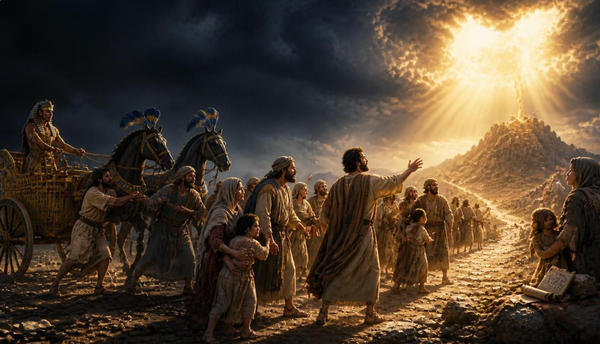
🏜️🌵⛈️✝️✨🌱 The Wilderness Test: Complaining Versus Training [3 parts]
I.🪞 Two Lenses: Same Situation, Different Meaning
1. Now-Centric Complaining ⛈️
Core posture: “This shouldn’t be happening.”
This mindset is present-anchored but purpose-blind. It evaluates everything based on immediate comfort, fairness, or preference.
Characteristics:
- Short time horizon → only sees now
- Emotion-driven interpretation → “this feels bad = this is bad”
- Assumes disruption = injustice
- Focus on removal, not growth
Biblical pattern:
- Wilderness Israel (Exodus–Numbers)
- Same manna → miracle provision becomes monotony complaint
- Same desert → training ground becomes evidence of abandonment
They weren’t just complaining—they were misinterpreting reality.
2. Purpose / Training-Centered Thinking 🏋️♂️
Core posture: “What is this forming in me?”
This mindset is future-aware and formation-focused. It assumes difficulty may be intentional, not accidental.
Characteristics:
- Long time horizon → sees trajectory, not just moment
- Meaning-driven interpretation → “this hurts, but what is it producing?”
- Assumes tension = training
- Focus on transformation, not escape
Biblical anchor:
- Hebrews 12:10–11 → discipline yields “the peaceful fruit of righteousness”
- James 1:2–4 → testing produces steadfastness
This is not denial of pain—it’s re-framing pain within purpose.
⚖️ The Real Difference: Interpretation of Pressure
| Situation | Now-Centric Lens | Training-Centered Lens |
|---|---|---|
| Delay | “God is withholding” | “God is refining patience” |
| Difficulty | “This is against me” | “This is for my formation” |
| Correction | “I’m being rejected” | “I’m being shaped” |
| Repetition | “Why am I here again?” | “What haven’t I learned yet?” |
Same pressure.
Different conclusion. Completely different outcome.
🌱 Why Complaining Is So Dangerous
Complaining isn’t just venting—it’s misalignment with reality.
It does three subtle things:
- Erases purpose → reduces everything to inconvenience
- Blocks growth → you resist what you’re meant to learn
- Distorts God’s character → turns a trainer into an oppressor
Repeated complaint in Scripture is treated seriously because it’s not emotional weakness, it’s interpretive error.
🔥 Training Requires Reinterpretation
Think in terms of athletic training:
No one lifts a weight and says:
“This resistance is ruining my workout.”
The resistance is the workout.
So spiritually:
- Pressure = resistance
- Resistance = development
- Development = capacity for glory
Without re-framing, you will:
- avoid the very thing that builds you
- pray against the process meant to mature you
🧠 The Internal Shift
The transformation is not situational—it’s perceptual 🪞
From:
- “Why is this happening to me?”
To:
- “What is this doing in me?”
That one shift:
- converts frustration → formation
- converts delay → discipline
- converts pain → participation in purpose
🌿 Jesus as the Model
Look at how Jesus Christ interprets suffering:
- Doesn’t deny the pain (“let this cup pass”)
- But submits to purpose (“not My will, but Yours”)
He doesn’t operate in now-centric reaction—He operates in mission-centric endurance.
🧩 Insight
Now-centric complaining asks: “How do I get out of this?”
Training-centered thinking asks: “Who do I become through this?”
One seeks relief. The other seeks refinement.
II. 👑 The Son Tested in the Wilderness
1. Israel: God’s Son Who Failed 🌵
God explicitly calls Israel His son:
- Exodus 4:22–23 → “Israel is My firstborn son”
Their identity was never the issue.
Their response under pressure was.
The Wilderness Pattern:
- Forgetting → God’s past faithfulness fades
- Grumbling → present discomfort is misinterpreted
- Looking back → Egypt becomes “better” in memory
Key failure modes:
🧠 Forgetting
They saw:
- plagues
- Red Sea deliverance
- manna
Yet:
“They forgot His works…”
Memory failure led to faith failure.
🗣️ Grumbling
- Complaints about water, food, leadership
- Interpreting provision as neglect
Grumbling is not just emotion—it is accusation against God’s character.
👀 Looking Back
They longed for Egypt:
- “We remember the food…” (Numbers 11)
This mirrors Genesis 19:26—Lot’s wife looking back.
Looking back reveals:
- a divided heart
- a re-romanticizing of bondage
🔑 Summary of Israel:
They were sons by calling, but failed to live as sons under testing.
✨ Jesus: The Son Who Succeeded 🏜️
Now enter Jesus Christ:
Matthew 3:16-17 - “As soon as Jesus was baptized, He went up out of the water. At that moment heaven was opened, and He saw the Spirit of God descending like a dove and alighting on him. And a voice from heaven said, “This is My beloved Son, whom I love; with Him I am well pleased.””
Immediately after He is led into the wilderness in a deliberate parallel to Israel.
- Israel → 40 years
- Jesus → 40 days
Jesus is reliving Israel’s story—but rightly.
2. The Threefold Victory Pattern
Where Israel failed, Jesus succeeds in exact correspondence:
🧠 1. Remembering (“It is written”)
Every test:
“It is written…”
Jesus quotes from Deuteronomy—the very book summarizing Israel’s wilderness failure.
Where Israel forgot, Jesus anchors Himself in remembered truth.
👉 Memory becomes obedience.
🙌 2. Glorifying the Father (Not Self)
Temptations offered:
- bread (self-provision)
- spectacle (self-exaltation)
- kingdoms (self-rule)
Jesus refuses all shortcuts.
Where Israel tested God,
Jesus trusts God.
🎯 3. Looking Ahead (Not Back)
Israel:
- looked back to Egypt
Jesus:
- looks forward to the cross and mission
This mirrors Moses:
Hebrews 11:26 - “He was looking forward to the reward.”
Jesus is not anchored in:
- immediate hunger
- immediate relief
He is anchored in future fulfillment.
⚖️ Side-by-Side: Failed Son vs Faithful Son
| Pattern | Israel (Son) | Jesus (Son) |
|---|---|---|
| Memory | Forgot | “It is written” |
| Speech | Grumbled | Glorified God |
| Vision | Looked back | Looked ahead |
| Response to hunger | Complained | Trusted |
| Testing | Failed | Obeyed |
🔥 The Deeper Theological Reality
Jesus is not just better than Israel—
He is Israel as it was meant to be.
- He embodies the faithful Son
- He fulfills the calling Israel could not
This is why:
- He passes through water (baptism)
- Enters wilderness
- Is tested
Israel treated the wilderness as a place to survive. Jesus treated it as a place to obey. He is recapitulating the story and rewriting its outcome.
This pattern isn’t just historical—it’s a discipleship blueprint. We all face wilderness seasons. And those seasons refine and prove sonship.
The question is: Which “son pattern” are we walking in?
🪞 The Three Diagnostic Questions
When pressure hits:
1. Memory
- Am I forgetting what God has done?
- Or grounding myself in truth?
2. Speech
- Am I grumbling?
- Or aligning my words with trust?
3. Vision
- Am I looking back?
- Or pressing forward?
III. 👑 1. Shared Sonship: From Israel → Christ → Us
🧬 The Pattern of Sonship
Israel:
- Called son → Exodus 4:22
- Fails in the wilderness
Jesus:
- Declared Son → at baptism
- Succeeds in the wilderness
Believers:
- Become sons in Christ → Romans 8, Galatians 4
👉 This is not metaphorical fluff—it’s participatory identity.
We don’t just admire Jesus’ obedience. We are invited to share in His sonship.
🔥 Critical Insight
Jesus doesn’t just succeed for us—He succeeds as the true Son, so that we can succeed in Him.
- He is the faithful template
- We are conformed into that pattern
🏊♂️ 2. The Sequence: Baptism → Wilderness → Mission
This is one of the most consistent Kingdom structures in Scripture.
🌊 Step 1: Identity Declared (Baptism)
At Jesus’ baptism:
“This is My beloved Son…”
Before:
- no miracles
- no public ministry
👉 Identity is given before performance.
🏜️ Step 2: Identity Tested (Wilderness)
Immediately:
The Spirit leads Him into the wilderness
Not punishment—purposeful testing.
🎯 Step 3: Authority Released (Mission)
After victory:
- He returns “in the power of the Spirit”
- Ministry begins with authority
⚖️ Why the Wilderness Comes After Identity
Because identity must move from:
- declaration → internalization
The wilderness answers: “Will you live as who you are when nothing external supports it?”
🪞 3. Participation: Our Lives Mirror This Pattern
Every believer walks this same arc:
🌊 Identity (You are God’s child)
- Received, not earned, not grasped
- Spoken over you in Christ
🏜️ Wilderness (The “now-centric vs training-centered” moment)
This is where the earlier concept locks in 🔒
You will face:
- delay
- lack
- obscurity
- contradiction
And the core temptations will echo Jesus’:
🍞 1. Provision Test
“Turn stones to bread”
👉 Will you trust God… or force outcomes?
🎭 2. Identity Test
“Prove who you are”
👉 Will you rest in identity… or perform for validation?
👑 3. Authority Test
“Take the kingdoms now”
👉 Will you wait for God’s way… or take shortcuts?
🎯 Mission (Authority flows from obedience)
Authority in the Kingdom is not claimed—it is entrusted.
- Israel failed → authority delayed
- Jesus obeyed → authority manifested
🔥 4. The Deep Connection: Memory, Glory, Vision
🧠 Memory (Past Faithfulness)
- Israel → forgot
- Jesus → “It is written”
👉 In our wilderness: Scripture becomes our memory bank
🙌 Glory (Present Alignment)
- Israel → grumbled
- Jesus → honored the Father
👉 Our speech reveals our interpretation
🎯 Vision (Future Orientation)
- Israel → Egypt
- Jesus → the cross and beyond
👉 Direction determines endurance
🧩 The Integrated Model
| Phase | Israel | Jesus | Believer |
|---|---|---|---|
| Identity | Given | Declared | Received |
| Wilderness | Failed | Obeyed | Tested |
| Outcome | Delay | Power | Formation → Authority |
🌿 The Moses Connection (Forward Vision)
Moses becomes a bridge figure:
- Chooses reproach over Egypt
- Fixes eyes on future reward
He models what Israel largely didn’t: forward-facing faith
Jesus embodies this perfectly.
🪞 Final Synthesis
The wilderness is not where sonship is questioned—
it’s where sonship is expressed.
Identity is given → tested through pressure → proven through obedience → released into purpose.
⚡ Pragmatic Edge
Next time you hit pressure, don’t just ask:
- “Why is this hard?”
Ask:
- “Which son pattern am I walking in right now?”
Because in that moment, you are:
- either echoing Israel
- or participating in Christ