🌱🌳🌾🔥 The Worshiper and the Worship: From Cain's Offering to a Life Poured Out to God [3 parts]
Introduction ✨
Throughout Scripture, God receives offerings, hears prayers, accepts worship, and calls His people to gather before Him. Yet Scripture repeatedly presses beneath the outward act of worship to a deeper question: What kind of person is standing before God?
The biblical story does not allow worship to remain detached from character, obedience, justice, mercy, and love. From the earliest offerings in Genesis through the prophetic confrontation of Israel's religious practices and into Paul's vision of the believer as a “living sacrifice,” Scripture gradually reveals a unified picture of worship that encompasses the whole life.
This three-part study follows that movement. We begin with Cain and Abel, where an offering placed before God raises questions about the person who brings it. We then listen to the prophets as they expose worship that has become disconnected from righteousness.
Finally, we consider the positive biblical vision: a person rooted in God, transformed by His truth, bearing fruit, loving others, practicing justice, and offering his entire embodied life to God.
I. ✨ Part One - The Offering and the Worshiper: Cain, Abel, and the Question of Acceptance
🌾 Cain, Abel, and the problem of the offering
Genesis deliberately describes both brothers as bringing something to YHWH:
Genesis 4:3–5 - “Cain brought to the LORD an offering of the fruit of the ground, and Abel also brought of the firstborn of his flock and of their fat portions. And the LORD had regard for Abel and his offering, but for Cain and his offering he had no regard.”
Notice the order. God regards the person and the offering. The text does not say simply that Abel brought the correct commodity while Cain brought the wrong one. Both offerings are described as legitimate products of their respective vocations.
The Hebrew word minḥâ (“offering”) is used of Cain's gift, and the problem is not explicitly identified as “vegetables versus animals.”
That leaves us with an important interpretive question: Was Cain's problem the offering itself, the manner in which he offered it, the condition of his heart, or some combination?
The text gives us clues rather than a complete explanation.
Abel brings “the firstborn of his flock and of their fat portions”—language emphasizing the choicest portion. Cain's offering is described more generically as “an offering of the fruit of the ground.” That contrast may suggest that Abel's offering expressed intentionality and honor while Cain's did not.
⚖️ Amos gives us a theological lens
Amos 5 makes the principle explicit. Israel is performing abundant religious activity:
- festivals
- assemblies
- burnt offerings
- grain offerings
- peace offerings
- songs
- musical instruments
Yet God says:
Amos 5:21 - “I hate, I despise your feasts, and I take no delight in your solemn assemblies.”
Amos 5:23 - “Take away from Me the noise of your songs.”
Amos 5:24 - “Let justice roll down like waters, and righteousness like an ever-flowing stream.”
The problem is not that worship itself is bad. The problem is worship severed from covenant faithfulness. Israel is apparently bringing God religious activity while simultaneously failing to embody the character of the God they claim to worship. And that becomes especially interesting when we return to Cain.
🔥 Genesis 4 immediately moves from worship to violence
Cain's offering is rejected. Then God speaks directly to Cain:
Genesis 4:6 - “Why are you angry, and why has your face fallen?”
God does not tell him, Your sacrifice was the wrong kind. Instead, God addresses Cain himself:
Genesis 4:6 - “If you do well, will you not be accepted?”
Then comes the warning about sin crouching at the door. And what follows is Cain murdering his brother. That narrative sequence is enormously significant:
altar → rejected worship → exposed heart → warning → refusal to master sin (aka, repent/turn back to God)→ violence against brother.
In that light, Cain's worship can plausibly be understood as hollow or deficient worship, although Genesis does not use Amos's terminology. The worship episode exposes something deeper inside Cain.
🌊 Amos 5 and Genesis 4 may share the same biblical logic
- Genesis 4
Cain brings an offering → God does not regard Cain and his offering → Cain becomes angry → God warns him about sin → Cain kills Abel.
- Amos 5
Israel brings offerings → God rejects their religious assemblies → God exposes their injustice → God demands righteousness and justice.
✨ God refuses to allow ritual to function as a substitute for righteousness. ✨
Cain's worship does not produce righteousness toward his brother; instead, his anger culminates in his brother's death. That makes the juxtaposition particularly powerful.
🩸 The brother becomes the test of the worshiper
Cain's problem ultimately becomes relational.
- God asks: “Where is Abel your brother?” (Gen. 4:9)
- Cain responds: “I do not know; am I my brother's keeper?”
The irony is extraordinary. Cain has just approached God in worship, yet when God asks about his brother, Cain rejects responsibility for him. That resonates strongly with the prophetic tradition.
✨ Worship cannot be isolated from how one treats other human beings created by God. ✨
Amos 5:24 therefore becomes an illuminating theological principle for reading Genesis 4: God is not interested in worship that rises upward while righteousness collapses horizontally.
Cain approaches God with an offering, but his relationship with his brother reveals what is actually happening within him.
🌱 And there is an intriguing agricultural irony
There is another detail worth noticing.
Cain is “a worker of the ground” (ʿōḇēḏ ʾăḏāmâ), and he brings the fruit of that ground. After Cain murders Abel, God tells him:
Genesis 4:11 - “And now you are cursed from the ground, which has opened its mouth to receive your brother's blood from your hand.”
The ground appears twice in Cain's story:
Cain brings the fruit of the ground to God → Cain spills his brother's blood onto the ground → the ground becomes associated with Cain's judgment.
His worship comes from the ground, but his violence also pollutes the ground.
That gives the narrative a sobering theological movement: Cain's relationship with the ground cannot be separated from his relationship with his brother or from his relationship with God.
And this is precisely the kind of integration Amos demands. The land, worship, justice, covenant, and treatment of the vulnerable are not independent categories.
✨ Hebrews gives us another piece of the puzzle
Hebrews 11:4 - “By faith Abel offered to God a more acceptable sacrifice than Cain.”
That is important because Hebrews identifies faith (pistis) as the differentiating factor. It does not say Abel discovered a superior sacrificial menu. Abel's offering was an expression of faith. And that brings us surprisingly close to Amos:
✨ God wants the reality represented by worship, not religious performance detached from the worshiper's life. ✨
Genesis 4 does not explicitly say that Cain's offering was rejected because it was hollow worship, but the narrative strongly invites us to consider the state of the worshiper behind the offering.
Amos 5 makes explicit what Genesis 4 dramatizes: God does not accept religious activity as a substitute for righteousness. Cain approaches God with an offering, but his treatment of Abel exposes a heart that has not yielded itself to God. His worship rises toward God while violence takes root toward his brother.
Cain asks, “Am I my brother's keeper?” Amos answers with justice and righteousness. Jesus eventually takes the matter even further: love of God and love of neighbor belong together.
God rejects religious activity when the worshiper’s relationship to God and the moral shape of his life contradict the worship being offered. The authenticity of worship is revealed not only by what reaches the altar, but by what comes out of the worshiper's life afterward. 🌾🔥⚖️
II. ✨ Part Two - When Worship Rings Hollow: Amos, Isaiah, and the Prophetic Call to Righteousness
Genesis 4:7 is often translated: “If you do well, will you not be accepted?”
But the Hebrew is more compact and potentially more evocative. The phrase (śəʾēt) is related to the verb nāśāʾ, “to lift, carry, bear,” and can carry the sense of acceptance, lifting up, or being received depending on how the construction is understood.
That matters because Cain has just brought an offering (minḥâ) before YHWH. God has not regarded Cain and his offering, and then God tells him that there is a path toward being accepted.
So the sequence is: offering → rejection → invitation to “do well” → acceptance
That is already remarkably close to the theological movement Paul develops in Romans 12. There is a very interesting sacrificial and cultic dimension to Genesis 4:7 that makes Romans 12:1–2 a particularly fruitful connection.
🔥 Sacrifice from the altar to the person
Romans 12:1 - “I appeal to you therefore, brothers, by the mercies of God, to present your bodies as a living sacrifice, holy and acceptable to God, which is your spiritual worship.”
The Greek is particularly significant:
- (parastēsai) — “to present/offer”
- (thysian zōsan) — “a living sacrifice”
- (euareston tō theō) — “acceptable/pleasing to God”
- (latreia) — worship/service.
Paul therefore takes sacrificial terminology and applies it to the whole person. That creates a fascinating conceptual bridge back to Genesis 4: Cain brings something to God. Paul says, in effect, bring yourself to God.
The question is no longer, What did you put on the altar? It becomes: What kind of person is standing beside the altar?
🌿 Romans 12:2 explains what “living sacrifice” looks like
Romans 12:2 - “Do not be conformed to this world, but be transformed by the renewal of your mind…”
The sacrifice is therefore ongoing embodied obedience, not a ritual transaction. And that sounds remarkably like Amos: “Let justice roll down like waters, and righteousness like an ever-flowing stream.”
Amos rejects worship when the worship gathering is disconnected from righteousness. Romans describes worship precisely in terms of a life transformed into conformity with God's will. So we can trace a three-stage biblical pattern:
- 🌾 Genesis 4: Cain brings an offering, but God addresses the worshiper and calls him toward what is right.
- 🌊 Amos 5: Israel brings elaborate offerings, but God rejects worship disconnected from justice and righteousness.
- 🔥 Romans 12: God's people are called to present themselves as living sacrifices, with transformed lives embodying God's will.
And Genesis 4:7 may be especially important because of what happens next
God says:
“Sin is crouching at the door. Its desire is contrary to you, but you must rule over it.”
That means God's concern with Cain does not end at the offering. The real question becomes what Cain will do with himself. Cain has brought an offering to God, but now God calls Cain himself to become obedient.
And tragically, Cain refuses that transformation. His anger becomes murder.
This makes the Romans 12 connection especially poignant. Romans 12:1–2 is not describing a religious ceremony that earns God's favor. It describes a whole life surrendered to God in response to God's mercy.
Paul's “therefore” is essential: “by the mercies of God…” The sacrifice is a response to grace. That also gives us a potentially beautiful theological distinction: Cain seems to think in terms of an offering he brings. Romans 12 teaches us to become the offering God receives.
And that leads directly into Romans 12:3–21, where Paul describes what that living sacrifice actually looks like: humility, mutual belonging, serving others, genuine love, patience, generosity, blessing persecutors, refusing vengeance, and overcoming evil with good.
In other words, the altar produces a way of life. That brings us right back to Abel and Cain—and to Amos.
✨ The authenticity of worship is revealed in what happens when we leave the altar. ✨
III. ✨ Part Three - The Living Offering: Becoming What We Bring Before God
🌱 1. "Will you not be accepted?”
The first movement is striking because God does not simply criticize Cain's offering and leave him without recourse:
Genesis 4:7 - “If you do well, will you not be accepted?”
Whatever precise nuance we assign to śəʾēt, the context is unmistakably about God's response to Cain and his offering. Cain has brought something before God, but God turns His attention toward the kind of person Cain is becoming.
And the next sentence makes the issue explicit:
Genesis 4:8 - “Sin is crouching at the door. Its desire is contrary to you, but you must rule over it.”
The offering therefore becomes the doorway into a much larger question: What kind of person is Cain going to be?
✨ God does not want worship to be confined to what happens at an altar, in an assembly, or during a religious practice. He wants the worshiper himself to become a person whose life reflects His character. ✨
⚖️ 2. God wants a particular kind of person
Micah deliberately piles up increasingly extravagant religious possibilities:
Micah 6:6 - “With what shall I come before the LORD?”
Burnt offerings?
Year-old calves?
Thousands of rams?
Ten thousands of rivers of oil?
Even one's firstborn?
Then comes the answer:
Micah 6:8 - “He has told you, O man, what is good;
and what does the LORD require of you
but to do justice, and to love kindness,
and to walk humbly with your God?”
That is extraordinarily relevant to Cain. The question isn't: “What can I bring God?” It is: “What kind of person does God want me to become?” And Micah's threefold answer is beautifully relational:
- Do justice → how you treat others.
- Love kindness → what your heart delights in.
- Walk humbly with your God → how you relate to God.
There is no separation between vertical and horizontal faithfulness. Cain approaches God, but fails his brother. Micah says that:
✨ walking with God necessarily reshapes how we walk among people. ✨
🌊 3. Fasting itself can become hollow worship
Isaiah 58 may be one of the strongest parallels to Amos 5. Israel asks:
Isaiah 58:3 - “Why have we fasted, and you see it not?”
God's answer is essentially: because your fasting has not produced the life I desire. They fast while exploiting others, quarreling, and oppressing. Then God describes the fast He actually desires:
Isaiah 58:6-7 - “Is not this the fast that I choose: to loose the bonds of wickedness, to undo the straps of the yoke, to let the oppressed go free, and to break every yoke? Is it not to share your bread with the hungry
and bring the homeless poor into your house?”
That is remarkably close to Amos.
- Amos: Let justice roll down like waters.
- Isaiah: Loose the bonds of wickedness.
- Micah: Do justice and love kindness.
- Genesis: Sin is crouching at the door; rule over it.
- Romans: Present your bodies as a living sacrifice.
The common denominator is embodied covenant faithfulness.
🌳 4. God wants a person whose life bears fruit
Psalm 1 moves away from sacrificial language altogether and uses botanical imagery:
Psalm 1:3 - “He is like a tree planted by streams of water that yields its fruit in its season, and its leaf does not wither.”
This is important because Psalm 1 doesn't begin with: “What does the righteous person sacrifice?” It begins with: “What does the righteous person delight in?”
Psalm 1:2 - “His delight is in the law of the LORD, and on His law he meditates day and night.”
And then the result is fruit. That gives us another dimension of the biblical concept: God wants transformed character that produces fruit naturally because the person is rooted in Him.
This also creates an intriguing connection with Cain, a man of the ground who brings fruit from the ground. Psalm 1 later gives us a different kind of fruitfulness: not simply fruit brought from the ground, but fruit produced from a life planted beside God's waters.
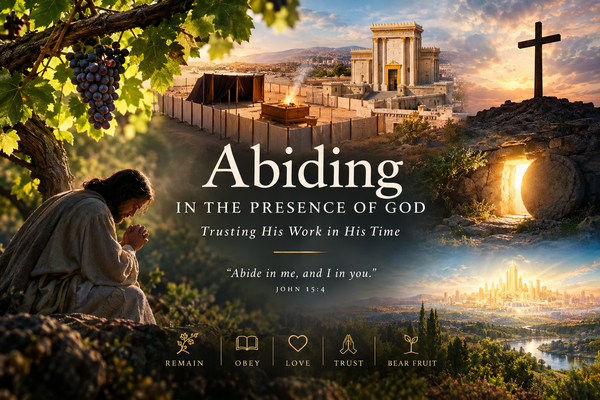
🍇 5. God looks for fruit
Isaiah 5 develops the vineyard metaphor: God plants, cultivates, protects, and tends His vineyard.
Isaiah 5:2 - “He looked for it to yield grapes, but it yielded wild grapes.”
The issue is not the absence of cultivation. God has invested Himself in the relationship. He expects a corresponding fruit. John 15 develops this imagery even further:
John 15:8 - “By this My Father is glorified, that you bear much fruit and so prove to be My disciples.”
And Jesus describes that fruit in relational terms:
John 15:9 - “Abide in My love.”
John 15:12 - “This is My commandment, that you love one another as I have loved you.”
So the biblical progression is remarkably consistent: God cultivates → we abide → abiding produces fruit → fruit glorifies God.
❤️ 6. God wants steadfast love
Hosea 6:6 - “For I desire steadfast love and not sacrifice,
the knowledge of God rather than burnt offerings.”
God isn't saying sacrifice has no place. Rather, sacrifice cannot compensate for the absence of covenant love. That is exactly the problem exposed in Amos 5. And it helps illuminate Cain.
The question is not simply whether Cain performed the ritual correctly. The question is whether the offering corresponds to a heart that is becoming faithful to God. Cain's subsequent treatment of Abel exposes a profound disconnect.
🫀 7. Obedience over ritual
Samuel tells Saul:
1 Samuel 15:22 - “To obey is better than sacrifice,
and to listen than the fat of rams.”
Scripture isn't establishing an anti-sacrifice theology, its establishing an anti-hollow-worship theology. God would rather have obedience than religious performance, as obedience reveals whether the heart actually belongs to Him.
This brings us right back to Genesis 4:7, “If you do well…” The issue is becoming a person who does what is good before God.
👐 8. Worship becomes visible
James gives perhaps the New Testament's most concise description of this:
James 1:27 - “Religion that is pure and undefiled before God… is this: to visit orphans and widows in their affliction, and to keep oneself unstained from the world.”
Notice the two directions: toward the vulnerable and toward personal holiness. That is remarkably similar to:
- Micah 6:8: justice + kindness + humility before God.
- Isaiah 58: liberating the oppressed + feeding the hungry + walking rightly.
- Romans 12: living sacrifice + transformed mind + love + service + generosity + blessing enemies.
👣 9. God has prepared a way for us to live
Ephesians 2:10 - “For we are His workmanship, created in Christ Jesus for good works, which God prepared beforehand, that we should walk in them.”
God makes us → God transforms us → we walk in the works He has prepared.
That is fundamentally different from trying to manufacture righteousness through religious performance. The Christian life is not “Perform enough religious activity to become acceptable,” it is “Because God has acted in mercy, become the person whose life corresponds to that mercy.”
That is Romans 12:1–2.
🔥 10. The life becomes an offering
Matthew 5:16 - “Let your light shine before others, so that they may see your good works and give glory to your Father who is in heaven.”
The goal is not human applause. The goal is God's glory through visible faithfulness. That sounds remarkably like Romans 12:1, “...a living sacrifice, holy and acceptable to God.”
The sacrifice is no longer confined to something placed upon an altar. The person becomes the offering. And the offering is displayed through the person's life.
🕊️ 11. Become a visible contrast
Philippians 2:14-16 - “Do all things without grumbling or disputing, so that you may become blameless and pure, “children of God without fault in a warped and crooked generation.” Then you will shine among them like stars in the sky as you hold firmly to the word of life.”
Deuteronomy 32:4-5 - He is the Rock, His works are perfect, and all His ways are just. A faithful God who does no wrong, upright and just is He.
They are corrupt and not His children; to their shame they are a warped and crooked generation.
Isaiah 49:6 - [God] says: “It is too small a thing for you to be My servant to restore the tribes of Jacob and bring back those of Israel I have kept. I will also make you a light for the Gentiles, that My salvation may reach to the ends of the earth.”
Christian identity becomes visible through conduct in the same way the Israelites were to be a light to the nations. The biblical concern isn't simply: Did you worship? It is: What did worship make you like?
🌿 The remarkable unity of these passages
Put them together and a remarkably coherent theology appears:
| Passage | Religious activity | What God seeks |
|---|---|---|
| Genesis 4:3–7 | Offering | Doing what is right; mastering sin |
| Psalm 1 | Meditation on God's instruction | A fruitful, rooted life |
| 1 Samuel 15:22 | Sacrifice | Obedience |
| Hosea 6:6 | Burnt offerings | Steadfast love + knowledge of God |
| Isaiah 58 | Fasting | Liberation, generosity, mercy |
| Amos 5:21–24 | Festivals, offerings, songs | Justice + righteousness |
| Micah 6:6–8 | Sacrifice | Justice + kindness + humble walking with God |
| Romans 12:1–2 | Worship | A transformed body/life |
| James 1:27 | Religion | Care for vulnerable people + holiness |
| John 15 | Abiding | Fruit + love |
And there is a beautiful progression:
Offering → obedience → character → fruit → justice → love → transformed life.
🌾 Cain and the living sacrifice
Cain's problem may not be adequately described as “he brought the wrong sacrifice.” The narrative seems much more interested in the person behind the sacrifice.
God's response is: “If you do well, will you not be accepted? Sin is crouching at the door.” Then Cain kills Abel. So Cain gives us an early biblical picture of worship that fails to penetrate the worshiper.
- Amos later gives the prophetic formulation: Your assemblies, songs, and offerings mean nothing when your lives contradict them.
- Isaiah says: Your fasting means nothing when you continue oppressing people.
- Micah says: God wants justice, kindness, and humble fellowship with Him.
- Hosea says: God desires steadfast love and knowledge of Him.
- And Paul takes all of this and turns it toward the believer: “Present your bodies as a living sacrifice.”
✨ Have you become the kind of person whose entire life is an acceptable offering to God? ✨
Cain brings fruit to God, while Psalm 1 describes the person from whom God produces fruit: a tree planted by streams of water, receiving from God, rooted in His instruction, and consequently bearing fruit in season. 🌳
Conclusion - The Worshiper Becomes the Worship
Taken together, these passages reveal a remarkably consistent biblical theology of worship.
- Cain brings an offering, but God addresses Cain.
- Amos watches Israel bring offerings, but God demands justice.
- Isaiah watches Israel fast, but God demands mercy and liberation.
- Micah hears the question, “What shall I bring?” and answers with justice, kindness, and humble fellowship with God.
- Hosea hears the language of sacrifice and reminds Israel that God desires steadfast love and knowledge of Him.
- Psalm 1 shows us the person who is rooted in God and therefore fruitful.
- Jesus calls His disciples to abide and bear fruit.
- And Paul finally takes the sacrificial vocabulary and places it directly upon the believer: “Present your bodies as a living sacrifice.”
The trajectory is profound:
Offering → obedience → character → fruit → justice → mercy → love → whole-life worship.
🌾 Cain brings fruit.
🌊 The prophets demand fruitfulness of character.
🌳 Psalm 1 depicts the righteous person as a fruitful tree.
🍇 Jesus calls His disciples to bear fruit by abiding in Him.
🔥 Paul calls the entire person a living sacrifice.
This also helps us understand what “acceptable” worship means.
God is not impressed by religious performance divorced from the person performing it. Neither does He ask us to abandon worship, sacrifice, prayer, fasting, singing, gathering, or giving.
Rather, He wants those practices to do what they are supposed to do: form a people who increasingly resemble the God they worship.
✨ The sacrifice is not something we occasionally place before God, by God's mercy, we become the offering. ✨
The worship God seeks is not exhausted when the offering leaves our hands. It is fulfilled when God's character begins to shape our lives.